Recommended resources
The freely available resources this lesson will direct you to.
- A-level Mathematics 9709: Argand diagrams and lociwww.youtube.com
- Complex Numbers - Loci : Perpendicular bisector : ExamSolutions Maths Video Tutorialswww.youtube.com
- Loci with Complex Numbers - A Level Maths Revision Noteswww.savemyexams.com
- Part 3: Complex Vectors and Loci | Beginner's Guide to Y12 Maths Ext 2www.matrix.edu.au
Hello! In the previous lesson, measured the straight-line distance between two roots of unity. This lesson turns that observation around: when an exam question gives you a condition involving a modulus, what set of points does it describe?
You will translate modulus conditions into circles, lines and regions on an Argand diagram, then use Cartesian algebra to verify less obvious cases. The aim is not to memorise a collection of sketches. It is to recognise the distance statement inside each expression and make a sketch you can justify.
A modulus measures distance
Let be a variable point and a fixed point. Subtraction gives the displacement between them, so
is their distance on the Argand diagram. Thus , for , describes every point at distance from : a circle with centre and radius . If , the locus is just the point ; if , there are no points, since a distance cannot be negative.
The sign inside the modulus matters. In , the fixed point is , because the expression can be written as . The image below shows this circle and, above it, a horizontal-line example. Focus on part (b) for now; we will return to the question in part (c) later.
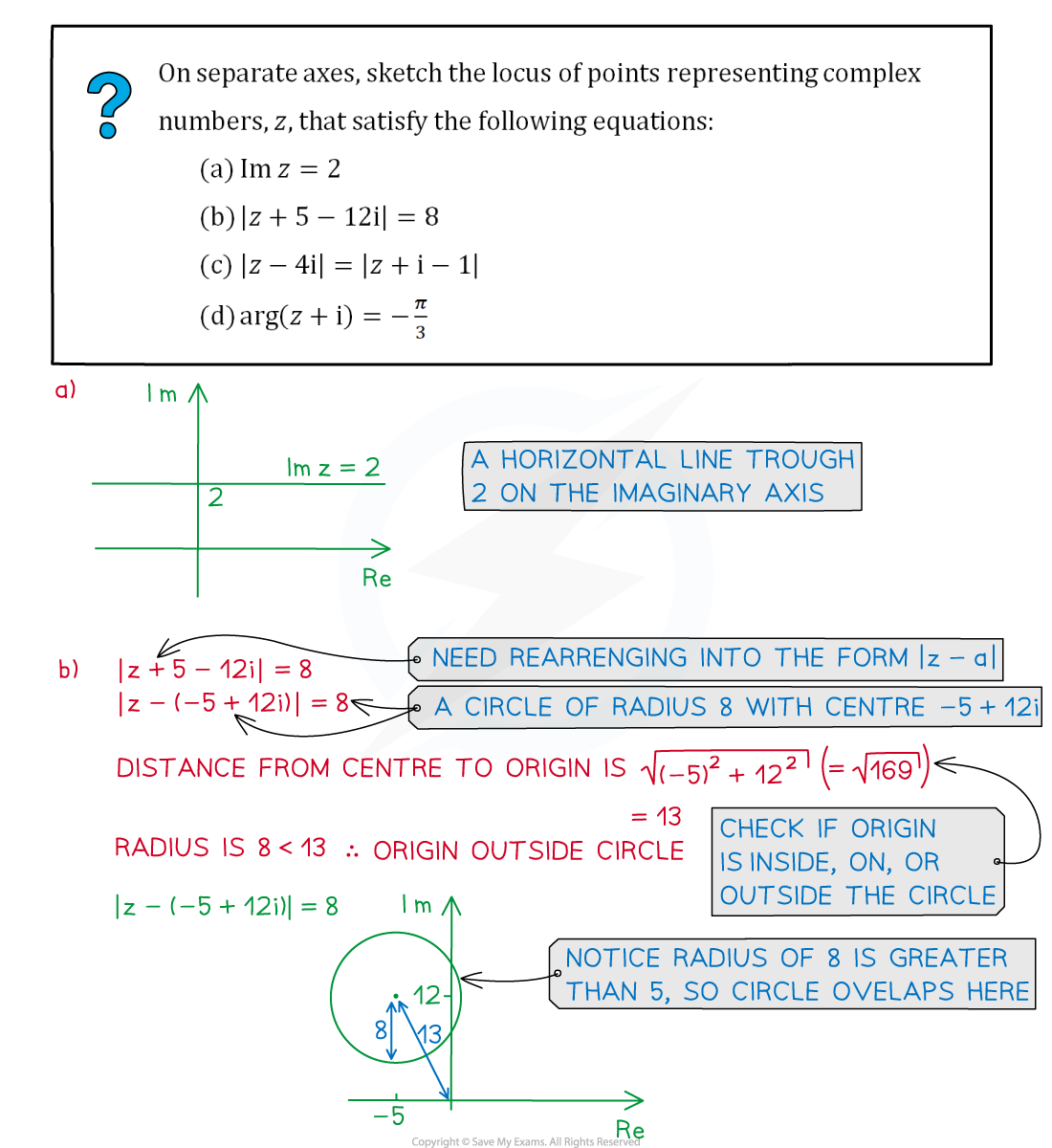
The centre in part (b) is units from the origin, since . Its radius is , so the origin must be outside the circle. Yet the circle crosses the imaginary axis: the centre is only horizontal units from that axis, less than the radius. Those two checks make the sketch more accurate without requiring you to plot many points.
Watch the circle example in A-level Mathematics 9709: Argand diagrams and loci by Thomas Davis. Its numbers differ from the image, but the important move is the same: rewrite the expression to expose the centre before drawing.
A-level Mathematics 9709: Argand diagrams and loci
Watch Thomas Davis identify the centre and radius of a circle from a modulus equation, then convert the same condition to Cartesian form.
Watch the circle example. Notice why z+3-2i gives a centre of -3+2i, not 3-2i, and how the centre and radius produce the Cartesian equation.
Writing provides a check on the geometry. The circle in part (b) has equation
Both descriptions say the same thing: each point is units from . In an exam solution, the distance interpretation often identifies the locus fastest; the Cartesian equation is useful when precise intersections or coordinates are required.
When the expression is not already
A coefficient of does not necessarily make the locus unfamiliar. Since , a nonzero coefficient can be factored out before you decide what to sketch.
For example, consider
Here . Factoring gives
As , this reduces to
The locus is a circle centred at , with radius . More generally, if ,
This is a useful recognition step, not a licence to call every modulus equation a circle. For instance, cannot be put into the form by factoring out a constant coefficient of . First inspect what lies inside the modulus.
Equal distances give a perpendicular bisector
Suppose and are distinct fixed complex numbers. The condition
says that is equally distant from the points and . The entire locus is the perpendicular bisector of the segment joining those points—not just its midpoint.
The visual explanation in Complex Numbers - Loci: Perpendicular bisector from ExamSolutions makes the transition from an ordinary geometry diagram to complex-number notation.
Complex Numbers - Loci : Perpendicular bisector : ExamSolutions Maths Video Tutorials
Watch ExamSolutions build the perpendicular-bisector locus from two equal distances. This supplies the geometric reason for the complex equation, rather than just a shape to memorise.
Watch equal distances, from the opening question about two fixed points through the construction of |z-z_1|=|z-z_2|. Focus on why subtracting the complex numbers represents the relevant line segments.
Now return to part (c) of the earlier image:
Rewrite the right-hand side as . The two fixed points are therefore , at , and , at . Their midpoint is . The segment joining them has gradient , so its perpendicular bisector has gradient . That information is enough for a labelled sketch.
If the question also asks for an exact equation, let . Because both moduli are nonnegative, squaring their equality is valid:
Expanding and cancelling the quadratic terms gives
You can check the result against the diagram: the midpoint satisfies this equation. That quick check is especially valuable when an unfamiliar question has several minus signs.
Inequalities describe regions, not just boundaries
Changing to an inequality changes a circle into a two-dimensional locus. For , includes points inside the circle but not on it; includes both the interior and the circumference. With or , the locus is outside instead. On a sketch, use a dashed boundary when equality is excluded and a solid boundary when it is included.
Watch the brief inequality discussion in the same Thomas Davis video you used for circles.
A-level Mathematics 9709: Argand diagrams and loci
Return to Thomas Davis for the distinction between a circular boundary and a region. The boundary style records a mathematical condition, not merely a drawing convention.
Watch circle inequalities. Compare the dashed boundary for a strict inequality with the included boundary for a non-strict inequality.
Two bounds on the same distance can produce a ring. For example,
describes points more than unit and at most units from . Its inner circumference is excluded; its outer circumference is included.
Equal-distance comparisons can also define a region. Consider
Points satisfying it are closer to than to , suggesting the open half-plane to the right of the imaginary axis. Cartesian algebra confirms both the side and the excluded boundary:
When conditions are combined with and, retain only points that satisfy both. For instance,
first restricts to the imaginary axis, so . On that axis, the second condition becomes . The complete locus is the closed line segment from to , including both endpoints. It is neither the whole line nor the whole disk.
Unequal distances: let algebra reveal the shape
An equality between two moduli is not always a perpendicular bisector. That conclusion depends on the distances being equal. If one side has a different multiplier, the shape can change.
Consider
The points have a fixed distance ratio: is twice as far from as it is from . Let . Squaring both nonnegative sides gives
Expanding and completing the square yields
So this particular locus is a circle, centred at with radius , rather than a line. A check at confirms the original ratio: its distances from and are and .
For distinct fixed points , a condition with gives a perpendicular bisector when and a circle when . You need not memorise a formula for that circle’s centre. Setting , squaring carefully and completing the square is a reliable method when the geometric shape is not immediately clear.
Across all these cases, use the same exam-ready habit: identify the fixed points and distances first; decide what boundary or region the words imply; use coordinates when the sketch needs verification or an exact equation.
Key takeaways
The modulus is the distance from to . A fixed positive distance gives a circle; equal distances from two distinct points give their perpendicular bisector. Inequalities select regions and determine whether boundaries belong to the locus, while combined conditions select intersections. When coefficients or unequal distance ratios obscure the geometry, simplify the modulus or convert to Cartesian form rather than guessing a shape.
Next, you will translate argument conditions. Distance will no longer be the defining quantity: a specified direction gives a ray, while bounds on direction can produce sectors.