Recommended resources
The freely available resources this lesson will direct you to.
- KILLER Complex Numbers Question (HSC 2023)www.youtube.com
- Complex Numbers HSC Revision Questions | Extension 2 Mathematicswww.youtube.com
- 2.7: Polar Form of Complex Numbers - Mathematics LibreTextsmath.libretexts.org
- Most Difficult Question From HSC Maths Extension 2 Exam 2023 – Mind Your Decisionsmindyourdecisions.com
Hello! In the last two lessons, you used moduli to describe distances and arguments to describe directions and angles. This is the final lesson in our first complex-numbers module, so the question changes from “How do I use this form?” to “Which form will make this problem easiest?”
That choice matters most in unfamiliar exam questions. A problem may begin with an argument, involve a quotient, and end by asking for a region in ordinary coordinates. You do not have to solve the entire problem in one form. Today you will practise choosing a starting form, recognising when it has done its job, and switching without losing restrictions or endpoints.
Choose the form that exposes the next step
Write when you need its real and imaginary parts. Write a nonzero number as when its modulus and direction drive the calculation. Neither is a more advanced version of the other: they make different features visible.
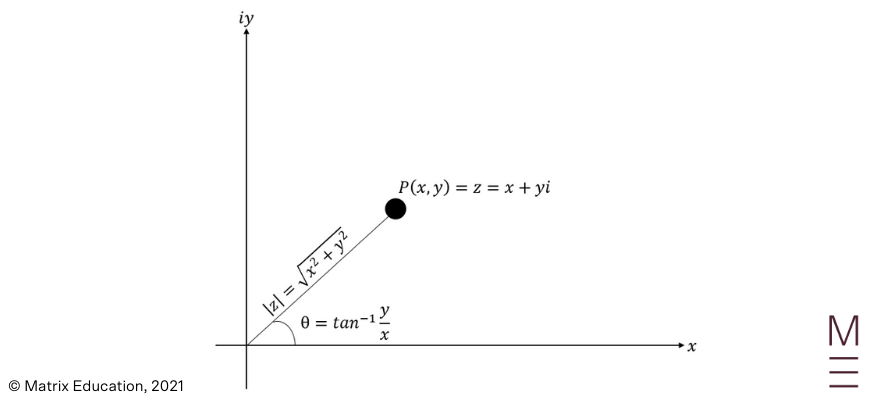
Here is a useful way to read the task, rather than merely the notation in which it was given:
- Addition, subtraction, or a condition on real and imaginary parts? Cartesian form often reveals what to equate or compare.
- Powers, roots, or a product of numbers with convenient arguments? Modulus–argument form often avoids a long expansion.
- Distances or directions involving ? Begin with the Argand geometry. Introduce if you need an exact boundary or inequality.
- A requested final form? You may need to convert again at the end, even if another form was best for solving.
The cost of conversion matters. Expanding for arbitrary real is manageable and gives real and imaginary parts directly. But for , a quick sketch reveals . Hence , with much less algebra.
Watch the comparison in Complex Numbers HSC Revision Questions from mcgrathematics. These are examples from earlier HSC papers, used here to examine the method choice rather than the specifications of your future paper.
Complex Numbers HSC Revision Questions | Extension 2 Mathematics
Watch “Complex Numbers HSC Revision Questions” from mcgrathematics to compare a direct Cartesian expansion with a conversion to modulus–argument form.
Start with Cartesian expansion in the opening cubic example: notice that the result is already separated into real and imaginary parts. Then watch convert and cube in the next question, from the Argand sketch of z=-1+i\sqrt3 through its cube. Focus on why conversion saves work in the second example; do not turn “use polar for powers” into an automatic rule for every small power.
An efficient first move is therefore to ask: What calculation would each form make me do? If Cartesian form leaves two simple equations, use it. If it leaves a large expansion while a known argument makes the power immediate, convert.
Switch forms when the question switches language
Consider this mixed problem:
We want every satisfying all three conditions. Starting with would make an expression in and . That is possible, but the first two conditions are especially compact in modulus–argument form. Let
By De Moivre’s theorem, . Its principal argument is when
for an integer . Within the principal range for , this gives two candidates:
Thus or . Both arise from the argument condition; stopping at would lose one.
Now the remaining condition is a distance from the point , not an angle about the origin. Cartesian form makes the final test short. Since ,
Consequently, is equivalent to , or . Of our two candidates, only qualifies. Therefore
The switch was purposeful: modulus–argument form found the candidates efficiently; Cartesian form tested a translated distance efficiently. Notice also why it was safe to square the final modulus inequality: both sides of are nonnegative. In a written solution, retaining the strict sign and checking both candidates are part of the answer, not optional polish.
An unfamiliar question may require both forms in succession
The following question, from an earlier Extension 2 examination, looks intimidating because it starts with two unspecified complex numbers and finishes on an -plane. The key is to find the one combination of those numbers that the expression actually uses.
Let , and suppose
For real , consider
We want the region where . Before calculating coordinates, simplify:
The individual positions of and have disappeared. Only their ratio matters. Watch how the ratio and the real multipliers are interpreted geometrically in KILLER Complex Numbers Question (HSC 2023) from VCE Maths with Mr Lim. Stop at the specified point: the later discussion changes the interpretation of which quantities must be held fixed.
KILLER Complex Numbers Question (HSC 2023)
Watch “KILLER Complex Numbers Question (HSC 2023)” from VCE Maths with Mr Lim for the geometric first move in a mixed-form problem.
In simplify the ratio, focus on why w/z, rather than the separate locations of w and z, determines the calculation. Continue through scaling and shifting: track what multiplying w/z by a real y, then adding a real x, can do to its imaginary part. We will use coordinates below to pin down the exact boundary.
Let
Because , the ratio has modulus . Thus
and the expression becomes
Modulus–argument form extracted everything useful from the given ratio. Cartesian form now answers the requested region: a nonzero complex number has principal argument strictly between and exactly when its real part is negative and its imaginary part is positive.
Here and . Hence
while
The inequality reverses when we divide by , because it is negative. For a fixed pair , and therefore a fixed , the answer is the open wedge
Both boundary lines are excluded. For instance, if , the description is : an open wedge to the left of the origin. A sketch should label its sloping boundary and show that neither boundary ray nor the origin is included.
There is a subtle distinction here that matters in unfamiliar prompts. We were told a range containing the fixed angle , not its exact value. The slope of the wedge therefore depends on the particular . We cannot replace it with one numerical slope without another condition. Nor should we silently answer a different question—finding only the that work for every possible in the range. Reading what is fixed and what varies is as important as the algebra.
A short decision routine for exam conditions
When you meet a novel complex-number question, take a moment before expanding anything.
- Identify the target. Are you finding a number, its powers, a locus, a coordinate inequality, or a proof about all possible numbers?
- Look for the controlling expression. A quotient may depend only on ; a translated modulus is a distance from , not from the origin.
- Choose the form for the next operation, not for the whole problem. Use angles to simplify powers or ratios; use real and imaginary parts when the target is a quadrant or coordinate region.
- Check what conversion might conceal. Record before using its argument, keep every angle differing by a full turn when solving a power condition, and restore strict inequalities and exclusions after sketching.
This routine is not a substitute for calculation. It is a way of making the first calculation useful. In particular, if a proposed polar conversion produces an awkward unknown angle and no simplification, return to . If a Cartesian expansion is growing while all the important quantities are moduli and angles, step back and convert.
Key takeaways
Cartesian form exposes components, signs and coordinate boundaries. Modulus–argument form exposes size, rotation and powers. Geometry often identifies the shape before either calculation finishes it. Efficient complex-number solutions move between these views deliberately and keep track of which quantities are fixed, which vary, and which points are excluded.
You have now completed the polar form, powers and loci module. Next, the course turns to reasoning and proof: the care used here with words such as every, with reversed inequalities, and with excluded points will become an explicit part of constructing mathematical arguments.