Recommended resources
The freely available resources this lesson will direct you to.
Hello! Last lesson, you used De Moivre’s theorem to find a power by multiplying an angle by the exponent. This lesson reverses the question: if , what could have been? The challenge is that angles differing by a full revolution describe the same , but can produce different answers when divided by .
You will derive a method that finds every solution, use it for a non-real target, and place the solutions accurately on an Argand diagram. In an exam, finding one root is rarely enough: you need to show why your list is complete.
Why one angle gives several roots
Let be a positive integer and suppose first that . Write
where . By De Moivre’s theorem,
Thus requires . For the angles, however, we need not have exactly: angles that differ by a whole number of revolutions represent the same complex number. Consequently,
Here means the positive real th root of . Substituting gives the complete formula:
Watch the short derivation in De Moivre’s Formula | How to Find the nth Roots of A Complex Number from Let’s Get Complex. The video calls the number being rooted and a possible root ; our notation reverses those roles, but the equation and reasoning are the same.
De Moivre's Formula | How to Find the nth Roots of A Complex Number
Watch the derivation to see how the modulus condition and the angle condition are separated.
In the root formula, focus on why the angle condition includes whole revolutions and why the lecturer stops at the values k=0 through n-1.
Why stop there? Increasing by increases a root’s angle by , returning to the same point. Conversely, two values among differ by less than , so their angles cannot differ by a whole . The formula therefore gives exactly distinct roots when .
This is also why taking just is insufficient. It gives the root, not the complete solution set.
A worked equation:
The target has modulus and argument , so
Every cube root has modulus . Its angle comes from
Keeping visible makes it easy to account for all three answers:
| Angle | Root in Cartesian form | |
|---|---|---|
Hence
If the question requests principal arguments, replace with ; these are two arguments of the same root. Do not alter an angle merely because it exceeds unless the requested range calls for it.
A quick check combines algebra and geometry. For , cubing gives . The other two angles exceed by and ; cubing adds respectively and to the resulting angle, so they also produce . As a direct sign check, .
From solutions to an Argand diagram
To draw the three roots of , first sketch and label the real and imaginary axes. Draw a circle of radius centred at the origin: every root must lie on it. Then plot and label
These coordinates correspond, respectively, to angles , , and . Each successive point is around the circle. Joining them would make an equilateral triangle, though the equation asks you to represent the points, not necessarily to draw its sides.
The following image shows a related triangle: the cube roots of , rather than the cube roots of . Compare its equal angular spacing with ours. Its points are on the unit circle and begin at angle ; ours are on a circle of radius and begin at .
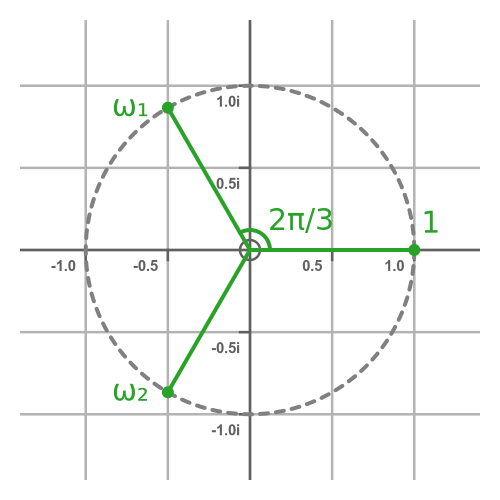
In general, the roots of , for , all lie on the circle of radius . Their angles differ successively by . For , they are the vertices of a regular -sided polygon centred at the origin; for , the two points are diametrically opposite.
Watch a fourth-root example to see the same method applied to a target in the second quadrant. In the video, the target is . Notice why its argument is , and follow the plotting of all four roots.
De Moivre's Formula | How to Find the nth Roots of A Complex Number
Return to the same video for a worked example with four roots and an Argand-diagram interpretation.
Watch the fourth roots. Follow the quadrant check when the target is converted to polar form, then the quarter-turn between successive roots. At about 00:10:15 the lecturer corrects the angle equation to use four times the root’s angle; keep that correction in mind.
Making the method reliable under exam conditions
A compact solution should expose four things: the target’s correct polar form, the general expression for , the specified values of , and a diagram whose radius and labels agree with the algebra. If Cartesian answers are requested, evaluate each cosine and sine rather than leaving only a formula.
Pay particular attention to the target’s quadrant. A negative real target has argument , not ; a negative imaginary target can have argument . Either of two arguments differing by will work, provided you still include before dividing by . The choice may change the order in which you list the roots, but not the set of answers.
There is one boundary case. If , the equation has only . Zero has no argument, so the polar root formula is not used. If , the sole solution is simply .
Key takeaways
For nonzero , solving means taking the positive real th root of the modulus while allowing for all whole revolutions in the angle. The values give every distinct solution. On an Argand diagram, check two features at a glance: a common radius and equal spacing .
Next, you will examine the special case more closely. The image’s equally spaced points are the beginning of that story.