Recommended resources
The freely available resources this lesson will direct you to.
- Build better products with continuous product discovery | Teresa Torreswww.youtube.com
- Justify Your Product Decisions and get Stakeholder Buy in - Teresa Torres Mind the Product SF 2019www.youtube.com
- Outcomes Are Hard - Silicon Valley Product Group : Silicon Valley Product Groupwww.svpg.com
- Shifting from Outputs to Outcomes: Why It Matters and How to Get Startedwww.producttalk.org
Hello! In the previous lesson, you mapped who supplies, checks, and acts on information in a customs-filing workflow. That map revealed an important limit: an integration can move a manufacturer value between systems, but it cannot establish that the value is correct when the sources disagree.
This lesson gives you a way to describe what an integration delivers, what changes for the people using it, and what that change might mean for the business. Keeping those claims separate will help you evaluate a proposal without mistaking a successful launch for a successful product.
What was shipped, and what changed?
The distinction begins with a question: Are you describing something the product team delivered, or a difference that delivery made?
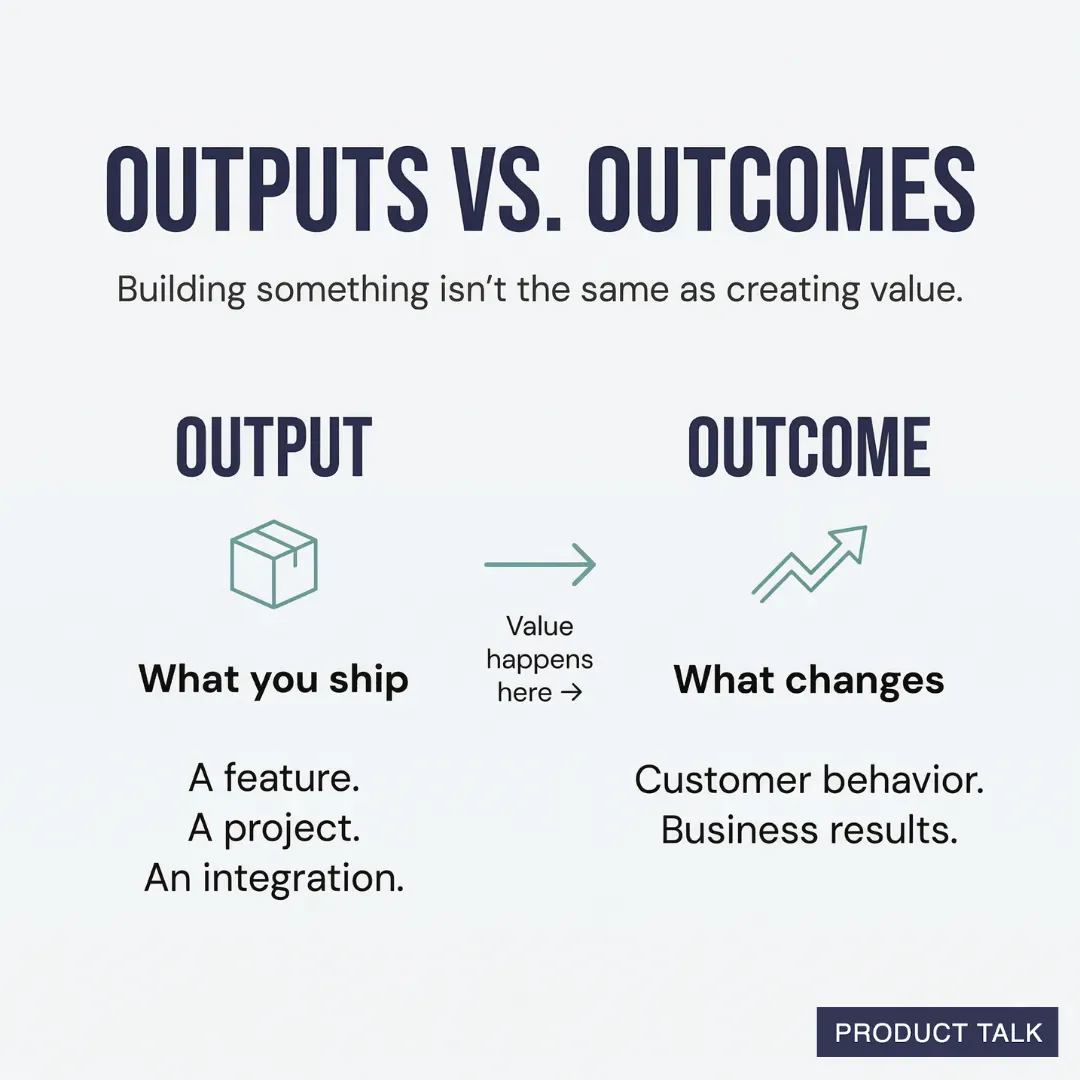
For this course, use three levels:
| Level | Question | Customs-filing example |
|---|---|---|
| Product output | What did the team ship? | A connection that imports supplier data and flags conflicting manufacturer values. |
| User outcome | What changed for someone doing the work? | Filing specialists resolve source-data discrepancies in time to prepare supportable drafts, with fewer avoidable clarification cycles. |
| Business impact | What changed in an organization’s results? | The integration provider spends less on support per customer account, or retains more accounts that depend on the workflow. |
These levels use different kinds of evidence. A release record can confirm that the connection shipped. Workflow observations and operational data can show whether filing specialists’ work improved. Financial or account-level data can show whether the provider’s business benefited. None of those findings automatically proves the next one.
Read the following sections for the underlying product terminology. The author uses product outcomes for changes in customer behavior or sentiment and business outcomes for business results. Here, user outcome and business impact keep those two meanings distinct.
Shifting from Outputs to Outcomes: Why It Matters and How to Get Started
Read Teresa Torres’s article on Product Talk to see why an integration is an output even when customers use it, and why feature adoption is not always the best measure of value.
Start with “What is a desired outcome?” Read from desired outcomes. In “What’s the difference between an outcome and an output?”, continue from the integration example, including the table below it. Then, under “What are the different types of outcomes?”, read from the two levels. Continue through the traction warning, stopping before “How do you identify business outcomes?” Notice the difference between using a feature and getting a job done better.
“Outcome” is sometimes used broadly enough to include both customer and business change, as it is in the image and parts of the reading. The three-level vocabulary is useful when a proposal needs to make each claim explicit.
Apply the distinction to a filing integration
Return to the illustrative sample from the earlier lessons: 31 of 120 ISF drafts were paused. That figure tells you there is a problem worth investigating. It does not tell you why each draft paused, or how many pauses an integration could prevent.
Suppose a team proposes syncing manufacturer and country-of-origin fields from a supplier system into the filing specialist’s workspace. The team might also deliver a discrepancy flag, a link to the source record, and a way to record a reviewer’s decision. Those are all outputs: capabilities the team can build and test for delivery. API availability, successful transfers, and mapped fields can help establish that the output works technically. They do not establish that a draft is ready to file.
To describe a user outcome, return to the filing specialist’s job. When two sources disagree, the valuable change is not that one value appears on the screen more quickly. It is that the specialist can identify the disagreement, obtain or verify the right evidence, and get a supportable draft ready by the organization’s agreed internal cutoff. That internal cutoff is a workflow measure, not a claim about the legal filing deadline.
One possible outcome measure would be the share of eligible drafts with required source facts verified and ready by that cutoff. A companion measure could track the time spent resolving source-data discrepancies. Before treating the 31 paused drafts as a baseline for either measure, the team would need to identify which pauses involved these facts and define “verified” consistently.
The stakeholder map explains why this distinction matters. A supplier may possess the source document, while the importer’s specialist sees the conflicting draft values and a compliance reviewer makes the decision about an uncertain fact. Syncing two systems helps only part of that arrangement. If neither source holds a reliable value, faster transfer cannot resolve the pause. If two records disagree, silently selecting one might remove a visible warning while making the filing less supportable.
There may also be user outcomes for more than one party. A broker, if engaged, might receive fewer incomplete requests. A supplier might receive clearer, more specific clarification requests instead of repeated emails. Those are changes in their work, not additional features. They are worth stating separately because improving one person’s screen could otherwise shift work to someone else.
Connect user value to business impact—without assuming it
Why would a logistics SaaS provider invest in this workflow? Perhaps customers who can prepare filings more reliably renew their subscriptions. Perhaps clearer source information reduces support work. These would be business impacts for the provider: changes in retention, revenue, cost, or another organizational result.
That is different from an impact on the customer’s organization. An importer might spend less staff time on clarifications. A broker might handle exceptions more efficiently. Those results matter, but they are not themselves revenue or cost savings for the SaaS provider. A product case can explain how customer value might support the provider’s business, while naming the two organizations’ results separately.
The connection is a hypothesis, not a guarantee. Consider two plausible results after launch:
- The connection transfers records successfully, but most paused drafts lack a trustworthy source fact. The output works; the intended user outcome has not yet appeared.
- Specialists resolve discrepancies faster and prepare more supportable drafts. Customers value the improvement, but the provider’s retention has not measurably changed. The user outcome may be real even though the proposed business impact remains unproven.
There is a third possibility to guard against: a system could appear to reduce clarification requests simply because people stop checking disputed values. A lower request count alone would then be misleading. Pair a speed or effort claim with evidence that the facts used in drafts remain supportable, and examine exceptions rather than declaring every reduction in manual work a success.
Business impact also has its own boundary. A gross reduction in support tickets is not necessarily a net saving if the integration introduces substantial maintenance or exception-handling costs. Retention is influenced by many parts of a customer relationship, so an increase after launch should not automatically be credited to this one feature. Later lessons will develop product metrics and causal measurement; for now, the discipline is to state what you observed and what you are only proposing.
Write a proposal that keeps the claims separate
An outcome-led description need not conceal the solution. It puts the solution in its proper place:
Proposed output: Provide a supplier-data connection that shows source records and flags conflicting manufacturer or country-of-origin values for review.
Intended user outcome: Filing specialists can verify required facts and get more eligible ISF drafts ready by the agreed internal cutoff, without losing the evidence behind a decision.
Hypothesized business impact: Customers find the filing workflow more valuable, supporting account retention; fewer avoidable clarification cycles may also reduce support cost.
Notice the strength of the verbs. The team proposes an output, intends a user change, and hypothesizes a business result. The earlier sample of 31 paused drafts provides a reason to investigate, not proof that these particular changes will occur.
This framing also leaves room for a better solution. If observation shows that the main delay is obtaining facts from suppliers, a connection between importer and broker systems may be less useful than a clearer request-and-verification workflow. The desired user outcome can remain stable while the proposed output changes. That flexibility is valuable when learning from customers and stakeholders, rather than defending a feature because it is already on a roadmap.
When reading an integration proposal, look for three distinct statements: what will exist after delivery; what users will be able to do differently, with what quality of result; and which organization’s result is expected to improve. If a sentence says only “launch the integration to improve efficiency,” it has named an output and an aspiration, but not yet a specific change in work or a credible business claim.
Takeaway
Outputs are what you ship. User outcomes are changes in people’s work or experience. Business impacts are changes in organizational results. An integration may contribute to all three, but delivering the first does not prove the other two. In the customs-filing example, moving data is useful only insofar as it helps people prepare supportable drafts—and that user value must be connected to business value with evidence rather than assumption.
Next, you will translate company strategy into decision principles. These distinctions will help you judge which user outcomes a logistics product should pursue when several improvements are possible.