Recommended resources
The freely available resources this lesson will direct you to.
Welcome back. In the previous lesson, you learned to assess a source’s authority, relevance, purpose, and evidentiary limits. Now you will make those judgments usable.
A large research project can easily become a folder full of links, quotations, and exciting ideas that cannot be traced back to their origin. Your research database prevents that. It should let you retrieve a source not only by title or author, but by what it is for: a technical mechanism, a documented event, a philosophical problem, a Nigerian media text, a narrative precedent, or an inspiration whose limits must remain visible.
The aim is not to assign a permanent moral grade to sources. It is to record a transparent judgment: what this source can support, how confidently, how it connects to other sources, and what it may contribute to fiction.
A database is an evidence map, not a bookmark collection
A bookmark answers, “Where was that page?” A research database should answer more demanding questions:
- Which sources can explain how routers make forwarding decisions?
- Which sources document a particular event, rather than merely comment on it?
- Which sources concern Nigerian Pentecostal media specifically, rather than “African spirituality” in general?
- Which sources challenge the idea that a profile is an accurate copy of a person?
- Which research supports a scene about a Shadow being denied access to its own memory?
- Which apparent facts are actually interpretations, hypotheses, or fictional inventions?
This is closer to a small relational database than to a reading list. Each source has its own record, but it is also connected to claims, concepts, notes, and other sources.
The central rule is:
A source is not itself a claim.
A source may contain many claims, and the same source may be highly useful for one claim but weak for another.
For instance, Living in Bondage could be a strong primary source for the claim that a particular film depicts occult wealth, social aspiration, and spiritual danger. It would not by itself establish what all Nigerians believe about those themes. A technical standard can strongly establish the intended rules of a protocol, but not prove that every deployed system follows those rules.
Read source categories as roles, not prestige rankings
Before choosing tags, identify the source’s role. The University of Illinois guide offers a useful foundation: whether something is primary or secondary depends on the research question, not merely on the medium. A historical newspaper can be a primary source for studying the worldview of its period; a current article may instead function as secondary reporting.
Annotated Bibliography – Writing for Inquiry and Research
Read the University of Illinois Library’s discussion of source types to establish why “primary” and “secondary” are contextual research roles rather than fixed quality labels.
In the section “Types of Sources,” begin with the paragraph starting the source-category problem. Then read through the examples of firsthand accounts and scholarly analysis, ending with the historical-newspaper qualification. Focus on what the source is evidence of, not whether it is universally “better.”
For this course, your source-role tags can use the following controlled vocabulary:
| Source role | What it is usually strongest for | Typical limitation |
|---|---|---|
| Technical standard or specification | Intended protocol behavior and formal requirements | Does not prove universal implementation or real-world compliance |
| Technical measurement or trace | What occurred in a particular observed system at a particular time | May not generalize beyond the observed conditions |
| Vendor documentation | A product’s stated design, terminology, and intended use | The vendor has an interest in presenting its product favorably |
| Scholarly empirical study | Findings produced by stated methods, datasets, and measures | Results may be limited by sample, design, or interpretation |
| Scholarly theory or philosophy | A reasoned conceptual framework or argument | Does not establish an empirical fact merely by being rigorous |
| Journalism or investigative reporting | Documented events, interviews, public records, reported consequences | May be provisional, incomplete, or reliant on inaccessible sources |
| Policy, legal, or institutional document | Official rules, stated commitments, regulatory decisions | Does not guarantee enforcement or settle moral legitimacy |
| Cultural or religious primary material | A particular narrative, ritual account, sermon, film, or performance in context | Does not represent every member of a culture or tradition |
| Creative work | Narrative technique, imagery, structure, and imagined possibilities | Is not empirical evidence of how the world works |
These tags describe the source’s function in your evidence system. They are not a hierarchy in which technical documents are always “above” films, or scholarship is always “above” testimony.
The five tags every source needs
For The Digital World, give every saved source at least five meaningful tags or fields:
- Domain
- Claim type
- Reliability for the specific claim
- Fictional use
- Relationship to other sources
Add basic bibliographic metadata—creator, title, date, publication, URL or identifier, and access date—separately. Metadata helps you find the source; the five tags explain why it belongs in the project.
1. Domain: what part of the project does this source serve?
Use a small, stable vocabulary. A source may have several domains, but normally choose one primary domain and no more than two secondary domains. Excessive tagging makes searching less useful.
A practical starting vocabulary is:
| Tag | Domain |
|---|---|
networking |
Packets, routing, protocols, DNS, transport, Internet architecture |
infrastructure |
Cables, data centers, ISPs, cloud regions, maintenance, energy |
systems |
Operating systems, processes, memory, storage, permissions |
data |
Databases, records, tracking, identity graphs, profiles |
ai-agents |
Models, prediction, generative agents, bots, synthetic populations |
surveillance |
Ad tech, brokerage, behavioral data, influence, privacy |
governance |
Law, standards bodies, platform power, regulation, security |
identity |
Personhood, representation, authentication, digital doubles |
philosophy |
Map and territory, simulation, consciousness, agency |
nigerian-contexts |
Nigerian history, religion, media, personhood, spiritual economy |
mythology |
Spirits, doubles, possession, divination, ritual, adaptation |
narrative |
Plot structures, world exploration, scenes, genre, craft |
A paper on generative agents might receive ai-agents as its primary domain and identity and systems as secondary domains. A study of Nigerian occult cinema might use nigerian-contexts as primary and mythology and narrative as secondary.
2. Claim type: what kind of statement are you recording?
Do not tag a whole source “fact” simply because it contains factual material. Tag the particular claim you extract.
Use the claim categories established in the previous lesson:
| Claim-type tag | Meaning |
|---|---|
established-mechanism |
A well-supported technical or historical mechanism |
documented-event |
A specific event supported by records, testimony, reporting, or official documentation |
academic-theory |
An explanatory framework offered in scholarly work |
philosophical-argument |
A reasoned normative or conceptual claim |
hypothesis |
A testable proposal not yet established |
speculation |
A plausible extrapolation beyond available evidence |
myth-or-folklore |
A culturally situated narrative, belief, or symbolic account |
fictional-invention |
A deliberate element of your world, not presented as real-world fact |
This produces a vital distinction:
- “The film depicts wealth gained through occult exchange” can be tagged
documented-eventor, more precisely, documented feature of a cultural text. - “The film reflects a widespread Nigerian belief” is an interpretive claim requiring careful contextual scholarship.
- “Data brokers trap fragments of human identity in commercial memory vaults” is a fictional invention, perhaps inspired by evidence about data brokerage.
The database must preserve these differences so that metaphor never quietly turns into assertion.
3. Reliability: assess the source–claim pair
“Reliable” should never mean “I agree with it” or “it has an academic-looking website.” It means that the evidence, method, scope, and provenance fit the claim being made.
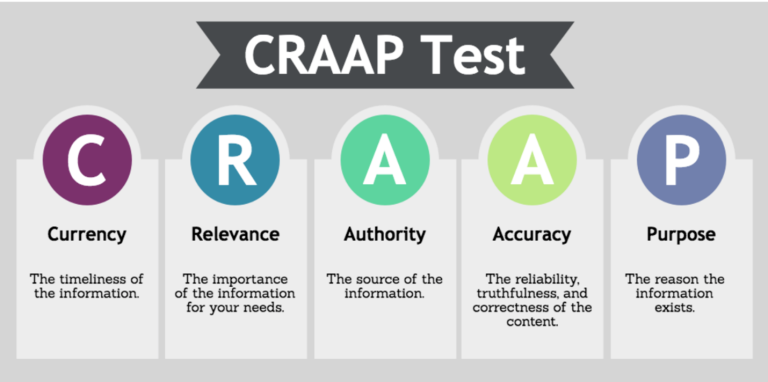
The CRAAP framework provides useful prompts: Currency, Relevance, Authority, Accuracy, and Purpose. Treat it as a diagnostic checklist rather than a numerical scorecard.
Use one of these reliability tags and write a one- or two-sentence justification:
| Reliability tag | Meaning |
|---|---|
R4—corroborated |
Strong direct evidence, suitable scope, and independent confirmation where appropriate |
R3—well-supported |
Transparent and relevant evidence, but corroboration or qualification is still needed |
R2—limited-or-interested |
Useful, but narrow in scope, interpretive, self-interested, dated, or otherwise incomplete |
R1—unverified-or-disputed |
The claim is not adequately supported, or credible sources substantially contest it |
R0—not-evidence-for-this-claim |
The source may be valuable for another purpose, but cannot support this factual claim |
A source’s rating can change with the claim:
- A film may be
R4for “this film contains this scene.” - The same film may be
R0for “this scene proves a social practice was universal.” - A company privacy policy may be
R4for “the company publicly states this policy.” - It may be
R2for “the company always behaves this way in practice.”
This is more rigorous than calling a source simply trustworthy or untrustworthy.
4. Fictional use: what can this source do in the Story Bible?
A source should not enter the database only because it is “interesting.” Record what it can generate.
Use one or more fictional-use tags:
| Tag | Story function |
|---|---|
mechanism |
Establishes a rule of Digital World physics |
geography |
Inspires a place, route, boundary, or scale relationship |
institution |
Inspires a law, profession, authority, market, or public service |
culture |
Inspires customs, etiquette, ritual, language, or status |
conflict |
Produces vulnerability, inequality, disagreement, or struggle |
character |
Shapes a role, motive, or identity problem |
scene |
Supports a specific encounter or dramatic event |
image-atmosphere |
Provides tone, visual language, or symbolic texture |
counterargument |
Complicates an easy interpretation and prevents simplification |
research-question |
Identifies something the story needs to investigate further |
Then add a short note identifying the metaphor limit. For example:
Fictional use:
institution,culture,scene
Translation: A TLS handshake becomes a formal border ritual through which visitors prove identity before entering a protected city.
Metaphor limit: The ritual must not imply that encryption proves a visitor’s moral character; technically, it establishes cryptographic properties and authentication under particular conditions.
That final sentence keeps the fiction anchored to the mechanism rather than replacing it.
Check reliability outside the source’s own presentation
Lateral reading is the habit of leaving a source’s page to investigate who produced it, how it is regarded elsewhere, and whether its claims can be traced to stronger evidence.
Read Stanford’s Civic Online Reasoning introduction for the core principle behind the reliability field in your database: sources should not be evaluated solely through their own self-description.
At the top of the page, read the introduction to lateral reading. Focus on the distinction between examining a webpage vertically and checking independent information about its producer and reputation.
For every source that will support an important factual claim, make a brief lateral-reading record:
- Creator: Who made this?
- Process: Was it measured, peer reviewed, reported, recorded, argued, marketed, or performed?
- Institution: What organization published or funded it?
- Scope: Which system, population, location, date range, or tradition does it actually address?
- Independent context: What do other credible sources say about the source or its central claim?
- Revision trail: Is there a version history, erratum, correction, reply, or later critique?
A university, government, or nonprofit domain can be a useful clue about provenance, but it is not a reliability certificate. You still need to inspect authorship, method, scope, purpose, and evidence.
Relationships: make sources speak to one another
A list of sources becomes research only when you can see how the sources relate. Avoid vague relation tags such as related-to. Use a precise verb and a short explanation.
Useful relationship tags include:
| Relationship tag | Meaning |
|---|---|
supports |
Independently provides evidence for the same specific claim |
specifies |
States a formal intended rule or standard |
measures |
Observes behavior in a defined system or dataset |
implements |
Describes a particular realization of a standard or design |
reports |
Documents an event through journalism, records, or testimony |
contextualizes |
Supplies historical, social, institutional, or cultural background |
interprets |
Offers a scholarly reading of a text, practice, or event |
critiques |
Challenges a method, conclusion, or framework |
updates |
Revises a source with newer evidence or a newer version |
supersedes |
Replaces an older specification, law, or formal document |
adapts |
Creatively transforms a source into a new narrative work |
inspires |
Supplies an artistic or worldbuilding precedent without factual authority |
Consider a small technical cluster:
- An Internet specification specifies how a protocol is intended to work.
- A networking textbook explains that specification for learners.
- A packet capture measures behavior in one actual connection.
- A security paper may critique a weakness in a particular implementation.
- Your scene outline adapts the mechanism into a border encounter.
These relationships prevent a textbook explanation, a formal standard, a real measurement, and a fictional metaphor from being flattened into the same kind of evidence.
A practical schema: three linked tables
You can build this in a spreadsheet, Notion, Obsidian, Airtable, a plain-text system, or Zotero with notes and tags. The tool matters less than the structure.
For a project of this scale, use three linked tables.
Table 1: Sources
| Field | Example |
|---|---|
source_id |
NET-001 |
| Citation | Author, title, date, publisher or journal |
| Source role | Technical standard |
| Primary domain | networking |
| Secondary domains | infrastructure, governance |
| Date and version | Publication date; version, RFC status, or edition where relevant |
| Provenance note | Who made it and for what purpose |
| Default fictional uses | mechanism, institution |
| Status | to-read, appraised, core, background, retired |
Table 2: Claims
| Field | Example |
|---|---|
claim_id |
NET-001-C02 |
source_id |
NET-001 |
| Atomic claim | “The specification requires a defined connection-establishment exchange.” |
| Claim type | established-mechanism |
| Evidence location | Page, section, timestamp, or quotation |
| Reliability | R3—well-supported |
| Reliability note | Strong for intended protocol behavior; does not establish universal deployment behavior |
| Scope and limits | Applies to the named protocol version only |
| Story translation | “Entry into a protected district requires a three-part recognition ritual.” |
| Metaphor limit | Recognition is cryptographic, not moral or spiritual proof |
| Story question | “Who is excluded when old clients cannot complete the ritual?” |
Table 3: Relationships
| From source | Relationship | To source | Rationale |
|---|---|---|---|
NET-001 |
explained-by |
NET-014 |
The textbook gives conceptual context for the standard |
NET-001 |
measured-by |
NET-020 |
A packet trace observes one implementation’s behavior |
NET-001 |
critiqued-by |
NET-032 |
A security paper identifies a deployment weakness |
NET-001 |
adapted-into |
SCENE-004 |
A scene uses the mechanism as a border ritual |
The third table can include story artifacts as well as sources. That is intentional: the Story Bible should preserve the path from research to invention.
A worked example: one source, three different uses
Imagine you save a scholarly paper about generative agents.
Source record
- Primary domain:
ai-agents - Secondary domains:
identity,systems - Source role: Scholarly empirical study
- Default fictional uses:
mechanism,character,research-question
Now create distinct claim records rather than one broad summary.
| Claim | Claim type | Reliability | Correct use |
|---|---|---|---|
| “The authors built agents with memory, reflection, planning, and action components.” | documented-event |
R4—corroborated for what the paper reports building |
Describe the architecture accurately |
| “This architecture can produce plausible social behavior under the study’s conditions.” | academic-theory or study finding |
R3—well-supported |
Discuss the reported demonstration with its stated limits |
| “Therefore such agents are conscious persons.” | philosophical-argument if argued, otherwise unsupported extrapolation |
R0—not-evidence-for-this-claim |
Do not attribute this conclusion to the study |
| “A future platform Shadow may remember, plan, negotiate, and revise its self-narrative.” | speculation |
Not a factual conclusion; mark as your extrapolation | Use as a bounded fictional premise |
The fictional translation might be:
Scene use: A Shadow revisits fragments of memory, decides which experiences matter, and develops a goal its human source never endorsed.
Technical grounding: Memory retrieval and reflection are modeled as explicit system components.
Speculative step: The Shadow’s personal continuity, dissatisfaction, and moral claim are inventions that go beyond the study.
This is the standard you will use throughout the course: preserve the seam between evidence and imagination.
Optional tool setup: use tags, relations, and notes in Zotero
If you want dedicated reference-management software, Zotero can store citations, files, tags, linked items, and notes. It will not make the intellectual judgments for you, but it can hold the database structure you are creating.
How To Use Zotero (A Complete Beginner's Guide)
Watch “How To Use Zotero (A Complete Beginner’s Guide)” by Steven Bradburn for a short demonstration of the features most relevant to this course: collections, tags, related references, and notes.
Watch collections and tags to see how one reference can belong to multiple collections and carry searchable labels. Then watch relations and notes to see how linked sources and appraisal notes can be stored. Recreate only the features you need; a spreadsheet remains fully adequate for this course.
A useful Zotero structure would be:
- Collections:
Networking,Infrastructure,Shadows,Philosophy,Nigerian Contexts,Narrative Precedents - Tags: the controlled domain, claim-type, reliability, and fictional-use tags
- Notes: the source appraisal card and extracted claim records
- Related items: explicit source relationships such as
critiques,updates, orcontextualizes
Do not rely on automatically imported tags. Replace them with your controlled vocabulary so that searches stay coherent six months from now.
Build the first version of your research database
Create a database with the three-table structure above, then enter three deliberately different sources from your current or planned reading:
- A technical source, such as a protocol standard, textbook chapter, or technical documentation page.
- A scholarly, journalistic, or policy source about data, platforms, or AI.
- A cultural, religious, film, or literary source relevant to the Shadow mythology or narrative method.
For each source:
- Assign one primary domain and up to two secondary domains.
- Identify its source role.
- Record one atomic claim rather than a broad summary.
- Assign a claim type.
- Give a reliability tag with a short scope-based justification.
- Add one fictional-use tag and one metaphor limit.
- Link it to at least one other source, course concept, or Story Bible entry using a precise relationship verb.
Your deliverable is a starter evidence map with three source records, three claim records, and three relationship records. It should be small enough to maintain, but precise enough that another reader could see what you know, what you infer, and what you have invented.
Key takeaways
- Treat a source database as an evidence map, not a storage bin for links.
- Separate the source’s role from the claim you are extracting from it.
- Use stable domain tags so that sources remain searchable across technical, philosophical, cultural, and narrative research.
- Assign claim types to particular statements: fact, documented event, theory, argument, hypothesis, speculation, myth, or invention.
- Rate reliability for the source–claim pair, never as a permanent property of the source alone.
- Record fictional use and metaphor limits together, so research informs imagination without being misrepresented.
- Use precise relationships such as
specifies,measures,contextualizes,critiques, andadaptsto show how knowledge is connected.
Next, you will shift from evaluating sources to defining the territory they describe: the difference between the Internet, the Web, cloud computing, platforms, and individual applications.