Recommended resources
The freely available resources this lesson will direct you to.
Hello! Last lesson, you represented a relation as ordered pairs or as arrows in a directed graph. We will now ask what patterns those pairs follow. You will test four properties—reflexivity, symmetry, antisymmetry, and transitivity—and, just as importantly, learn what evidence is enough to establish or refute each one.
Start with the set, then ask four questions
A relation on a set selects pairs from . The set matters: to decide whether is reflexive, for example, you must know every element that needs a self-pair.
Here are the four tests. Read “” as “ belongs to .”
| Property | What must hold for every relevant element of ? | What disproves it? |
|---|---|---|
| Reflexive | Every satisfies . | One missing pair . |
| Symmetric | If , then . | A pair whose reverse is missing. |
| Antisymmetric | If and , then . | Both directions between two distinct elements. |
| Transitive | If and , then . | Two connected pairs with missing. |
The first three tests are illustrated in Neso Academy’s Types of Relations (Part 1). Watch the indicated segments for how the definitions are checked against actual pairs; we will examine transitivity separately.
Neso Academy’s Types of Relations (Part 1) gives short worked illustrations of reflexive, symmetric, and antisymmetric relations.
Watch reflexivity for the requirement on every self-pair. Then watch symmetry and antisymmetry. In the last segment, pay particular attention to why a pair going in just one direction does not violate antisymmetry.
A useful habit is to separate two kinds of reasoning. To show that a property fails, find one precise counterexample. To show that it holds, account for every case—or give an argument that works for arbitrary elements.
Reversing a pair is not the same as forbidding its reverse
Recall the factor relation from last lesson, on :
It is reflexive: the three required self-pairs are present. It is not symmetric: , but .
What about antisymmetry? The one-way connection from to is perfectly acceptable. So are all three loops. To break antisymmetry, we would need and for some . No such distinct pair occurs in , so is antisymmetric.
This is the distinction most worth holding onto:
- Symmetry requires a reverse whenever a pair is present.
- Antisymmetry forbids having both directions between distinct elements.
They are not opposites. A relation containing only self-pairs is both symmetric and antisymmetric: reversing a self-pair changes nothing, and there are no two-way connections between distinct elements.
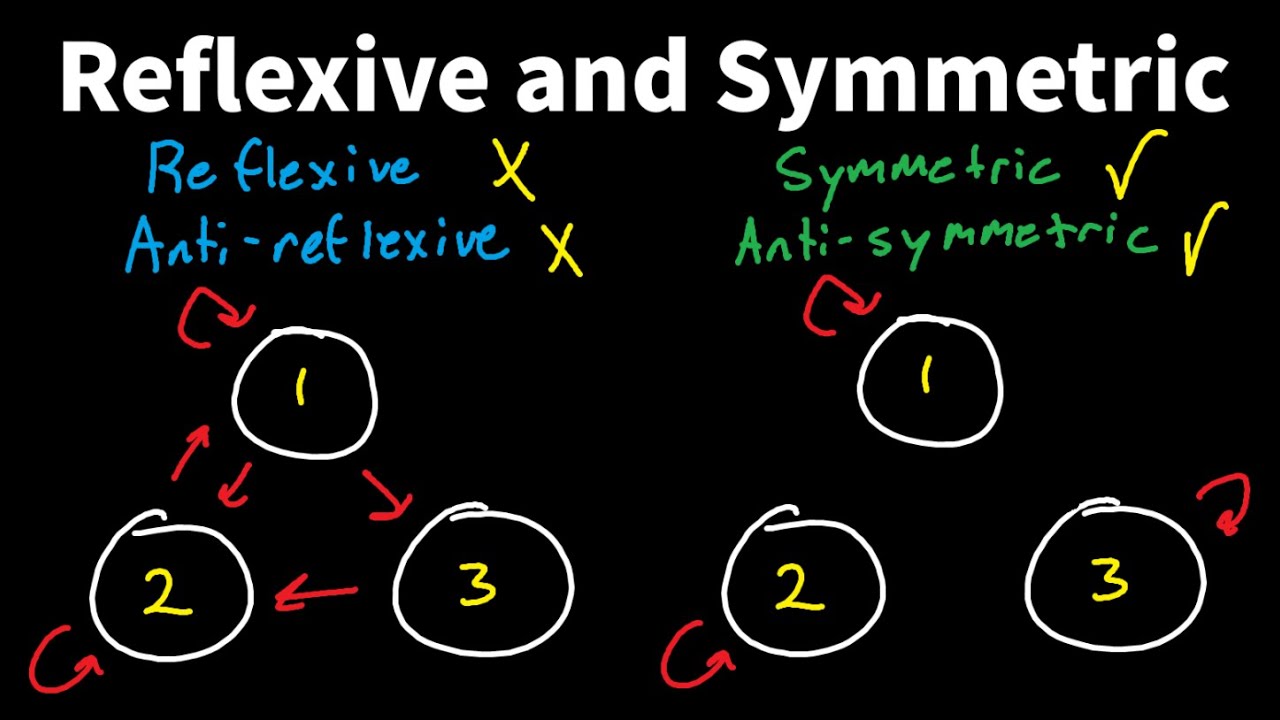
The image also shows why “not reflexive” does not mean “no loops.” The left-hand graph has some loops, just not one at every vertex.
For a closer look at the symmetry–antisymmetry distinction and the graph tests, use the following targeted parts of 7.2: Properties of Relations by Mathematics LibreTexts.
Read the distinction between symmetry and antisymmetry, one counterexample-rich worked case, and the digraph criteria. These will help you check pairs without relying on how a picture happens to look.
In Section 7.2, find the second “Remark” immediately after the “Definition.” Read the distinction through the end of that remark, stopping before Example 7.2.1. Then go to Example 7.2.3, which starts by defining a relation containing (2,3) and (3,2). Read its worked analysis, including the counterexamples, stopping before the first hands-on exercise. Finally, after Example 7.2.8, find the paragraph beginning “Instead of using two rows of vertices.” Read the digraph reminder and the five graph-property bullets that follow; stop before “The incidence matrix.” Focus on how two opposite arrows affect antisymmetry and how a two-step route affects transitivity.
Transitivity checks connected pairs
Reflexivity concerns loops; symmetry and antisymmetry compare directions. Transitivity asks a different question: whenever and are present, is also present?
The middle entry must match. The pairs and create a transitivity requirement for . The pairs and do not create one together, because the first pair ends at while the second begins at .
Here is a relation on that makes several tests visible at once:
It is reflexive because all three self-pairs are present. It is symmetric because each pair between distinct elements has its reverse. It is not antisymmetric, witnessed by and , since .
It is also not transitive: and belong to , but does not. That single connected pair of arrows is enough to settle the question; you need not check every other route once you have found a failure.
To establish transitivity rather than refute it, the burden is broader. Return to the factor relation . You could inspect every connected pair in its five-pair roster. But its defining rule gives a shorter argument: if is a factor of , and is a factor of , then is a factor of . This works for every , so is transitive. Thus the factor relation has three of our four properties: reflexive, antisymmetric, and transitive, but not symmetric.
On a very small set, systematic inspection is often quickest. For a relation specified by a rule, such as “is a factor of,” try reasoning directly from the rule. In either method, remember that , , and need not be distinct: a route can involve a loop or return to its starting point.
A dependable testing routine
When you are given a new relation, work in this order:
- Identify the set and the selected pairs. For a finite rule-defined relation, listing its pairs may prevent missed cases.
- Check self-pairs for reflexivity.
- Check reverses for symmetry, then look specifically for a two-way connection between distinct elements for antisymmetry.
- Check connected pairs for transitivity. Either find a missing required pair or justify why every required pair is present.
Neso Academy’s Types of Relations (Solved Problem) applies all four questions to the rule . This is a useful contrast with checking a finite roster: the relation is given by a condition, so counterexamples and general reasoning do the work.
Types of Relations (Solved Problem)
Watch the first worked relation in Neso Academy’s Types of Relations (Solved Problem) to see the four tests applied to a condition rather than a list of ordered pairs.
Watch the worked test for the relation defined by x+y=0. Notice when one chosen pair is enough to disprove a property, and when the reasoning must cover every pair satisfying the condition.
The central habit is to state your evidence, not just your verdict. “Not symmetric” becomes a clear argument when you name a pair that is present and its reverse that is absent. “Not transitive” becomes clear when you name both connected pairs and the missing required pair.
You can now test a relation using its roster, rule, or directed graph: look for all loops, reversed pairs, forbidden two-way connections between distinct elements, and completed two-step routes. A single counterexample defeats a property; establishing one calls for a complete check or a general argument.
Next, you will use some of these tests to identify equivalence relations, then determine the groups of elements—equivalence classes—that they form.