Recommended resources
The freely available resources this lesson will direct you to.
Hello! In the previous lesson, you grouped elements using equivalence relations. A condition such as “every element is related to itself” was already doing logical work: the word every specifies how many elements must satisfy the condition.
This final lesson in the module makes that logic explicit. You will translate statements containing “every” and “some” into plain language, then construct negations that say exactly when the original statements fail. The same skill will help you read definitions throughout mathematics, including the definitions of functions in the next module.
What a quantifier says—and what it ranges over
A predicate is a condition whose truth may depend on a variable. For example, might mean “ is even.” Until you choose a value of , or say which values the claim covers, is not yet a complete statement.
A quantifier supplies that missing scope:
The set is the domain. It is part of the claim, not a detail to skip. “There is an integer whose square is ” is false, while “There is a real number whose square is ” is true. In both cases the condition is the same; the permitted values differ. Also, some means at least one, not necessarily “some but not all.”
Watch the opening of TrevTutor’s Predicate Logic and Quantifier Negation for the distinction between a condition with variables and a quantified statement. The translation example then shows how to read a statement with two variables without trying to decide its truth first.
PREDICATE LOGIC and QUANTIFIER NEGATION - DISCRETE MATHEMATICS
Watch Predicate Logic and Quantifier Negation by TrevTutor to establish what the symbols claim before working on negations.
Watch predicates and quantifiers, focusing on why a predicate with an unspecified variable differs from a statement. Continue with translation examples; focus on the words “for every” and “there exists” and on the domain attached to each variable. The examples are about translating claims, not verifying them.
Here is a familiar statement in this notation. A relation on is reflexive when
Read it aloud: “For every element of , the ordered pair belongs to .” The notation specifies both which elements to inspect and what must hold for each one.
A negation identifies the way a claim can fail
A logical negation must be true precisely when the original statement is false. Suppose someone claims that every element of satisfies . To overturn that claim, you need one element of for which fails. Conversely, to overturn a claim that at least one element satisfies , you must rule out every possible element:
The symbol here means that the expressions make the same claim. Watch how the video derives the first rule from the meaning of “all,” rather than treating it as a rule to memorise without a reason.
PREDICATE LOGIC and QUANTIFIER NEGATION - DISCRETE MATHEMATICS
Return to TrevTutor’s Predicate Logic and Quantifier Negation for the reasoning behind switching a quantifier when negating it.
Watch quantifier negation. Focus on the finite-domain picture: “all” behaves like a collection of conditions joined by and, whereas “exists” needs at least one condition to hold. Notice why “not all” calls for one failure, not failure everywhere.
The following image places the four forms side by side. Read the diagonal pairings as negations, not as interchangeable statements.
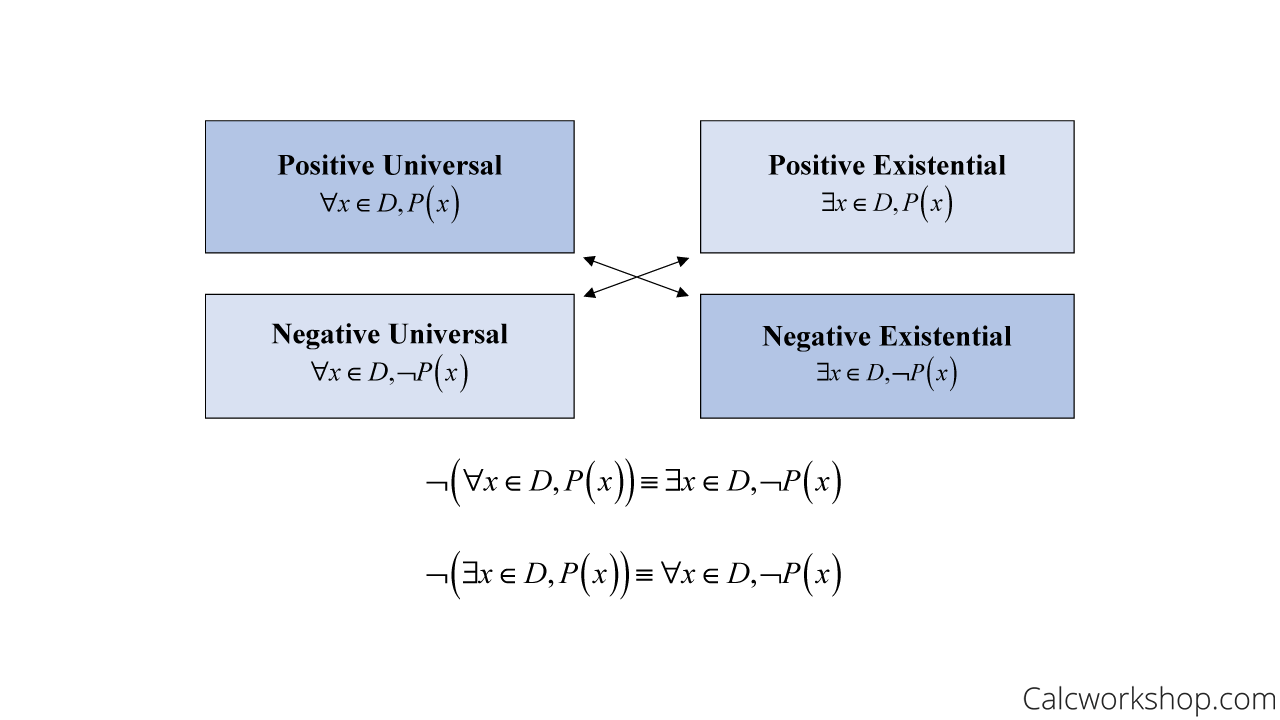
One distinction in the diagram is especially important: “Every does not have ” is not the negation of “Every has .” The former says none have ; the latter is disproved as soon as one does not.
For example, let and let mean “ is even.” Both “every element of is even” and “every element of is not even” are false. That alone shows they cannot be negations of each other. The correct negation of “every element is even” is “at least one element is not even”; supplies such an element.
Return to reflexivity. Its precise negation is
In plain language: “There is an element of that is not related to itself.” You do not need every self-pair to be missing. The particular that makes a universal claim fail is called a counterexample.
Negating the condition inside the quantifier
Changing “every” to “some,” or vice versa, is only the first step. You must also negate the whole condition that follows. When that condition has more than one part, its logical structure matters.
Read the short discussion of “and,” “or,” and “if…then” in 3.2 Negating Quantified Statements. These are the tools needed to finish a negation after switching its quantifier.
3.2 Negating Quantified Statements
Read the discussion of logical connectives in 3.2 Negating Quantified Statements on Runestone Academy. It explains what happens inside a quantified statement when its condition contains more than one claim.
In the discussion immediately after Activity 3.2.2, start at logical connectives. Read through the “AND statement,” “OR statement,” and “IF...THEN statement” entries under “Negations of Logical Statements.” Focus on why negating an “and” gives an “or,” and why a failed conditional requires its first part to hold and its second part to fail.
Consider the claim
It reads: “For every real number , if , then .” A conditional fails only when its if-part is true and its then-part is false. Thus the negation is
In words: “There is a real number whose square is greater than , but which is not greater than .” The choice confirms that this negation is true. Notice that negating gives , not merely : equality must be included.
An “and” condition changes differently. To negate “there is an integer with and ,” you must say that every integer fails at least one of those requirements:
This resulting statement happens to be false— defeats it—but it is still the correct negation. Constructing a negation and deciding whether it is true are separate tasks.
When one quantifier sits inside another
With two variables, order matters. Compare:
and
The first says, “For every integer , there is an integer whose sum with is zero.” It is true: may depend on . The second demands one fixed integer that works for every , so it is false.
Read the section below to see these different readings laid out together and to follow a negation through two quantifiers. Stop before the later summary table; the worked derivation is what you need here.
2.4: Quantifiers and Negations
Read “Statements with More than One Quantifier” in LibreTexts’ 2.4: Quantifiers and Negations. Its integer examples make the order of “for every” and “there exists” concrete.
In “Statements with More than One Quantifier,” begin at multiple quantifiers. Read the four versions of the integer-sum claim and the worked negation that follows them. Stop after the sentence stating that the given statement is false and its negation true. Focus on how the negation moves through one quantifier at a time while the order of the variables stays intact.
To negate a nested claim, work from the outside inward: switch each quantifier as the negation reaches it, then negate the final condition. For the first integer statement above, this gives
Read that result carefully: “There is an integer such that no integer sums with it to zero.” Since the original claim is true, this negation is false. The translation makes that clear without needing to test integers one by one.
The same method can reveal what a counterexample to a nested claim must look like. Let . The claim “For every , there is a with ” is false. Its negation says:
That is, “Some element of is at least as large as every element of .” Choosing confirms it. Here the counterexample to the original “for every ” claim must be an for which every possible choice of fails.
A reliable reading routine
For a quantified statement, first identify the domain and read the quantifiers in their written order. Then state the remaining condition in ordinary language. To negate it, switch each quantifier as you move inward and negate the complete condition at the end. A final plain-language reading is a useful check: does your result describe exactly how the original could fail?
The core distinction is short but powerful: “not every” means “at least one fails”; “not even one” means “every one fails.” With nested quantifiers, preserve their order while switching each one. You now have the language needed to read mathematical definitions more precisely; next, you will use relations and specified domains to decide when a mapping qualifies as a function.