Recommended resources
The freely available resources this lesson will direct you to.
Hello! This first module begins with sets: a way to describe exactly which objects belong to a collection. We will use them later to study relations, functions, and mathematical logic. Today’s task is practical: take a verbal condition and write the same set as a roster, in set-builder notation, or—when it describes a range of real numbers—in interval notation.
The key habit is to ask two questions before choosing symbols: What kind of numbers are allowed? and Which of those numbers satisfy the condition?
Rosters: show the members
A set needs a clear membership rule. “The integers greater than 2 and less than 7” is precise; “some fairly large numbers” is not. In roster form, you list the members inside curly braces:
Order does not matter, and repeating a member changes nothing: and describe the same set. We normally write each member just once. The symbol means “ belongs to .”
Watch the roster and set-builder examples in Roster and Set-builder form, from Khan Academy India – English. Notice when the speaker lists answers and when they state a rule for finding them.
Roster and Set-builder form | Sets | Grade 11 | Math | Khan Academy
Watch “Roster and Set-builder form” to see the two representations built from the same verbal conditions.
Watch roster form for braces, repeated elements, and patterns that continue. Then watch set-builder form; focus on how a number type and a further condition work together.
Number type matters immediately. Throughout this lesson, denotes the natural numbers, the integers (including zero and negative integers), and the real numbers.
Consider “the natural numbers that are at least 2, even, and less than 12.” Checking those conditions gives
For a larger patterned set, an ellipsis is useful if the continuation is unmistakable: means the positive even integers without an upper limit. An ellipsis is not a substitute for a clear rule when several continuations are possible.
A roster can also be empty. There is no natural number strictly between 0 and 1, so its roster is , also written . That is not , which contains one number.
Set-builder notation: state the membership test
A roster gives the members; set-builder notation gives a test that every member must pass. A useful template is
Read this as “the set of in such that the condition holds.” The symbol means such that; a colon is often used instead. The set specifies the allowed type of object, sometimes called the domain of discussion.
For the even-number example above, we can write
Both restrictions matter. If you omit “even,” the set also contains 3, 5, and other odd numbers. If you omit , the intended kind of number is less explicit.
Here is a condition that requires more work than simply counting along a number line: “the integers whose squares are less than 10.” Set-builder form preserves the statement directly:
Since but , the permissible integers run from through . Thus
The negative values are easy to miss if you start listing before examining the condition. Notice also that changing “integers” to “natural numbers” would change the roster, even though stayed the same.
Intervals: include every real number in a range
Now change the wording to “real numbers greater than 1 and less than 5.” A roster such as misses , , and infinitely many other members. Interval notation is designed for a continuous range of real numbers:
A parenthesis excludes an endpoint; a square bracket includes it. Watch Intervals and interval notation, from Khan Academy, as the number-line drawings are translated into inequalities and intervals.
Intervals and interval notation | Functions | Algebra I | Khan Academy
Watch “Intervals and interval notation” to connect verbal endpoint rules with a number line, an inequality, and interval notation.
Watch included endpoints, then excluded endpoints. Finish with one of each. At each endpoint, check whether equality is allowed before choosing a bracket or parenthesis.
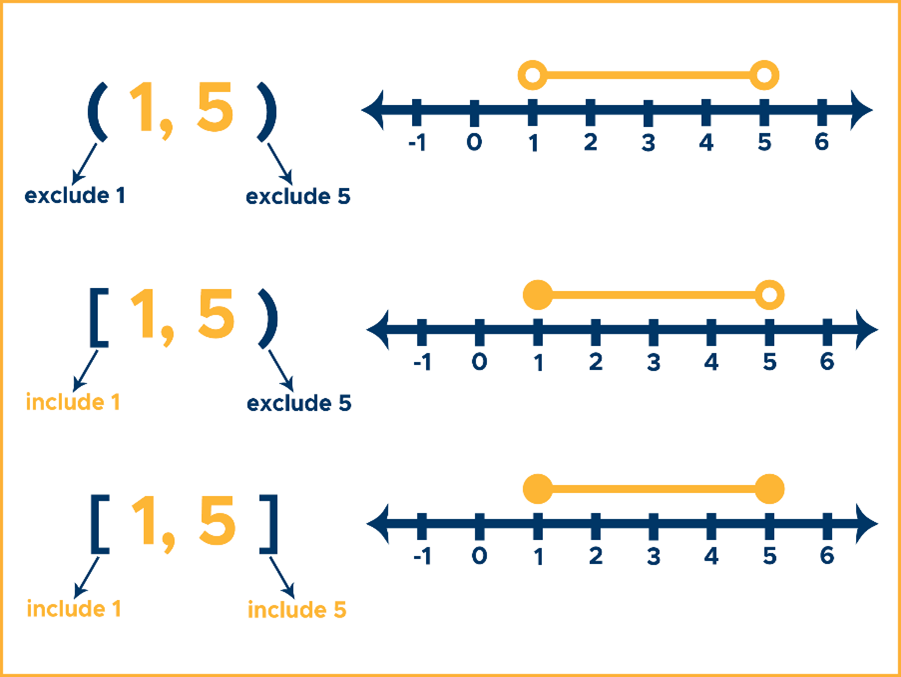
For example, “real numbers at least but below ” includes and excludes :
Translate each end separately. “At least,” “at most,” “no less than,” and “no more than” permit equality; “greater than,” “below,” and “strictly between” do not. If a prompt just says “between,” check whether it specifies the endpoints—the word alone can be ambiguous.
Choose the notation that preserves the number type
Intervals can extend indefinitely. In the final part of the interval video, pay attention to why infinity always gets a parenthesis and why excluding one point splits a range into two pieces.
Intervals and interval notation | Functions | Algebra I | Khan Academy
Return to “Intervals and interval notation” for unbounded ranges and a range with one value removed.
Watch unbounded ranges. The example excluding 1 shows why one interval cannot always describe a set; the final explanation establishes the parenthesis convention at infinity.
For example, “real numbers at least 3” is
Infinity is not a real endpoint that the set can contain, so it never receives a square bracket. Similarly, “all real numbers except 1” requires two intervals:
Here joins the two pieces. Set operations, including this one, are the subject of the next lesson.
An interval describes real numbers, not just the integers within its bounds. Compare these two conditions:
The second set contains ; the first does not. Consequently, is not interval notation for the first set.
When translating a new description, work in this order:
- Identify the allowed objects: natural numbers, integers, or real numbers?
- Turn every verbal restriction into a membership condition, paying special attention to equality at boundaries.
- Choose a roster for a manageable list, set-builder notation for a precise rule, or intervals for real-number ranges. Check an endpoint and a value inside the range against your result.
The central idea is that notation must preserve both the condition and the kind of number allowed. Rosters display members, set-builder notation states their membership test, and intervals capture real-number ranges with precise endpoints. Next, you will use these sets to work with unions, intersections, differences, and complements.