Recommended resources
The freely available resources this lesson will direct you to.
Good to see you again. In the previous lesson, you rearranged formulas while preserving equality and checked them by substitution. That work ended with a useful observation: the rearranged cost formula
also “looks right” in terms of its units. This lesson makes that observation into a systematic diagnostic tool.
Dimensional consistency asks whether every quantity in an equation has units that can legitimately be combined. It is a fast way to catch algebra slips, transcription errors, and implausible market formulas before you use them in a spreadsheet, model, or Python program. Plan for about 30 minutes.
Units are part of the meaning of a number
A numerical value without a unit is often incomplete. The number might mean 12 tonnes, 12 euros per unit, 12 percent, or 12 months. Each describes a different kind of quantity.
A unit is the measurement label attached to a quantity:
- length: metres, kilometres
- time: seconds, months, years
- quantity: units, tonnes, barrels
- money: USD, EUR
- price: USD per unit
- rate of production: units per month
- revenue flow: USD per month
A dimension is the more general type of physical quantity behind a unit. For example, metres and kilometres are both units of length; miles per hour and metres per second share the dimension length per time.
In economics, unit checks are often more immediately useful than abstract physical dimensions. You need to know not merely that two quantities both involve money, but whether they are both measured in, say, USD per month rather than one in USD and the other in USD per tonne.
For example, suppose:
and
Then revenue is
Its units are
The units of quantity cancel, leaving revenue per month. This makes economic sense because multiplying a price per unit by units sold per month gives money earned per month.
Think of units as algebraic factors:
- multiply units when you multiply quantities;
- divide units when you divide quantities;
- cancel common units across a fraction;
- add or subtract only quantities with matching units.
The last rule is the most important one.
Watch “Dimensional Analysis” by Garrison Turner for a concise visual account of why matching dimensions are a necessary condition for a valid equation, followed by a worked consistency check.
First watch the core criterion, especially the distinction between a formula that fails a unit check and one that merely passes it. Then watch the worked check. The example uses velocity and acceleration, but focus on the transferable procedure: replace each variable by its generic units, simplify products and quotients, and verify that terms joined by addition have the same units.
The rules of a dimensionally consistent equation
An equation is dimensionally consistent when both sides have the same units or dimensions, and every addition or subtraction within it combines compatible quantities.
There are two questions to ask.
1. Do terms being added or subtracted have the same units?
Consider the cost model from the previous lesson:
Suppose this model is measured over a month:
Now check the product:
So the equation has the structure
This is consistent: fixed cost and variable cost are both monetary flows per month, so they can be added to obtain total cost per month.
Now compare an impossible formula:
Its units would be
The right-hand side tries to add money to physical output. This is not meaningful. A unit cost is needed to convert output into a cost.
2. Do both sides of the equality have matching units?
Consider a basic trade-value relationship:
where is the value of imports in a month, is an import price, and is imported quantity during the month. If
and
then
Thus must be interpreted as import value per month, not simply a one-off stock of money.
This distinction between stocks and flows is especially important in economic modelling:
| Quantity type | Example unit | Interpretation |
|---|---|---|
| Stock | tonnes, USD, units in inventory | Amount at a particular time |
| Flow | tonnes per month, USD per year | Amount accumulated or occurring over time |
| Price | USD per tonne | Money per physical unit |
| Rate | units per day | Change or activity per time |
A formula may have correct arithmetic but still fail because it confuses a stock with a flow.
Unit conversion makes quantities compatible
Before adding or comparing quantities, put them in compatible units. For example, you cannot directly add kilograms and tonnes numerically, even though both measure mass. Convert one first:
so
The same idea matters in market data. A price series in USD per barrel cannot be added to a price series in cents per litre. They may concern the same commodity, but conversion is necessary before numerical comparison or combination.
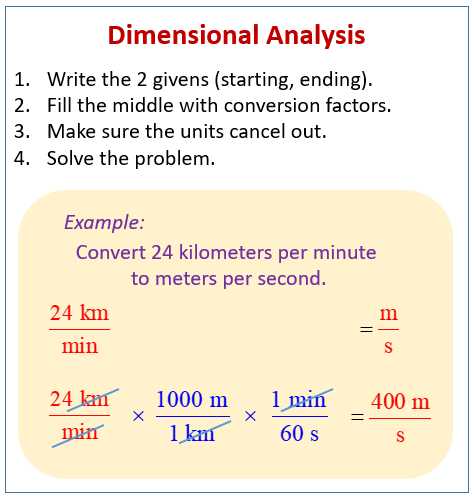
The visual shows conversion factors as fractions chosen to cancel unwanted units. For example,
This is not quite the same task as checking whether an equation is dimensionally consistent:
- Unit conversion rewrites one quantity in another equivalent unit.
- Dimensional checking asks whether an equation can make sense given the types of quantities it combines.
But both rely on treating units as factors that can be multiplied, divided, and cancelled.
Coefficients in economic models can have units
A common trap is to assume that every number in a formula is unit-free. Pure numerical constants such as , , and have no units. But estimated coefficients in economic equations often do have units.
Suppose a supply relationship is written as
where:
- is quantity supplied per month,
- is price in USD per unit,
- is an intercept,
- describes how supply changes with price.
If
then must also have units
because it is added to . For the equation to be consistent, must also be units per month:
Therefore, the units of must be
That may look unfamiliar, but it has a clear interpretation: converts a change in price per unit into a change in quantity supplied per month.
This becomes useful later when interpreting regression coefficients. A coefficient is never merely “0.4” in isolation. Its units tell you what kind of change it represents.
A tariff formula
The tariff relationship from the previous lesson also passes a unit check:
where is consumer price, is world price, and is an ad valorem tariff rate.
Because and are both prices, they have the same units:
The tariff rate is a proportion, so it is dimensionless:
Therefore,
and
The equation is dimensionally consistent.
This also explains why a tariff rate written as can be added to , while a price such as cannot. The former is a pure proportion; the latter carries units.
Checking a rearranged formula with units
Dimensional analysis provides a second check after algebraic rearrangement. Recall:
Solving for gave
Check the units of the right-hand side:
Dividing by a fraction is equivalent to multiplying by its reciprocal:
That is precisely the unit of output rate . The rearrangement passes the dimensional check.
Now consider a plausible-looking but incorrect rearrangement:
The two terms on the right have incompatible units:
but
So this expression attempts to subtract an output rate from a cost flow. Unit analysis immediately identifies the algebraic error.
A stock-flow example from a circular economy
Suppose a recycling firm tracks its stock of recovered material:
where:
- is ending inventory in tonnes,
- is starting inventory in tonnes,
- is tonnes recovered during the period,
- is tonnes shipped during the period.
This works if and refer to total amounts during the same period:
But suppose is a recovery rate measured in tonnes per month. Then this formula is inconsistent:
because it combines tonnes with tonnes per month.
To make the model consistent, multiply the rate by a duration :
If
and
then
Now every term is in tonnes. This kind of check is essential whenever a model combines inventory, production, demand, emissions, or cash balances with their corresponding rates.
Passing the check does not prove a formula is correct
Dimensional consistency is a necessary condition for a quantitative equation, not a sufficient one.
If an equation fails the unit check, it is definitely wrong. But a formula can have matching units and still be wrong because of a missing coefficient, incorrect sign, or unsupported economic assumption.
For example, both expressions below have units of revenue per month:
Dimensional analysis cannot decide whether the factor belongs in the formula. That requires reasoning from theory, evidence, or the specific definitions of the variables.
Similarly, both
and
are dimensionally consistent, but they describe different economic claims. Units cannot tell you whether a tariff raises or lowers the domestic price; economic reasoning does that work.
Use dimensional analysis as a filter:
- If units do not match, stop and correct the equation.
- If units do match, continue checking algebra, definitions, assumptions, and data.
One further rule will matter when logarithms and exponentials appear later in the course: their inputs must be dimensionless. For instance,
is meaningful only if has no units. If is measured in years, then must have units of “per year.” Likewise, a log-price model normally uses a ratio such as
rather than the logarithm of a price with units.
A reliable unit-checking routine
When you encounter a quantitative equation, use this routine:
- Write the unit of every variable, including model parameters and coefficients.
- Break the equation into terms separated by plus or minus signs.
- Multiply and divide units algebraically within each term.
- Check each addition or subtraction: all participating terms must have the same units.
- Compare both sides of the equality: they must reduce to the same units.
- Check time periods and unit scales: monthly versus annual flows, tonnes versus kilograms, USD versus cents.
- Remember the limitation: a passed check means “possible,” not “proven correct.”
Key takeaways
Dimensional consistency means that an equation respects the types of quantities it combines.
- Only add or subtract quantities with compatible units.
- Multiply and divide units just as you do algebraic factors.
- Keep stocks distinct from flows; multiplying a rate by time converts it to an amount.
- Treat economic coefficients as quantities that may carry units.
- Use unit checks to verify formula rearrangements and identify modelling errors.
- A failed unit check proves a formula is wrong; a passed check does not prove it is right.
You now have a practical safeguard for formulas before calculation. Next, you will begin using Python as a calculator: storing quantities in variables and evaluating numerical expressions with arithmetic operators.