Recommended resources
The freely available resources this lesson will direct you to.
Welcome back. In the previous lesson, you practised reading numerical expressions accurately: parentheses and fraction bars establish grouping, powers apply to a specific base, and operations at the same priority level are performed left to right. Those habits carry directly into this lesson, because a fraction is often the most exact way to write a quantity before translating it into a decimal or percentage.
Fractions, decimals, and percentages are not three different kinds of quantities. They are three notations for the same number. This matters constantly in probability, economic data, and later in Python: a report may say “,” a dataset may store , and a theoretical calculation may use . You should be able to recognize immediately that all three mean the same share.
Plan on roughly 30 minutes: first establish the underlying idea of percent, then learn reliable conversion methods and the distinction between exact and rounded values.
One value, three representations
A fraction describes a part relative to a whole:
A decimal uses base-ten place value:
A percentage means “per hundred”:
All three are equal:
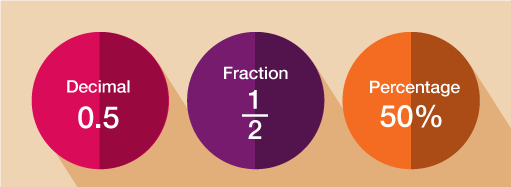
The percent sign is not decoration. It changes the numerical meaning of the number written before it. For example:
This is very different from:
The following short video establishes the central idea: every percent is a fraction with denominator .
Math Antics - What Are Percentages?
Watch “Math Antics - What Are Percentages?” by mathantics to connect the percent sign to the underlying fraction and decimal value, rather than relying only on a decimal-point shortcut.
Start with percent as a fraction, which explains why 15\% means \frac{15}{100}, including the useful boundary cases 0\%, 100\%, and percentages above 100\%. Continue with decimal conversion, focusing on why division by 100 places a percent in decimal form. Finish with the reverse view, which links decimals and fractions with denominator 100 back to percentages.
A percentage greater than is mathematically valid:
For instance, an expenditure level that rises to of its original level is times the original level. By contrast, a probability cannot exceed , because probability is limited to the interval from to .
The conversion toolkit
There are several possible routes between the three forms, but they follow just two ideas:
- A percent is a number divided by .
- A fraction is converted to a decimal by dividing its numerator by its denominator.
| Starting form | Target form | Reliable operation |
|---|---|---|
| Decimal | Percentage | Multiply by , then write |
| Percentage | Decimal | Divide by |
| Percentage | Fraction | Write the number over , then simplify |
| Terminating decimal | Fraction | Use place value, then simplify |
| Fraction | Decimal | Divide numerator by denominator |
| Fraction | Percentage | Divide to get a decimal, then multiply by |
The familiar “move the decimal point” rules are shortcuts for multiplying or dividing by . They work because:
and
It is worth keeping the multiplication or division interpretation in mind. That prevents a common mistake: treating as rather than as .
Decimals and percentages
To convert a decimal to a percentage, multiply by .
Therefore,
To convert a percentage to a decimal, divide by .
A few examples reveal the role of zeros clearly:
The decimal point may look like a small detail, but it changes the value by factors of ten. In particular:
while
The first is one half. The second is five thousandths.
Decimal percentages work in exactly the same way. For example:
Similarly,
A practical modelling interpretation: if a tariff rate is , the numerical multiplier used in a calculation is , not . For an import value of currency units, the tariff amount is:
Later, when you use Python for economic calculations, percentages will usually need this decimal form before they are multiplied by monetary values, quantities, or probabilities.
Decimals and fractions: place value gives the denominator
A terminating decimal can be written as a fraction by identifying the place value of its last digit.
For , the is in the tenths place:
For , the is in the hundredths place:
The zero is essential. Although both decimals contain a , they are not close in value:
For a decimal ending in the thousandths place, use as the denominator:
Then simplify by dividing numerator and denominator by their common factor :
So the full equivalence is:
Watch the first portion of this second video for a compact walkthrough of this place-value method, including simplification.
Converting Between Fractions, Decimals, and Percents | A Mini Course | Math with Mr. J
Watch “Converting Between Fractions, Decimals, and Percents | A Mini Course” by Math with Mr. J for a visual method of turning terminating decimals into simplified fractions.
Watch decimal to fraction. Pay particular attention to the contrast between 0.9 and 0.09, and to the two-stage method: first write the correct power-of-ten denominator, then simplify the fraction. The final example shows how the same method applies when a decimal has a whole-number part.
For a decimal greater than , you may write an improper fraction or a mixed number. For example:
Equivalently:
Both are correct. Improper fractions are often more convenient for algebra, while mixed numbers can be more readable in ordinary descriptions.
Two final place-value habits are useful:
- Adding trailing zeros does not change a decimal:
- Zeros between the decimal point and the first nonzero digit do change the value:
Fractions to decimals and percentages
To turn a fraction into a decimal, divide the numerator by the denominator:
Then multiply the decimal by to obtain a percentage:
Thus:
Sometimes you can instead turn the fraction directly into an equivalent fraction with denominator . For example:
Since , multiply both numerator and denominator by :
This is particularly efficient when the denominator can easily become , , or .
Consider a recycling rate recorded as of material collected. The three forms communicate slightly different things:
- is exact and shows the underlying ratio.
- is convenient in a calculation or dataset.
- is usually easiest to communicate in a report.
Percentages to fractions
To convert a percentage to a fraction, remove the percent sign, place the number over , then simplify.
For example:
Dividing numerator and denominator by gives:
Therefore:
Another example:
Decimal percentages require one additional step. Consider :
To remove the decimal from the numerator, multiply both numerator and denominator by . This preserves the value because you are multiplying the fraction by , which equals :
So:
In practice, converting the percentage to a decimal first is often quickest:
Exact values, repeating decimals, and rounding
Not every fraction has a terminating decimal. For instance:
The bar indicates that the repeats forever. The exact percent is therefore:
If a report needs a finite number of decimal places, round and use an approximation sign:
The distinction matters. The statements below are not equally exact:
A fraction is often the best form to retain during an algebraic derivation or probability calculation because it preserves exactness. A decimal or percentage may be preferable for interpretation, comparison, reporting, or model output.
A conversion check for market and probability data
When you convert, use the size of the result as a quick reasonableness test.
If the original value lies between and , then:
| Form | Expected range |
|---|---|
| Fraction | Numerator smaller than denominator |
| Decimal | Between and |
| Percentage | Between and |
For example, suppose a survey finds that of firms report using a recycled input:
All three forms are below one whole, so the result is plausible. Writing would immediately signal a factor-of-ten error.
A reliable written workflow is:
- Decide which form is being requested.
- Use the meaning of percent as “per ,” not only a decimal-point movement rule.
- Simplify fractions when practical.
- Label rounded answers with , rather than .
- Check the scale against , , and .
Key takeaways
Fractions, decimals, and percentages are equivalent ways of expressing one quantity:
The most useful conversion rules are:
- To convert a decimal to a percentage, multiply by .
- To convert a percentage to a decimal, divide by .
- To convert a terminating decimal to a fraction, use its final place value as the denominator and simplify.
- To convert a fraction to a decimal, divide numerator by denominator.
- To convert a percentage to a fraction, write it over and simplify.
- Keep repeating decimals as exact repeating notation or round them explicitly with .
Next, you will use these forms to distinguish absolute changes, relative changes, percentage changes, and percentage-point changes. That distinction is essential for interpreting claims such as “inflation rose by ” versus “inflation rose by 2 percentage points.”