Recommended resources
The freely available resources this lesson will direct you to.
- PHILOSOPHY - Epistemology: Hume's Skepticism and Induction, Part 1 [HD]www.youtube.com
- David Hume, Enquiry Concerning Understanding | Relations of Ideas & Matters of Fact | Core Conceptswww.youtube.com
- David Hume (Stanford Encyclopedia of Philosophy)plato.stanford.edu
- Hume's Fork, and his Theory of Relationsdavidhume.org
Introduction
In our previous lessons on rationalism, we explored how thinkers like Leibniz sought to understand the world through reason. You'll recall Leibniz's fundamental division of all truths into two kinds: Truths of Reason, which are necessary and knowable a priori, and Truths of Fact, which are contingent and explained by the Principle of Sufficient Reason.
We now turn from the rationalists to their great intellectual rivals, the empiricists. Our focus is on the Scottish philosopher David Hume, one of the most influential figures in the history of philosophy. Hume also proposed a fundamental division of all human knowledge, but he did so from a staunchly empiricist standpoint, arguing that all knowledge must ultimately be grounded in experience.
This lesson addresses the learning outcome: Describe Hume's distinction between relations of ideas and matters of fact. This distinction, often called "Hume's Fork," is the essential starting point for understanding his entire philosophical project. It provides the framework he uses to launch a powerful skeptical attack on concepts we often take for granted, such as causality and scientific induction—a topic we will tackle in our next lesson.
Hume's Project: The Science of Human Nature
Before diving into the distinction itself, it's helpful to understand Hume's overall goal. Inspired by Isaac Newton's success in the physical sciences, Hume aimed to develop a "science of human nature" by applying the experimental method to the mind. As he states in his Enquiry Concerning Human Understanding, this project requires us to reject any system "not founded on fact and observation."
For Hume, the basic building blocks of all our thoughts are perceptions, which he divides into two types:
- Impressions: Direct, vivid sensory experiences, emotions, and other mental phenomena (e.g., the feeling of warmth from the sun).
- Ideas: Fainter copies of impressions, such as memories and thoughts (e.g., the memory of the sun's warmth).
This empiricist foundation—that all our ideas are ultimately derived from experience—is crucial for the distinction he is about to draw.
Hume's Fork: Relations of Ideas vs. Matters of Fact
Hume argues that "All the objects of human reason or enquiry may naturally be divided into two kinds." These two kinds form the prongs of his famous fork.
To get a clear and concise overview of these two categories, let's start with a short video.
PHILOSOPHY - Epistemology: Hume's Skepticism and Induction, Part 1 [HD]
This video from Wireless Philosophy provides an excellent introduction to Hume's Fork, defining each category with clear examples.
Please watch from 01:24 to 04:11. Focus on the defining characteristics of 'relations of ideas' and 'matters of fact', particularly the test Hume uses to distinguish them.
As the video explained, the two categories are:
-
Relations of Ideas:
These are propositions whose truth can be discovered purely by thought, without needing to observe the world. They are known a priori. Your background in mathematics provides you with the perfect examples: geometry, algebra, and arithmetic.- Key Test: The denial of a relation of ideas results in a contradiction. It is inconceivable. You cannot coherently imagine a four-sided triangle or that does not equal 15.
- Nature: They are necessary truths.
-
Matters of Fact:
These are propositions about the world, and their truth or falsity depends on how the world actually is. They are known a posteriori—that is, through experience and observation.- Key Test: The contrary of any matter of fact is always possible. Its denial does not result in a contradiction. The statement "The sun will not rise tomorrow" is perfectly intelligible and conceivable, even if we believe it to be false. To determine its truth, we must rely on observation, not abstract reasoning.
- Nature: They are contingent truths.
To explore this distinction with the rigor it deserves, let's turn to a passage that quotes Hume's own words from the Enquiry and systematically analyzes the criteria he provides.
Hume's Fork, and his Theory of Relations
This excerpt from Peter Millican's paper, 'Hume's Fork, and His Theory of Relations,' offers a precise, scholarly breakdown of the distinction. It's an excellent resource for seeing how philosophical arguments are constructed and analyzed.
Please read the first four paragraphs of the paper, starting with 'Hume’s Fork, and Its Various Criteria' and ending just before the table. Then, read the paragraph that begins 'These last three criteria incorporate the point emphasised by Hume’s example...'. This section lays out Hume's original text and unpacks the specific criteria for each category.
This reading crystallizes the formal criteria Hume uses:
- Relations of Ideas are: discoverable a priori, intuitively or demonstratively certain, and their falsehood implies a contradiction.
- Matters of Fact are: not discoverable a priori, their falsehood is possible and conceivable, and they cannot be demonstrated.
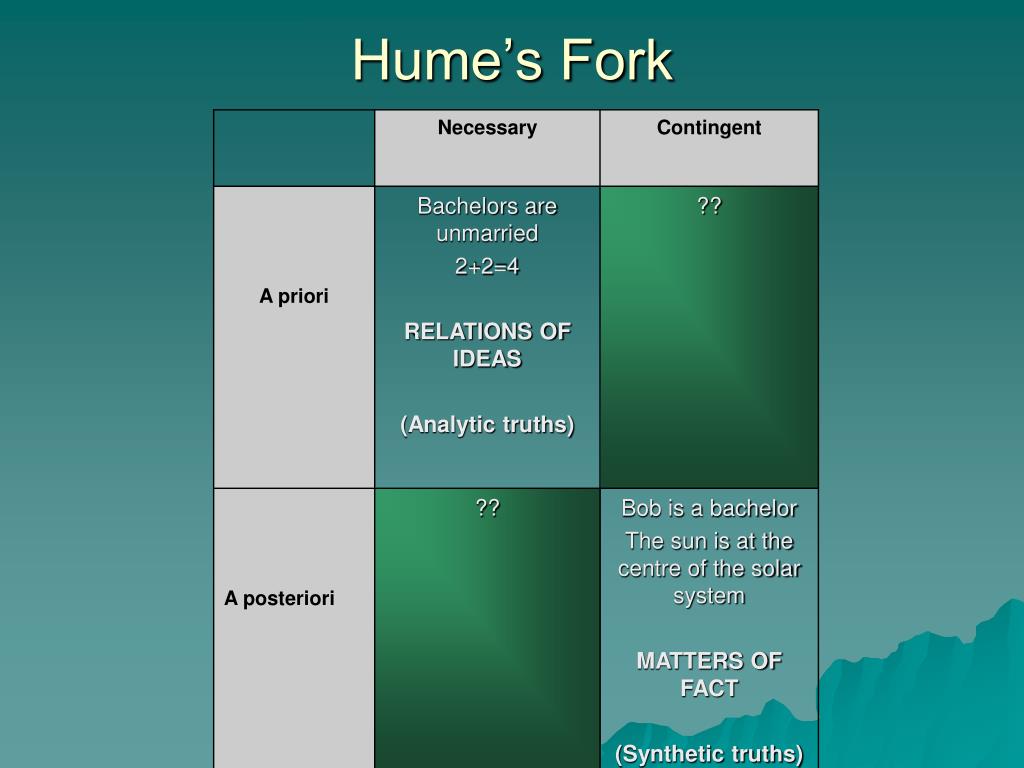
This image provides a helpful visual summary of the fork, connecting it to other important philosophical distinctions that will become central to our study of analytic philosophy.
Test your understanding!
Classify each of the following propositions as either a relation of ideas or a matter of fact. Justify your answer using Hume's key test (i.e., whether its denial implies a contradiction).
- Every effect has a cause.
- A cube has twelve edges.
- Water freezes at 0° Celsius at sea level.
- Either the team will win, or it will not win.
Show answer
- Matter of Fact. This is a tricky one, and it gets to the heart of Hume's later arguments. Can we conceive of an event happening without a cause? Hume argues that we can. We can imagine something popping into existence uncaused. Since its denial is not a contradiction, it cannot be a relation of ideas. Its truth (if it is true) must be established by experience.
- Relation of Ideas. The concept of 'having twelve edges' is part of the definition of a 'cube'. To deny this—to say "I have a cube with eleven edges"—is to state a contradiction. Its truth is known by analyzing the ideas involved, not by counting the edges of physical cubes.
- Matter of Fact. We can easily conceive of a world where the laws of physics are different and water freezes at -10° C. There is no contradiction in this thought. We only know the freezing point of water through repeated observation and experiment.
- Relation of Ideas. This is an instance of the Law of Excluded Middle in logic (). Its truth is guaranteed by the structure of the proposition itself. Denying it—"The team will neither win nor not win"—is a logical contradiction.
Connecting Hume's Fork to Modern Philosophy
Hume's distinction has had a profound influence, prefiguring several key concepts in analytic philosophy. Your goal to specialize in this area makes it worthwhile to see these connections early on.
The paper we just looked at draws these parallels explicitly.
Hume's Fork, and his Theory of Relations
Let's return to the Millican paper to see how Hume's Fork maps onto the modern distinctions that are fundamental to analytic philosophy.
Please read section 7, 'Analyticity, Apriority, and Necessity.' This section clearly defines the pairs: Analytic/Synthetic, A priori/A posteriori, and Necessary/Contingent, showing how Hume bundled them together.
As the reading shows, Hume essentially aligns:
- Relations of Ideas with analytic, a priori, and necessary truths.
- Matters of Fact with synthetic, a posteriori, and contingent truths.
Later philosophers, most notably Immanuel Kant (whom we will study soon), will challenge this neat alignment. The question of whether there can be "synthetic a priori" truths—substantive facts about the world that can be known through reason alone—becomes one of the most important questions in modern philosophy.
Conclusion
In this lesson, we have examined the fundamental tool in David Hume's empiricist toolkit: the distinction between relations of ideas and matters of fact. This "fork" allows him to sort all propositions into two exhaustive and exclusive categories based on a clear test: whether the proposition can be denied without contradiction.
Key Takeaways:
- Relations of Ideas are truths of logic and mathematics. They are necessary, known a priori, and their denial is a contradiction.
- Matters of Fact are truths about the world. They are contingent, known a posteriori (through experience), and their denial is always conceivable.
- This distinction, "Hume's Fork," is foundational to his empiricism and prefigures the crucial distinctions between analytic/synthetic, a priori/a posteriori, and necessary/contingent that are central to analytic philosophy.
Preview of the next lesson:
Now that Hume has established his fork, he can begin to apply it to traditional philosophical beliefs. His first and most famous target is our belief in cause and effect. We all believe that striking a match causes it to light, and that the future will resemble the past. But is this belief a relation of ideas or a matter of fact? In our next lesson, we will analyze Hume's famous problem of induction, a skeptical argument that challenges the rational foundation of all scientific reasoning and everyday inference about the world.