Recommended resources
The freely available resources this lesson will direct you to.
Welcome! This course focuses on chunks: short, reusable groups of words that English speakers use to manage real conversations. In this first module, you will learn to notice that a phrase can do more than carry dictionary meaning. It can also guide the listener, show an attitude, or organize the conversation.
Today’s goal is to distinguish a phrase’s literal meaning from its conversational function in short everyday dialogues. This is an important first step: if you understand only the individual words, fast conversation can sound confusing even when the vocabulary is familiar.
Meaning is not the whole message
When you hear a phrase, listen on two levels:
- Literal meaning: what the words mean individually or as a direct statement.
- Conversational function: what the speaker is doing with the phrase at that moment.
For example:
A: Can you lend me five dollars?
B: Well, I’m not sure if I have any cash.
The dictionary word well can describe doing something successfully:
She sings well.
But in the dialogue, well does not mean “successfully.” It gives B a moment to respond and signals uncertainty or possible reluctance. Its job is to make the answer less abrupt.
Compare a few common chunks:
| Chunk in a dialogue | Literal or basic meaning | Conversational function |
|---|---|---|
| “Well, I’m not sure.” | Not “in a good way” | Begins a hesitant, careful response |
| “So, what are you doing tonight?” | Not always “therefore” | Introduces a question or new point |
| “By the way, are you free Friday?” | The words do not describe a physical route here | Changes to a related or side topic |
| “Let me see…” | “Allow me to look” | Buys thinking time; signals that an answer is coming |
| “Really?” | Really can mean “very” | Shows surprise or asks for confirmation |
| “Right.” | Correctness | Often shows agreement or that the listener is following |
A useful habit is to avoid asking only, “What does this mean?” Also ask:
- Where is the conversation going after this phrase?
- What does the speaker want the listener to understand or do?
- Could I remove the phrase and still keep the basic factual message?
If you remove well from “Well, I’m not sure,” the basic answer remains. But the answer now sounds more direct:
I’m not sure.
The small chunk changes the social feeling of the response. That is conversational function.
Chunks as conversational road signs
Discourse markers are words and phrases that help speakers manage the flow of a conversation. They are like road signs: they tell listeners whether a speaker is beginning, changing direction, hesitating, responding, or finishing.
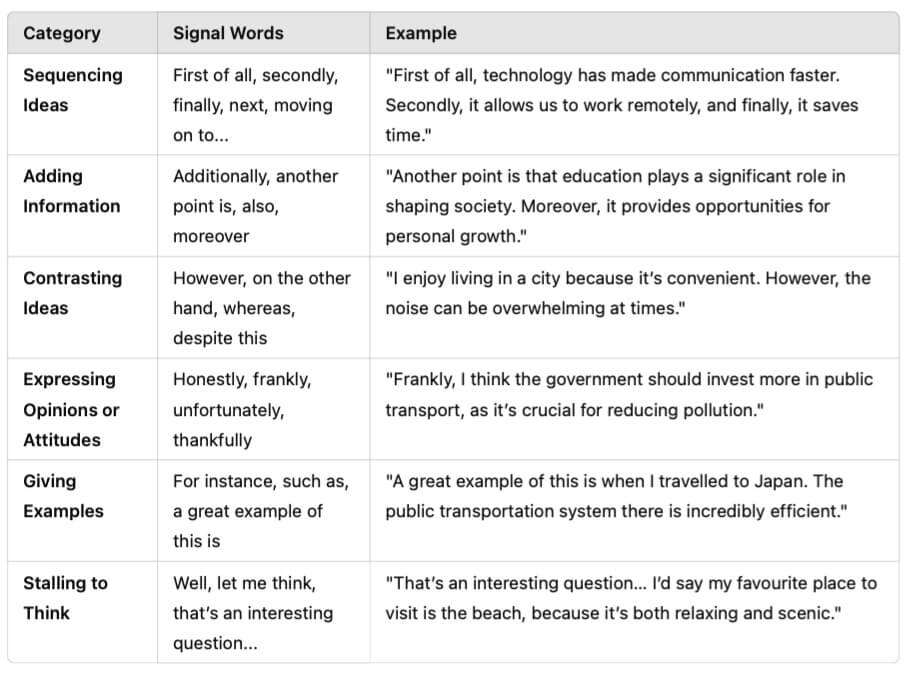
The categories in the image are useful, but do not treat them as rigid rules. A chunk can have more than one function depending on its position, context, and tone. For instance, anyway can help someone return to a topic, change the topic, or begin closing a conversation.
Study how several small chunks organize one short dialogue.
Read this VOA Learning English article to see how familiar phrases such as “hey,” “by the way,” “let’s see,” and “so” guide a conversation. It also introduces short listener responses such as “yeah,” “really,” and “exactly.”
First, read the opening dialogue between the two friends, beginning with the dialogue and explanation. Notice that the phrases do not add many facts; instead, they tell the listener how to follow the exchange. Then find the subsection “Use 4: responding to speaker.” Read the response-marker passage. Focus on the different jobs of “yeah,” “I see,” “really,” “exactly,” and “right”: interest, surprise, and agreement.
In the dialogue from the reading, notice these distinctions:
-
Hey, Tasha!
Hey is primarily an attention-getter and informal greeting. Its conversational function is more important than a dictionary definition. -
By the way, what are you doing tomorrow night?
The speaker is not talking about “a way” or a route. By the way warns the listener: “I’m changing direction slightly.” -
Let me see.
The speaker is not necessarily looking at something with their eyes. The chunk signals, “Give me a moment; I’m remembering or considering.” -
So, there is a book signing tomorrow…
Here, so launches the explanation behind the invitation. It helps the listener connect the question about tomorrow night with the new information. -
Really?
This one-word response can mean “That surprises me” or “Is that true?” Tone helps determine which one. It does not simply mean “very.”
The function is often clear from the speaker’s position in the conversation. A phrase at the beginning of a turn frequently prepares the listener for the kind of response that follows.
One word, several conversational jobs: well
Well is especially useful because its conversational purpose changes with context.
First, compare its ordinary lexical use with its discourse-marker use:
Maya speaks English well.
Well, Maya speaks English, but she is still practicing.
In the first sentence, well tells us how Maya speaks English. It has a direct descriptive meaning.
In the second sentence, well comes at the start. It prepares us for a qualification or contrast: Maya does speak English, but the speaker wants to add an important limit.
Read the following explanation of well in American English.
Using Discourse Markers in American English
This VOA Learning English article focuses on “well,” a very common word whose conversational function depends strongly on context. It is a useful example of why translating one word is not enough.
In the section “The case of ‘well,’” begin with the paragraph “Whatever the case…” and read the transition explanation. Notice how “well” creates a bridge between a question and a careful answer. Then continue with subsection “3. To show a conversation is ending.” Read the closing sequence. Pay close attention to the difference between a calm opening “Well…” and a strongly emphasized “WELL.”
Here are three important conversational uses of well:
1. A careful or uncertain answer
A: Can you come to dinner tonight?
B: Well, I have to work late.
B may be unable to come, but does not say a blunt “No.” Well gives the answer a softer beginning and signals that the response may not be the one A hoped for.
2. Contrast or gentle disagreement
A: This should take only ten minutes.
B: Well, there are a few things we still need to check.
B is not directly saying, “You are wrong.” But well signals that a different view is coming.
3. A possible move toward closing
Well, this has been a productive meeting.
The sentence sounds positive. Yet in context, the speaker may also be suggesting that the meeting is nearly over. The function is indirect: it helps prepare people for an ending without saying, “Stop talking now.”
So do not memorize a single translation for well. Learn a pattern:
Well + answer often signals a careful transition into that answer.
The speaker’s tone matters. A relaxed Well… can sound thoughtful or polite. A heavily stressed WELL can sound impatient or tense. You will study stress and intonation more directly later; for now, notice that the same words can perform different social actions.
Literal phrases, idioms, and conversational actions
Some chunks have a direct literal meaning. Others are idioms, meaning that the intended meaning cannot be worked out word by word. But both types can also have a conversational function.
Consider:
A: Do we need to decide our weekend plan now?
B: No, let’s play it by ear.
Literally, play it by ear sounds connected to music. In conversation, however, it means: “Let’s decide as the situation develops instead of making a fixed plan now.”
Its conversational function in this dialogue is to propose flexibility and reduce pressure to make an immediate decision.
Idioms We ACTUALLY Use in English
Watch “Idioms We ACTUALLY Use in English” by Professor Lao for a clear explanation of “play it by ear.” This example shows the difference between a phrase’s word-by-word image and its established conversational meaning.
Watch “play it by ear”. Focus on the situations in which speakers use the phrase: plans are uncertain, so they choose to decide later. Notice that understanding the idiom also helps you understand the speaker’s practical intention.
Now consider another kind of chunk:
A: The customer was a little upset.
B: That’s putting it mildly.
B is not talking about physically “putting” something somewhere. The established meaning is: “Your description is an understatement; the real situation was more serious.” In the conversation, B’s function is to agree while strengthening A’s statement.
A chunk can therefore have three layers:
| Layer | Example: “That’s putting it mildly.” |
|---|---|
| Word-by-word image | “Putting” something in a mild form |
| Established phrase meaning | The previous statement understates reality |
| Conversational function | Agreeing and emphasizing how serious the situation was |
This is why it is useful to learn chunks as complete units, with a dialogue—not as isolated vocabulary.
A practical method for short dialogues
When you meet an unfamiliar phrase, use this four-part method.
1. Find the phrase boundary
Identify the words that belong together:
- by the way
- let me see
- that reminds me
- to put it mildly
- play it by ear
Do not separate them too quickly. A chunk often has a conventional meaning only when the words stay together.
2. Notice its location
Ask where it appears:
- At the start of a turn: it may open, soften, hesitate, or shift.
- In the middle: it may add, contrast, or explain.
- At the end: it may seek agreement, show uncertainty, or prepare for closing.
3. Identify the surrounding situation
Compare these two uses of right:
Turn right at the pharmacy.
A: So the meeting starts at nine?
B: Right.
In the first sentence, right describes direction. In the second, it responds to another speaker. It means something like “Yes, that is correct” or “I agree.”
4. Name the speaker’s action in simple words
Do not force a word-for-word translation. Use an action label instead:
- getting attention
- buying time
- introducing a point
- changing topic
- showing surprise
- softening disagreement
- signaling an ending
- agreeing
- proposing flexibility
For quick review, keep chunk notes in this format:
| Chunk | Example context | Conversational job |
|---|---|---|
| Well, I’m not sure. | A difficult answer | Hesitate and soften |
| By the way… | A new but related thought | Change direction |
| Let me see… | The speaker needs time | Hold the turn while thinking |
| Really? | New, surprising information | Show surprise or check truth |
| Play it by ear. | Plans are uncertain | Suggest a flexible plan |
For a short daily noticing practice, listen to one English conversation—on a video, podcast, show, or in real life—and write down just two chunks. For each one, record the whole phrase, the surrounding sentence, and the speaker’s job. This will train you to hear conversation as a series of actions, not only as a list of words.
Key takeaways
A phrase’s literal meaning tells you what the words say. Its conversational function tells you what the speaker is doing socially: opening a topic, hesitating, reacting, agreeing, changing direction, or closing.
Remember these core examples:
- Well can signal uncertainty, contrast, or a move toward closing.
- By the way shifts to a side topic.
- Let me see gives the speaker time to think.
- Really? often expresses surprise or asks for confirmation.
- Play it by ear is an idiom meaning to decide as events develop; in conversation, it proposes flexibility.
In the next lesson, you will build on this skill by identifying where chunks begin and end in everyday American English, and by noticing which words receive the strongest stress.