Recommended resources
The freely available resources this lesson will direct you to.
Hello! In our last lesson, we established that electric currents are the source of magnetic fields, using Ampère's Law to calculate the field around a long, straight wire. We now turn to the other side of this interaction: how magnetic fields exert forces on moving charges.
This lesson focuses on the Lorentz force, the fundamental force experienced by a charge moving in a magnetic field. We will cover the force on a single moving particle and then extend that concept to derive the force on a current-carrying wire. Mastering this will be crucial for our later discussions on electric motors and generators.
By the end of this lesson, you will be able to calculate the magnitude and direction of the magnetic force on both individual moving charges and current-carrying wires.
1. The Magnetic Force on a Moving Charge
A magnetic field exerts a force, known as the Lorentz force, on any moving charged particle. A key feature of this force is that it acts only on moving charges; a stationary charge in a magnetic field experiences no force.
Given your background in vector calculus, the most precise way to define the magnetic force on a particle with charge moving with velocity through a magnetic field is using the vector cross product:
This compact equation contains all the information about the force, including its magnitude and direction.
The magnitude of the force is given by:
where is the angle between the velocity vector and the magnetic field vector . Notice two important cases:
- If the charge moves parallel or anti-parallel to the magnetic field ( or ), and the force is zero.
- The force is maximum when the charge moves perpendicular to the field (), as .
The following video provides an excellent visual introduction to this force and the rule for determining its direction.
This video from Bozeman Science introduces the formula for magnetic force and clearly demonstrates how to use the right-hand rule to find the direction of the force.
Watch from 01:26 to the end. Pay close attention to the formula (01:26-02:40), the demonstration of the right-hand rule for positive charges (02:40-04:37), the mention of the left-hand rule for negative charges (04:37-05:07), and the discussion of how the angle heta affects the force's magnitude (05:07-end).
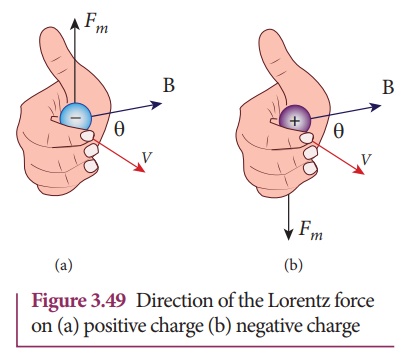
Direction: The Right-Hand Rule
As the video explains, the direction of the force is given by the right-hand rule because of the cross product. The resulting force vector is always perpendicular to the plane formed by and .
Here's the convention for a positive charge :
- Point your index finger in the direction of velocity ().
- Point your middle finger in the direction of the magnetic field ().
- Your thumb will point in the direction of the magnetic force ().
For a negative charge (like an electron), you can use the same rule and then simply reverse the direction of the resulting force, or use your left hand.
An Important Consequence: Magnetic Forces Do No Work
Since the magnetic force is always perpendicular to the velocity , it can change the direction of a particle's motion, but it cannot change its speed or kinetic energy. Recall that the work done by a force is , and power is . Because is perpendicular to , their dot product is always zero.
This is a fundamental property of magnetic forces. They can steer charged particles (as in a particle accelerator) but cannot speed them up or slow them down.
Test your understanding!
An electron ( C) travels at m/s in the positive x-direction into a uniform magnetic field of T pointing in the positive y-direction. What is the magnitude and direction of the force on the electron?
Show answer
First, let's calculate the magnitude. The velocity and magnetic field are perpendicular, so and .
Next, let's find the direction. Using the right-hand rule:
- Index finger (velocity ) points in the +x direction.
- Middle finger (magnetic field ) points in the +y direction.
- Your thumb (force ) points in the +z direction (out of the page).
However, the electron has a negative charge, so we must reverse this direction. The force on the electron is in the negative z-direction (into the page).
2. The Magnetic Force on a Current-Carrying Wire
We can extend the concept of the Lorentz force from a single charge to the macroscopic force on a wire carrying an electric current. A current is simply a flow of many charge carriers.
To make this connection more rigorous, please read the following brief derivation.
This excerpt from MIT's 8.022 course notes provides a concise derivation of the force on a current-carrying wire from the fundamental Lorentz force law. It's an elegant demonstration of building up from micro to macro.
Read the section titled '10.3 Force on a current'. Focus on how the force on a small charge element, dF = dq(v x B), is transformed into an expression involving current, dF = I(dl x B).
As the text shows, by considering the total charge in an infinitesimal segment of wire , we arrive at the differential force:
where is the current and is a vector representing the length and direction of the wire segment.
For a straight wire of length in a uniform magnetic field , we can integrate this to get the total force:
where is a vector whose magnitude is the length of the wire and whose direction is the direction of the current.
The magnitude of this force is:
where is now the angle between the direction of the current and the magnetic field.
Direction and Calculation Methods
The direction of the force on a wire is found using the same right-hand rule as before, with velocity replaced by current direction .
The following video demonstrates this and introduces a powerful alternative method using vector components, which you may find more systematic given your mathematical background.
Magnetic Force on a Current Carrying Wire
This video from The Organic Chemistry Tutor demonstrates how to calculate the force on a wire using two methods: the right-hand rule and the formal vector cross product with i, j, k unit vectors.
Watch the first four minutes (00:00-04:31) to see the standard application of the right-hand rule. Then, watch the segment from 04:31 to 10:02, which explains the vector cross product method. Finally, watch from 17:43 to 21:31 to see how the angle heta affects the force.
The vector method shown in the video is a direct application of the cross product definition:
If and , then can be calculated component-wise. This avoids the potential ambiguity of orienting your hand in 3D space.
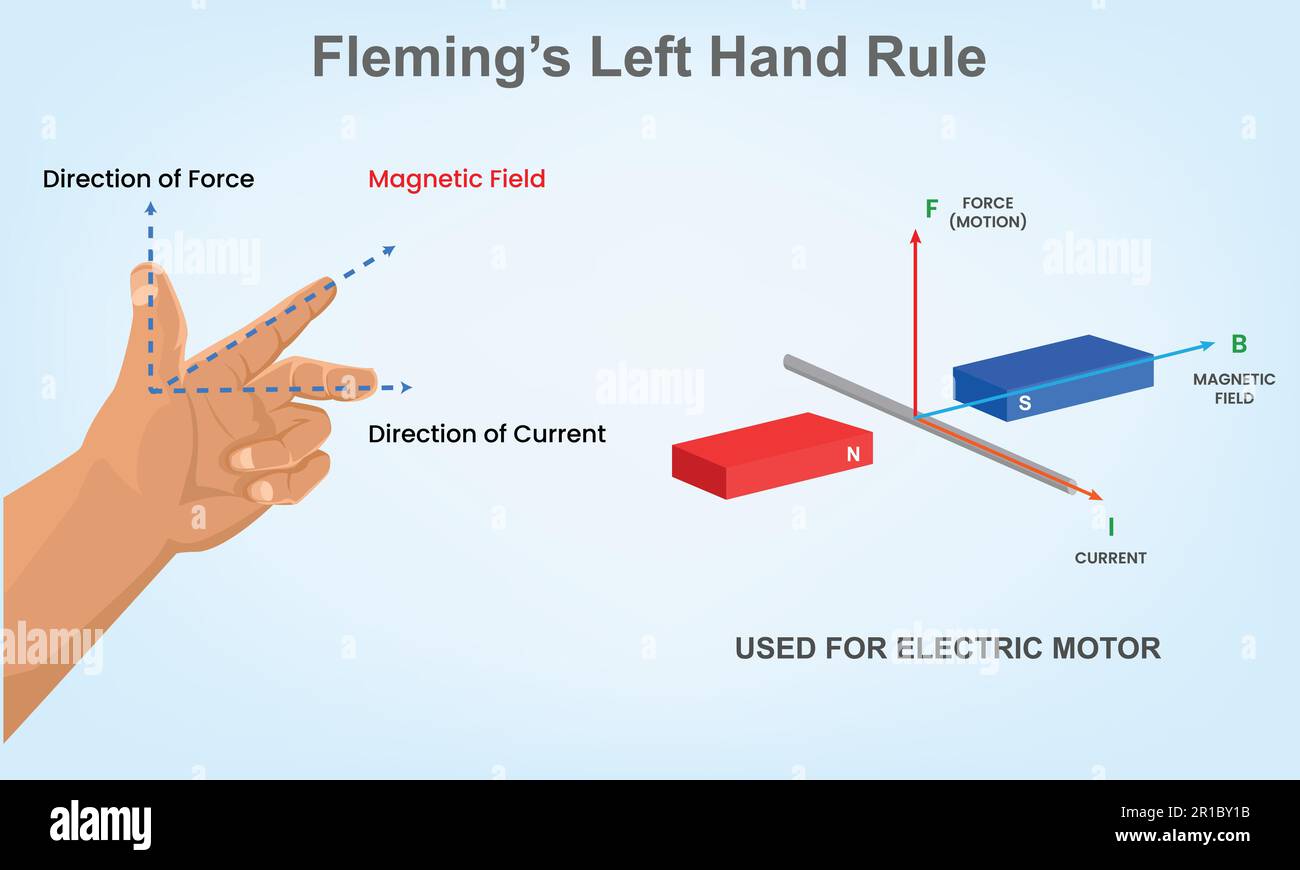
Another common mnemonic is Fleming's Left-Hand Rule, often used in the context of motors. It assigns force, field, and current to the thumb, forefinger, and middle finger, respectively. While useful, it's generally best to stick to one consistent convention based on the mathematical cross product.
3. Application: Force Between Two Parallel Wires
We can now combine what we learned in the last lesson with today's topic. Consider two parallel wires. Wire 1, carrying current , creates a magnetic field . This field then exerts a force on Wire 2, which carries current .
From the last lesson, the magnitude of the magnetic field from Wire 1 at the location of Wire 2 (a distance away) is:
Now, using today's formula, the force on a length of Wire 2 is:
Since the field from Wire 1 is perpendicular to the current in Wire 2, and . Substituting , we get the force per unit length:
What about the direction?
- Parallel Currents (same direction): Use the right-hand rule for the field from Wire 1 (fingers curl around the wire). At Wire 2, the field points into the page. Now use the right-hand rule for the force on Wire 2 (current up, field in), and you'll find the force points towards Wire 1. The wires attract.
- Anti-parallel Currents (opposite directions): The field is still into the page at Wire 2. But now the current is down. The force rule gives a force pointing away from Wire 1. The wires repel.
This interaction was historically used to define the Ampere.
Conclusion
Today we explored the Lorentz force, the crucial link that explains how magnetic fields influence the world of moving charges.
Key Takeaways:
- A charge moving with velocity in a magnetic field experiences a force .
- A straight wire of length carrying current in a magnetic field experiences a force .
- The direction of the magnetic force is always perpendicular to both the velocity/current and the magnetic field, as determined by the right-hand rule.
- A fundamental consequence is that magnetic forces do no work; they can only change the direction of a charged particle's motion, not its speed.
- These principles explain why parallel currents attract and anti-parallel currents repel.
Preview of the Next Lesson:
We have now established that moving a charge through a magnetic field creates a force. In the next lesson, we will see how this very same Lorentz force is the microscopic origin of electromagnetic induction. We will explore how moving a conductor through a magnetic field (or changing the field around a conductor) can induce a voltage and drive a current—the principle that makes electrical generators possible.