Recommended resources
The freely available resources this lesson will direct you to.
Hello! In our last lesson, we established the concepts of the electric field () and electric potential (), and we learned how to calculate them for systems of point charges. We saw that potential is a scalar property of space, making it much simpler to calculate than the vector-based electric field.
Today, we will connect this abstract concept of potential to the concrete, physical quantities of work and energy. This is the heart of why potential is so useful: it's a direct measure of the energy landscape that a charge experiences. By the end of this lesson, you will be able to relate the electric potential difference between two points to the work done in moving a charge between them, fulfilling your goal of understanding electricity in terms of "work done". This forms the theoretical basis for everything from accelerating particles to powering a simple light bulb.
1. From Electric Force to Potential Energy
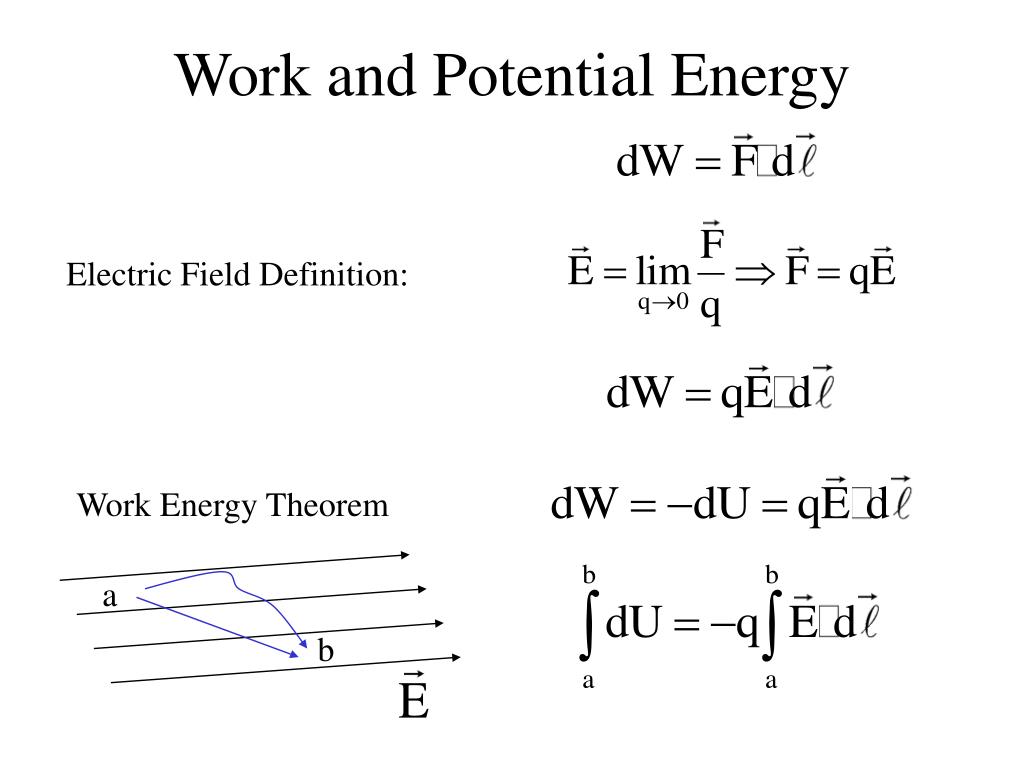
Let's start with a familiar concept from mechanics: work. Work is done when a force causes displacement. For a charge in an electric field , it experiences an electric force . If this charge moves from point A to point B, the work done by the electric field is the line integral of this force along the path of motion:
Your mathematical background will recognize this as a standard work calculation. A key property of the electrostatic force is that it is a conservative force. This means the work done by the field in moving a charge between two points is independent of the path taken. This is a powerful feature, analogous to the gravitational force.
Because the force is conservative, we can define a quantity called electric potential energy, denoted by . The change in potential energy, , is defined as the negative of the work done by the conservative force.
This negative sign is fundamental. Think of gravity: when a ball falls, the gravitational field does positive work, but the ball's gravitational potential energy decreases. The system naturally moves to a state of lower potential energy, and the field does work in the process.
The following reading formalizes this relationship.
7.2: Electric Potential Energy
This resource, from Phys LibreTexts, introduces electric potential energy by defining it in terms of the work done by the electric force.
Please read the introductory paragraphs (under 'Learning Objectives') and the section titled 'Electric Potential Energy'. Focus on the statement that the electrostatic force is conservative and the key relationship it enables: W = -ΔU.
The image below provides a concise mathematical summary of this derivation.
2. Relating Potential Energy to Electric Potential (Voltage)
In the previous lesson, we defined electric potential as electric potential energy per unit charge:
From this, the change in potential energy when a charge moves between two points with a potential difference is simply:
This potential difference, , is what we commonly call voltage.

3. The Work-Potential Relationship
We can now combine the two key equations from the previous sections:
This gives us the central relationship for this lesson:
This equation states that the work done by the electric field on a charge as it moves through a potential difference is .
It's also crucial to distinguish this from the work done by an external agent to move the charge. If we move a charge slowly (i.e., with no change in kinetic energy) against the electric field, we must apply a force that opposes the electric force. The work we do, , is therefore the negative of the work done by the field.
- Work done by the field (): Positive when a charge moves naturally (e.g., a positive charge moving to a lower potential). The field is "helping" the motion. Potential energy decreases.
- Work done by an external agent (): Positive when a charge is forced to move against its natural inclination (e.g., pushing a positive charge to a higher potential). You are "fighting" the field. Potential energy increases.
The following video walks through these concepts, derives the work formula, and provides several examples.
The Organic Chemistry Tutor provides a very clear explanation of the relationship between work, potential, and potential energy. Pay close attention to the derivation and the sign conventions discussed in the examples.
Watch the video from the beginning up to 16:49. This covers the definition of potential, the derivation of W = -qΔV, and several worked examples that illustrate how to apply the formula and interpret the signs of the results.
Test your understanding!
An electron (charge ) is moved from an initial point with a potential of +100 V to a final point with a potential of +20 V.
- What is the potential difference, ?
- What is the change in the electron's potential energy, ?
- How much work was done by the electric field during this move?
- Did the electric field do positive or negative work? Does this make sense physically?
Show answer
-
Potential Difference: .
-
Change in Potential Energy: . The potential energy of the electron increased.
-
Work by the Field: .
-
Interpretation: The electric field did negative work. This makes sense. An electron is a negative charge, so it is naturally attracted to regions of higher potential. Moving it from +100 V to +20 V is moving it away from where it "wants" to go. Therefore, the field opposed the motion, and an external agent must have done positive work to make this happen.
4. Conservation of Energy
The final piece of the puzzle is to connect work to kinetic energy (). The Work-Energy Theorem states that the net work done on an object equals its change in kinetic energy:
If the only force acting on our charge is the electric force, then . We can then write:
Rearranging this gives the law of conservation of energy for a charge in an electric field:
This means any change in kinetic energy is perfectly balanced by an opposite change in potential energy. A charge that is free to move in an electric field will accelerate, converting potential energy into kinetic energy, just as a falling object converts gravitational potential energy into kinetic energy.
This allows us to calculate the final speed of a particle if we know the potential difference it has been accelerated through.
Let's see a complete example that ties everything together. This final segment of the video calculates the work done on a charge and then uses the work-energy theorem to find its final speed.
Please watch from 25:30 to 33:17. This example provides a practical application of the concepts, calculating the work required to move a charge and then determining its final speed after accelerating from rest.
Conclusion
Today we have forged the crucial link between electric potential and the mechanical concepts of work and energy. This connection elevates potential from an abstract mathematical tool to a powerful physical concept that describes the energy landscape for charged particles.
Key Takeaways:
- The work done by the electric field when a charge moves through a potential difference is .
- The work done by an external agent to move the charge against the field is .
- For a charge moving freely in an electric field, energy is conserved: . A decrease in potential energy results in an equal increase in kinetic energy.
- Positive charges naturally accelerate from high potential to low potential.
- Negative charges naturally accelerate from low potential to high potential.
Preview of the Next Lesson:
We have now established the foundations of electrostatics. In the next lesson, we will shift our focus to magnetism. We will start by investigating the source of magnetic fields: moving electric charges, or currents. We will introduce Ampère's Law, which is for magnetism what Coulomb's Law is for electricity, and use it to describe the magnetic field around a current-carrying wire.