Recommended resources
The freely available resources this lesson will direct you to.
- Movement Direction with Vanessa Ewan | Creating Character | National Theatrewww.youtube.com
- Ian McKellen Explains The Difference Between Acting on Stage and In Movies | The Dick Cavett Showwww.youtube.com
- [PDF] Many ways of directing a film: teaching the 'modes of creative practice'centaur.reading.ac.uk
- Desirous Dreams: The feminist erotics of Rebecca Horn's 'Berlin ...www.anothergaze.com
Hello! Welcome back.
In our last lesson, we focused on the crucial art of communication—how to translate your directorial vision into clear, actionable language for a performer. We established that building trust and moving from abstract emotional goals to concrete verbs and objectives is fundamental to any director-performer relationship.
Today, we'll build on that foundation to address the specific learning outcome: Adapt directing techniques for performance-art approaches versus traditional screen acting. This is where your unique artistic goals come sharply into focus. Your interest in Rebecca Horn and the blending of sculpture, performance, and cinema requires a different directorial toolbox than one used for conventional, dialogue-driven narratives. We will explore how to direct performances that are rooted in physicality, gesture, and the interaction between a body and an object.
1. The Spectrum of Performance
First, let's establish a framework for understanding different types of performance. A screen actor's work is often about internal psychology revealed through subtle facial expressions, whereas a stage actor must use their entire body to project to a distant audience. Performance art, especially when filmed, occupies a fascinating space between these two poles.
To explore this distinction, let's hear from an actor who has mastered both stage and screen.
Ian McKellen Explains The Difference Between Acting on Stage and In Movies | The Dick Cavett Show
In this classic interview, Sir Ian McKellen explains the fundamental differences between acting for the stage and for film. This will help us situate the unique demands of filmed performance art.
Watch the segment from 01:02 to 03:58. Pay close attention to his distinction between the 'whole body' being visible on stage and the camera's intimate focus on the face in film.
McKellen's point is key: the medium dictates the actor's tools. Performance art often retains the "whole body" expressiveness of the stage, but the camera allows the audience to witness it with the intimacy of film. Your job as a director is to guide that physical expression and frame it in a way that creates meaning.
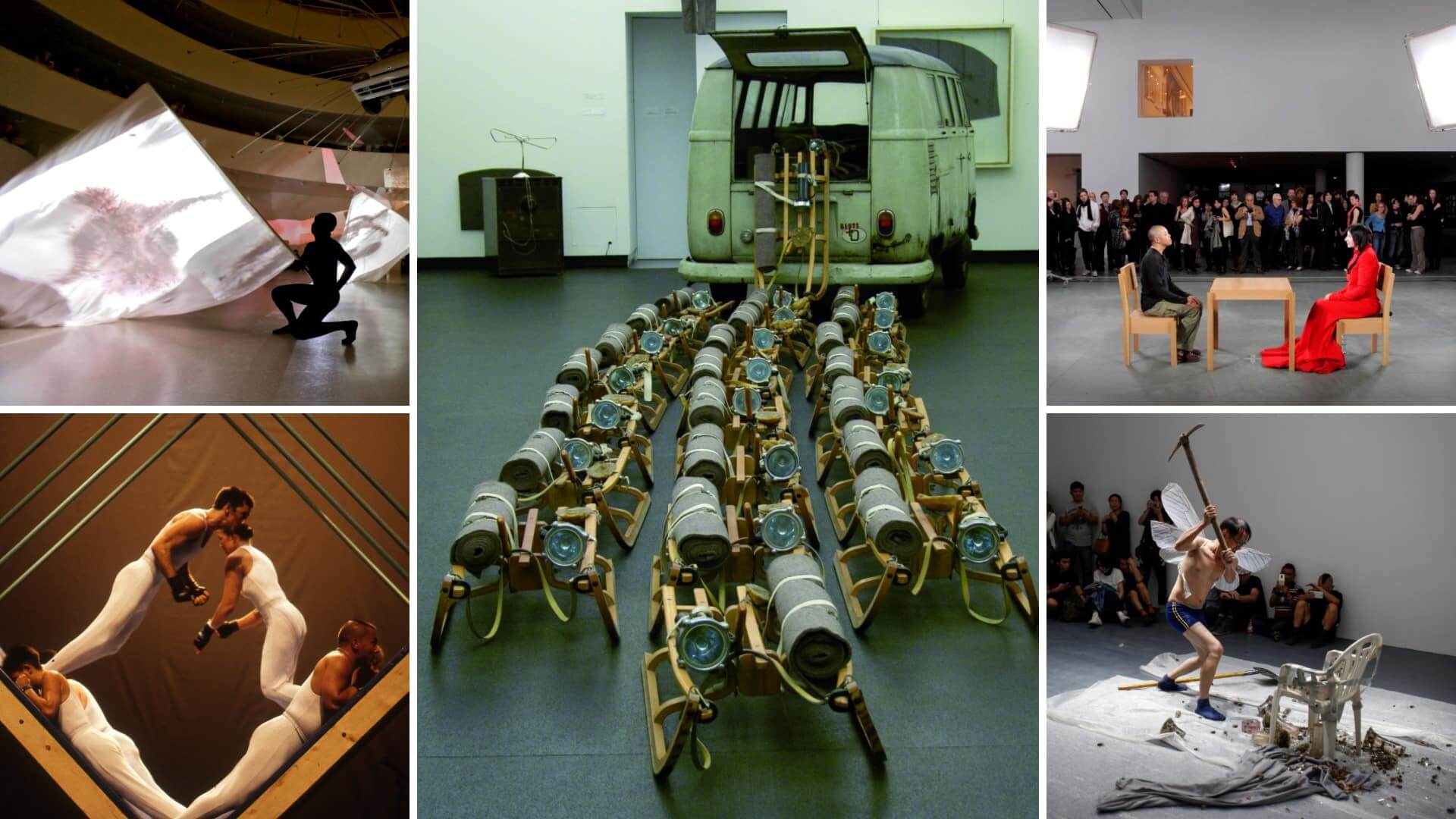
Performance art itself is incredibly diverse, encompassing everything from durational feats of endurance to interactive installations and object-based choreography.
2. Directing Modes: Centering Performance and Design
When the performance isn't driven by a traditional script, the director's creative process must also adapt. An academic paper by Dominic Lees proposes a useful way to think about this, categorizing directing into different "Modes of Creative Practice." Two of these are highly relevant to your work.
The paper 'Many Ways of Directing a Film' offers a theoretical framework for understanding different directorial approaches. We will look at two 'modes' that are particularly suited to experimental and art-based filmmaking.
Please read two sections from this paper (you may need to scroll a bit to find them): Start with 'The Performance-centred Mode of Creative Practice.' This section explores directors like Mike Leigh who build characters and stories through long periods of improvisation and collaboration with actors, often without a finished script. Next, read 'The Design-centred Mode of Creative Practice.' This section is crucial for you, as it describes directors for whom the visual environment—set design, costume, props—is the dominant creative force. As you read, consider how these two modes might merge in a project where a wearable sculpture is the catalyst for the entire performance.
For an artist like Rebecca Horn—and for your own ambition to integrate your textile and sculpture work—the Design-centred Mode is not just an approach; it's the very heart of the creative process. The wearable object is not a mere prop; it is the co-creator of the performance. It dictates the performer's movement, limitations, and expressive possibilities. Your direction, then, becomes about facilitating the dialogue between the performer and the object.
3. Case Study: Directing the Body with Rebecca Horn
Rebecca Horn is the quintessential example of an artist whose work lives at the intersection of the Performance-centred and Design-centred modes. Her "body-sculptures" are prosthetic extensions that both constrain and redefine the performer's body, generating a unique physical language.

In this kind of work, the director doesn't ask, "What is your character's motivation?" Instead, you ask, "What does the sculpture make you do? How does it feel? What new sensations or limitations does it create?" The performance emerges from a physical exploration, not a psychological one.
Let's dive deeper into how Horn achieved this in her film Berlin Exercises.
Desirous Dreams: The feminist erotics of Rebecca Horn's 'Berlin ...
This article, 'Desirous Dreams: The feminist erotics of Rebecca Horn's Berlin...', provides a detailed analysis of Horn's performative filmmaking. It gives us a direct window into how she 'directs' these interactions.
Read the sections analyzing two specific performances: The analysis of 'Two hands scratching both walls', which demonstrates how an object creates a task that becomes the performance. The analysis of 'Keeping those legs from fucking-around', which explores how an object (magnets) creates a system of co-dependence and physical struggle between two performers. Focus on how the rules and physical properties of the objects generate the entire dramatic and thematic content of the scene.
As the article shows, Horn’s direction is process-oriented. She creates a situation, introduces an object with specific properties (long fingers, magnets), and the performance becomes the documentation of the performer navigating that situation. The emotion is not "acted"; it is produced as a genuine byproduct of the physical effort, frustration, or connection experienced during the task.
4. A Toolbox for Physical Direction
So, how do you translate these ideas into practical directing techniques? While traditional actors often work from the "inside out" (finding an emotion to motivate an action), performance-art approaches often work from the "outside in" (using a physical action to generate an emotion).
This video from the National Theatre, though focused on creating a character for a play, is full of brilliant "outside-in" techniques that are directly applicable to performance art.
Movement Direction with Vanessa Ewan | Creating Character | National Theatre
In 'Movement Direction with Vanessa Ewan,' we can see a master coach using physical tasks and concepts to help an actor transform. These are precisely the kinds of techniques you can use to direct non-traditional performance.
Watch the following three segments: Laban Efforts (01:39 - 03:10): Notice how she uses abstract movement qualities like 'floating' and 'flicking' to generate a physical tick for the character. Animal Studies (03:10 - 04:56): See how studying a horse's physicality provides movement ideas that are authentic and non-human. Costume (06:13 - 08:00): This is especially relevant for you. Observe how she directs the actor to discover how the costume restricts or enables movement, letting the garment 'teach' them about the character.
Let's synthesize these ideas into a new set of tools to add to your directing kit:
-
Direct the Task, Not the Feeling: Give the performer a clear, physical objective related to an object or the space.
- Instead of: "Feel trapped."
- Try: "Find all the ways this sculpture prevents you from standing up straight."
-
Set Up a Rule or Process: Define a simple set of rules and let the performer execute them. The drama comes from the struggle and variation within the execution.
- Example: "You must always maintain contact with the wall," or "You must cross the room without letting the objects touch."
-
Use External Metaphors (Animals, Elements): Give the performer a physical quality to embody that is separate from human psychology.
- Examples: "Move as if your limbs are branches in the wind," or "Explore the twitchy, sudden movements of a bird."
-
Direct the Senses: Focus the performer’s attention on a sensory experience.
- Examples: "Focus only on the sound the fabric makes against the floor," or "Concentrate on the feeling of cold metal against your skin."
Practical Exercise: Directing "Shed" (Revisited)
Let's return to the scenario from your film "Shed," where a performer is wearing your "mechanical chrysalis" sculpture.
Scenario: You are filming the moment where the performer, after struggling, finally begins to move with the sculpture instead of against it. You want to capture a sense of discovery and symbiosis. In the last lesson, we approached this from a psychological angle. Now, let's use a performance-art approach.
Your Task (15 minutes):
Write 3-4 examples of directing prompts you would give the performer to achieve this symbiotic moment. Base your prompts on the physical, task-based, "outside-in" techniques we've explored in this lesson. Avoid any notes that ask for a specific emotion.
Conclusion
Adapting your directing style for performance art is less about abandoning the principles of good communication and more about shifting your focus. Instead of directing an actor’s internal world of thought and feeling, you become a choreographer of physical tasks, a setter of rules, and a keen observer of the emergent story that unfolds when a body interacts with an object or a space. The emotion becomes an authentic discovery, for both the performer and the audience.
Key Takeaways:
- Performance art often combines the full-body expressiveness of theatre with the intimacy of the film camera.
- Your directorial approach can merge the Performance-centred Mode (improvisation, devising) with the Design-centred Mode (letting objects and costumes drive the action).
- Directing physical performance is often about working from the "outside in."
- Your toolbox should include directing tasks, setting rules, using physical metaphors (like animals), and focusing on sensory experience.
What's Next?
We've now established the broad strategic differences between directing traditional acting and performance art. In the next lesson, we will get even more granular. We will focus on the specific learning outcome: Direct body movement and gesture as expressive tools, drawing on performance art traditions. We'll move from the "how-to" of setting up a performance to the "what-to-look-for" in the subtle language of the body itself.