Recommended resources
The freely available resources this lesson will direct you to.
Welcome back. In our previous lesson, we explored the Enlightenment, the 17th and 18th-century intellectual movement that championed reason and individual autonomy. We saw how thinkers of this era began to question traditional sources of authority and developed revolutionary political concepts like individualism, the social contract, and, most importantly for our purposes, natural rights.
This lesson zeroes in on the single most influential philosopher for the libertarian tradition: John Locke. As we previewed, his work provides the direct philosophical DNA for modern libertarianism. Our goal is to understand his foundational theory of natural rights, specifically the famous triad of life, liberty, and property. We will examine what these rights are, where Locke believed they came from, and why they are considered "natural."
The Radical Idea of Natural Equality
Before Locke, the dominant political theory in Europe was the divine right of kings. It held that monarchs derived their authority directly from God, and that society was a natural hierarchy where some were born to rule and others to serve. Rights were not seen as inherent possessions of individuals, but as privileges granted by a ruler.
Locke's first and most radical move was to reject this entire framework. He argued that all people are born with the same moral status. To see how revolutionary this was, let's start with a short video that sets the scene.
Essential John Locke: Natural Freedom and Rights
This video from The Fraser Institute, "Essential John Locke: Natural Freedom and Rights," clearly explains the shift from a world of natural hierarchy to Locke's idea of natural equality.
Please watch the entire video. It's quite short. Pay close attention to: The description of the pre-Lockean world, where rights were granted by authorities. Locke's core argument that everyone is born with the same moral status and therefore the same rights. The simple but effective example of Gary the farmer and King Louie, which illustrates that rights belong to all human beings, regardless of their station in life.
Locke's assertion that a poor farmer has the same fundamental rights as a king was a direct challenge to the established order. But if rights don't come from a king or government, where do they come from? To answer this, Locke uses a thought experiment: the state of nature.
The State of Nature and the Law of Nature
When political philosophers talk about a "state of nature," they are imagining what human life would be like without any government or civil society. For some, like Thomas Hobbes, this was a terrifying vision of a "war of all against all." Locke's view was profoundly different.
Locke believed the state of nature was generally peaceful and governed by natural law. This isn't a set of laws written in a book, but a universal moral code, given by God, that all human beings can discover through the use of their reason.
Let's read a short passage that explains this foundational concept.
Locke's State of Nature: A State of Peace and Reason - PolSci Institute
This article from the PolSci Institute provides a clear description of Locke's state of nature and the natural law that governs it.
Please read the first two sections. Start with the first two paragraphs under the heading "What is Locke’s state of nature?" to understand his vision of a pre-political society characterized by freedom and equality. Then, read the section "The role of natural law in governing human behavior." This explains that natural law is a moral code accessible through reason.
The core idea is this: even without government, we are not without rules. Our ability to reason tells us that other people are fundamentally like us—they also want to survive and be free. This rational insight leads to the central principle of natural law: that because all people are equal and independent, no one ought to harm another. It is from this fundamental law of nature that specific natural rights are derived.
The Three Natural Rights: Life, Liberty, and Property
Natural law gives rise to specific, inalienable rights that belong to every individual. For Locke, the three most fundamental are the rights to life, liberty, and property. These are not granted by government; they are rights you possess simply by virtue of being human.
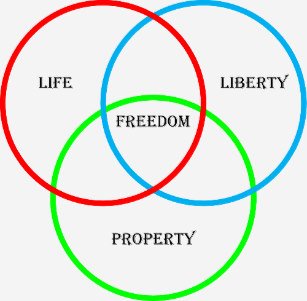
Let's break down each of these rights.
Exploring Locke's State of Nature and Natural Rights Theory
This article clearly defines natural law and then details each of the three primary natural rights that flow from it.
First, read the brief section on the role of natural law. Next, read the sections that define each of the three rights: Start with the introductory paragraph on natural rights. Read "The right to life." Read "The right to liberty." Read "The right to property."
Let's summarize and reinforce these crucial concepts.
-
The Right to Life: This is the most basic right. It is the right to self-preservation and to not be killed or harmed by others. For Locke, this had a theological basis: since we are created by God, we are His property. Therefore, harming another person is an offense against God, not just the individual. Suicide is similarly a violation of the law of nature because you are destroying God's property.
-
The Right to Liberty: This is the right to be free from the arbitrary will of another person. It means you are free to act, order your possessions, and live as you see fit, so long as you do not violate the equal rights of others. Critically, Lockean liberty is not license (the freedom to do anything you want). It is freedom within the bounds of natural law. Your freedom ends where someone else's rights begin.
-
The Right to Property: This is the right to enjoy the fruits of your own labor. When you apply your effort to the natural world—by picking an apple, tilling a field, or building a chair—you mix your labor with it and make it your own. This right is arguably the most distinctive and controversial element of Locke's philosophy, and it is so central to libertarianism that we will dedicate our entire next lesson to exploring its justification.
A passage from Locke's Second Treatise of Government perfectly summarizes the binding nature of these rights. A short video clip explains this key text.
John Locke - Second Treatise | Political Philosophy
This segment from James Muldoon's analysis of Locke's "Second Treatise" quotes and explains the most famous passage on the law of nature.
Please watch the clip from Locke on the law of nature. The narrator states Locke's conclusion: "being all equal and independent, no one ought to harm another in his life, health, liberty, or possessions."
This single sentence is the philosophical heart of the matter. It is the command, derived from reason, that obligates every person to respect the natural rights of every other person. It is the foundation upon which Locke, and later libertarians, would build a theory of legitimate government.
Conclusion
In this lesson, we have moved from the general Enlightenment concept of natural rights to the specific and powerful formulation developed by John Locke. His ideas represented a seismic shift in political thought, moving the source of rights from the whim of kings to the very nature of the human individual.
Here are the key takeaways:
- Locke rejected the idea of a "natural hierarchy" and argued that all individuals are born free and equal in a state of nature.
- This state of nature is governed by natural law, a universal moral code discoverable by reason, which dictates that no one should harm another.
- From this law, Locke derives three fundamental and inalienable natural rights:
- Life: The right to self-preservation.
- Liberty: The freedom to act without violating the rights of others.
- Property: The right to own the products of your labor.
You now understand the essential rights that form the ethical core of libertarianism. As you have seen, the right to property is a crucial component of this triad. In our next lesson, we will investigate it in much greater detail by exploring Locke's labor theory of property, which seeks to explain exactly how individuals can justly come to own parts of the natural world.