Recommended resources
The freely available resources this lesson will direct you to.
Welcome to the next step in our exploration of John Locke's political philosophy. In our last lesson, we examined how Locke justifies private property through labor and the two crucial constraints he places on this right: the sufficiency and spoilage provisos. This raised a natural question: if people have rights to life, liberty, and property in the state of nature, why would they ever choose to leave it and form a government?
This lesson answers that very question. We will investigate one of the most powerful and influential ideas in the history of political thought: Locke's argument that all legitimate government must be founded on the consent of the governed. You will learn why individuals would voluntarily agree to create a state and what this agreement implies about the nature and limits of political power. Understanding this concept is essential, as it forms a direct bridge between Locke's 17th-century ideas and the core principles of modern libertarianism.
The Inconveniences of the State of Nature
As we've discussed, Locke's state of nature is not the brutal "war of all against all" that Thomas Hobbes imagined. It is a state of liberty governed by the law of nature, where individuals are free and equal. However, it is not a paradise. Locke argues that the state of nature suffers from several "inconveniences" that make the enjoyment of one's rights uncertain and insecure.
What are these inconveniences? A short video segment explains them with excellent clarity.
John Locke - Second Treatise | Political Philosophy
This video, "John Locke - Second Treatise" from the James Muldoon channel, breaks down the three specific problems that arise in the state of nature, compelling people to seek a more organized society.
Please watch from the three reasons for forming a political society. As you watch, identify the three key things that are missing in the state of nature.
As the video explains, even with the law of nature to guide them, people in the state of nature lack three crucial mechanisms:
- An established, known law: While the law of nature exists, people may be ignorant of it or interpret it with bias in their own favor.
- A known and impartial judge: When disputes arise, each person is their own judge and jury. It is difficult for people to be objective when their own interests are at stake.
- The power to execute the law: Even if a just verdict is reached, there is no reliable power to enforce it and punish wrongdoers. An individual may be too weak to punish a powerful offender.
These inconveniences mean that while you have natural rights, they are constantly under threat. Your life, liberty, and especially your property are not secure. This insecurity is the primary motivation for individuals to create a political society.
The Social Contract: Trading Power for Security
To escape these inconveniences, Locke argues that free and equal individuals voluntarily come together to form a social contract. This is not a contract with a ruler, but a contract with each other to form a single political community. By doing so, they agree to give up one of their natural rights: the right to personally execute the law of nature (i.e., the right to be their own judge and enforcer).
They transfer this power to the community as a whole, which then establishes a government to act as an impartial referee. The government's sole purpose is to protect the rights that individuals retain: life, liberty, and property.
This exchange is the heart of Locke's social contract theory. The following diagram provides a simple but effective visual summary of this trade-off.
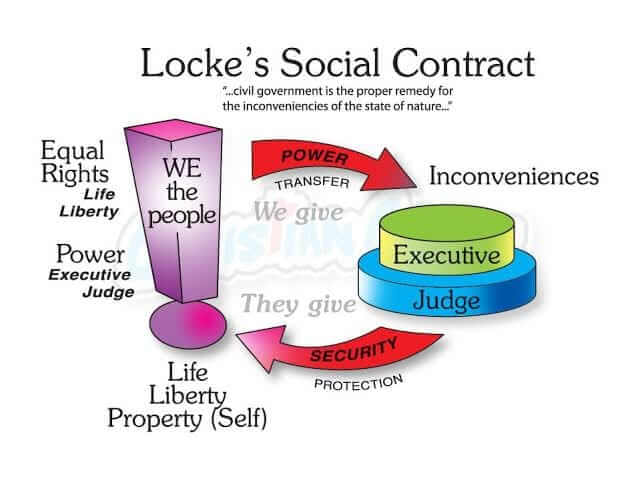
The crucial point here is that the government's authority comes from the consent of the people. This was a radical departure from the dominant theory of Locke's time, the divine right of kings, which held that a monarch's power came directly from God and could not be questioned.
To see why consent is the only legitimate basis for government, let's turn to a reading that puts this idea in its historical context.
An Introduction to Locke's Two Treatises | Libertarianism.org
This article from Libertarianism.org explains precisely why people create a state and explicitly grounds legitimate authority in consent.
Please read the section titled "Legitimate Authority". Pay close attention to the quote from Locke himself, which is one of the most famous statements of this principle.
As the article states, because all individuals are naturally free, no one can be subjected to the political power of another without their own consent. Any government that rules by force, without the consent of its people, is illegitimate.
What Counts as "Consent"?
This raises a practical question. Most people in modern societies have never been asked to sign a contract or take an oath to join their country. So, in what sense have we actually "consented" to be governed?
Locke addresses this by distinguishing between two types of consent: express consent and tacit consent. Understanding this distinction is key to seeing how his theory applies to the real world.
The Role of Consent in Locke's Political Philosophy
This article from the PolSci Institute is dedicated to explaining this core concept and provides clear definitions for both types of consent.
Please read from the beginning of the article down to the end of the section titled "The practicality of tacit consent". Focus on the definitions of express and tacit consent and why Locke needed the latter idea to make his theory work.
Let's break down these two forms of consent:
- Express Consent: This is a direct, explicit, and unambiguous act of agreement. For example, taking an oath of citizenship upon immigrating to a new country would be a form of express consent.
- Tacit Consent: This is an indirect or implied form of consent. Locke argues that a person gives their tacit consent simply by living within a territory and enjoying the benefits of its government. If you own property, travel on the roads, or are otherwise protected by the laws of a society, you are implicitly consenting to obey those laws and be subject to that government.
The idea of tacit consent is Locke's solution to the problem that most people are simply born into a society. While this concept has been debated by philosophers for centuries, it remains a powerful attempt to ground political obligation in the voluntary agreement of the individual, even if that agreement is silent.
The Right of Revolution: The Ultimate Consequence of Consent
If a government's legitimacy comes from the consent of the governed, it follows that this legitimacy is conditional. The people entrust power to the government for a specific purpose: the protection of their rights. What happens if the government breaks that trust and starts violating those rights instead?
For Locke, the answer is clear: the government becomes tyrannical and loses its legitimacy. By breaking the social contract, the rulers place themselves in a state of war with the people. When this happens, the people have the right to withdraw their consent and, if necessary, to overthrow the government and establish a new one.
John Locke - Second Treatise | Political Philosophy
Let's return one last time to the video "John Locke - Second Treatise". This final segment discusses the radical implications of grounding government in consent.
Please watch the portion of the video discussing the dissolution of government. Pay attention to who Locke considers the real "rebel" when a government becomes tyrannical.
This "right to revolution" is the ultimate backstop against tyranny in Locke's system. It's not a right to be exercised for minor mistakes or "every little mismanagement." But when there is a "long train of abuses" all pointing toward the subversion of the people's rights, the people are justified in taking back the power they originally delegated. This idea would, of course, be famously invoked by American revolutionaries in their Declaration of Independence.
Conclusion
In this lesson, we have seen Locke's powerful argument for why and how a legitimate government is formed. Far from being a divine or natural institution, government is an artificial creation, a tool invented by people for a specific purpose.
Here are the essential takeaways:
- People leave the state of nature to escape its "inconveniences"—the lack of a common law, an impartial judge, and the power to enforce justice—which make their natural rights insecure.
- They form a government through a social contract, giving up their individual power to enforce the law of nature in exchange for the security of having a government do it for them.
- The only legitimate basis for this government is the consent of the governed.
- This consent can be express (a direct agreement) or tacit (implied by living in and benefiting from a society).
- Because government is based on a trust, if it acts tyrannically and violates the rights it was created to protect, the people have the right to revolution.
These ideas—that rights come first, and that governments are limited institutions created by consent to protect those rights—are the foundation upon which much of modern libertarian thought is built.
In our next and final lesson on Locke, we will summarize his key contributions and trace a direct line from his writings to the core principles that define the libertarian movement today.