Recommended resources
The freely available resources this lesson will direct you to.
- Net force | Movement and forces | Middle school physics | Khan Academywww.youtube.com
- Newton's Second Law of Motion - Force, Mass, & Accelerationwww.youtube.com
- Newton's first and second laws (article) - Khan Academywww.khanacademy.org
- What is resultant force and acceleration in GCSE Physics? - BBC Bitesizewww.bbc.co.uk
Welcome back! In the previous lesson, you combined forces to find their net force: zero when they balance, or pointing in a particular direction when they do not. Now comes a different question. If you know the net force, what can you predict about an object’s motion?
The key is to distinguish the way an object is moving now from the way its motion is changing. You’ll use that distinction to predict whether an object starts moving, speeds up, slows down, or turns.
A net force changes motion
Picture a box resting on a floor. Gravity pulls down, and the floor pushes up. If those forces balance, the box remains at rest. Now picture a box already moving steadily in a straight line. If the forces on it balance, it continues at the same speed in the same direction. A zero net force does not mean “no motion”; it means no change in motion.
Read the box examples in Khan Academy’s Newton’s first and second laws. They connect balanced forces to both a stationary object and a moving one.
Newton's first and second laws (article) - Khan Academy
Read Khan Academy's box examples to see why balanced forces can accompany either rest or steady motion.
In “Newton's first law,” begin with the paragraph about a delivered box, starting the box examples, and stop at the statement that velocity remains constant, just before the boxed equation. Focus on what the resting box and the box moving in the truck have in common. You can leave the later “Inertial reference frames” section for another time.
Physicists use velocity to describe both how fast an object moves and its direction of travel. An object’s velocity changes if it speeds up, slows down, or turns. That is why a force can change motion without necessarily making something go faster.
When the net force is not zero, the object’s velocity changes in the direction of that net force. This change in velocity is called acceleration. The word has a broader meaning in physics than it often has in everyday speech: slowing down and turning also count as acceleration.
Read the lifting-box example for the crucial distinction between an object’s velocity and its acceleration.
Newton's first and second laws (article) - Khan Academy
Continue the Khan Academy article to establish what the net force's direction tells you—and what it does not.
In “Newton's second law,” begin with the lifting example, starting the lifting example. Read through the “Direction of acceleration” subsection and stop just before Question 3. Focus on the statement that acceleration points with the net force, while velocity need not. The later “Magnitude of acceleration” subsection is not needed for these qualitative predictions.
If the box starts at rest and has an upward net force, it begins moving upward. But if it is already falling, an upward net force does not make it jump upward instantly. It first changes its downward velocity: the box slows as it falls. To predict its motion, you need both the net force’s direction and what the box was doing beforehand.
Speeding up and slowing down
Consider a shopping cart already rolling to the right. If a person pushes it rightward with more force than any opposing forces, its net force is rightward. Its motion changes rightward too, so it speeds up. If the opposing forces are larger instead, the net force is leftward while the cart still rolls rightward. The cart slows down. If that leftward net force continues long enough, the cart can stop and then begin moving left.
Watch the following portion of Newton’s Second Law of Motion – Force, Mass, & Acceleration from The Organic Chemistry Tutor. It compares forces pointing with, against, and across an object’s current motion.
Newton's Second Law of Motion - Force, Mass, & Acceleration
Watch how the object's existing direction of travel changes the prediction you make from a net-force arrow.
Watch motion and force. First, compare the rightward-moving objects with rightward and leftward net forces. Then watch the sideways-force example as preparation for the next section. When the video discusses sideways force, distinguish changing direction from changing speed.
Here is a useful check on what a force diagram alone can tell you. In the image, the green sum of forces arrow points right. That establishes the cart’s direction of acceleration, but the image does not show whether the cart is currently moving right, moving left, or at rest.
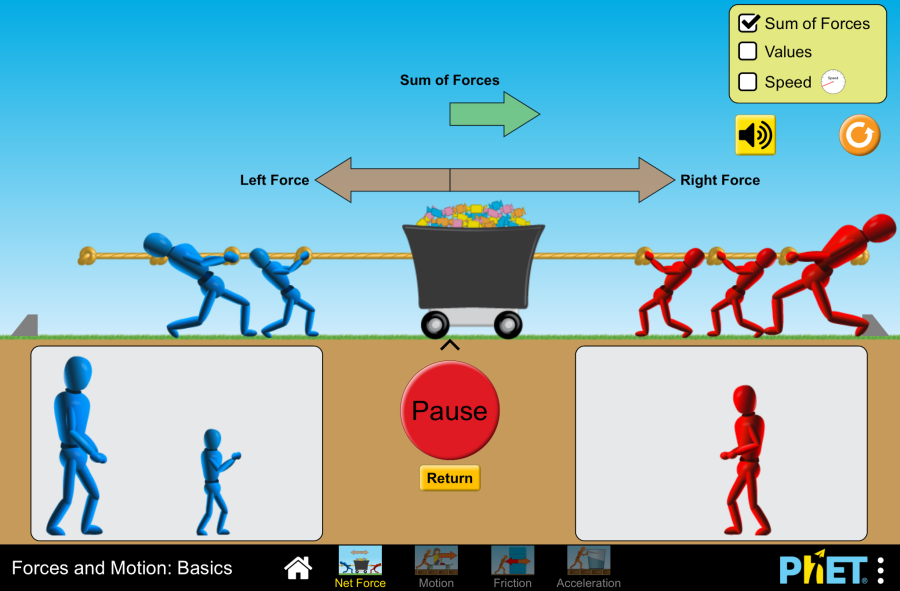
For this cart, a rightward net force means it would speed up if already moving right, slow down if moving left, or start moving right if at rest. Those are different predictions from the same net-force direction because the starting motions differ.
An upward-thrown ball offers another example. After it leaves your hand, gravity pulls downward. Ignoring air resistance, its net force is downward even while the ball is still rising. It slows on the way up; at the top it is momentarily at rest; then it moves downward and speeds up. The downward net force did not change direction at the top—the ball’s motion did.
What if the net force points sideways?
So far, motion and net force have pointed along the same line. Now imagine a small ball rolling rightward across a smooth tabletop. If it experiences a net force toward the far side of the table, its motion begins to bend toward that side. It does not need to stop moving right before it can turn: the force changes its velocity in the sideways direction.
At the instant the net force is exactly perpendicular to the ball’s motion, it changes the direction of velocity rather than its speed at that instant. Do not interpret that as “no acceleration”—a change of direction is acceleration. Nor does it guarantee the speed will stay constant later. If the force keeps pointing toward the far side while the ball turns, the force will no longer be exactly perpendicular to its new direction of travel.
This completes the qualitative rule. Acceleration points in the direction of the net force; velocity does not have to. A net force pointing partly along an object’s motion and partly sideways can change both its speed and its direction. You do not need to calculate a diagonal force to recognize those two effects.
To make a prediction in any of these situations, first identify the net force, not just one push or pull. Then establish whether the object is at rest or moving, and in which direction. Finally, compare that existing motion with the net force. If the net force is zero, predict no change in velocity; if it is not zero, predict a change in velocity toward the net force’s direction.
Key takeaways
A net force tells you how motion changes, not necessarily which way an object is moving right now. With zero net force, an object stays at rest or continues at constant speed in a straight line. A net force in the direction of travel makes it speed up; one opposite to travel makes it slow down; one sideways to travel makes it turn. An object initially at rest begins moving in the net force’s direction.
Next, you’ll look more closely at why objects keep their state of motion unless a net force changes it, using the experience of a sudden stop in a vehicle.