Recommended resources
The freely available resources this lesson will direct you to.
- What is Force? Contact and Non-Contact Force (Grade 3, 4 & 5) | Science for Kidswww.youtube.com
- GCSE Physics - Contact & Non-contact Forces (2026/27 exams)www.youtube.com
- Introduction to forces - Forces and movement - KS3 Physicswww.bbc.co.uk
- Physics Tutorial - Newton's Laws - Forces and Its Representation - The Meaning of Forcewww.physicsclassroom.com
Hello! In this first lesson of Motion and Forces Around Us, you’ll begin with a question that applies to nearly every everyday scene: What is pushing or pulling this object, and what is doing the pushing or pulling? You’ll learn to identify common forces and distinguish those that require contact from those that can act across a gap. Later lessons will build on this to examine how forces affect motion.
A force belongs to an interaction
A force is a push or pull on an object due to its interaction with something else. A hand can push a box; a rope can pull a bag; Earth can pull a falling ball. In each description, there is an object receiving the force and a source exerting it.
That source matters more than whether the object is moving. A book resting on a table still experiences forces: Earth pulls it downward, and the table pushes it upward. Nor must a push make something move: you can push against a wall without moving it.
Forces have directions and can be measured in newtons, abbreviated N. For now, you do not need to calculate their sizes. The useful question is: Which other objects are exerting forces on the object I’m considering?
Every force falls into one of two categories:
- A contact force requires physical interaction at the object’s surface.
- A non-contact force can act even when the source and object are separated.
Watch this short explanation before looking more closely at familiar situations.
GCSE Physics - Contact & Non-contact Forces (2026/27 exams)
Watch “GCSE Physics - Contact & Non-contact Forces” from Cognito for a visual introduction to the two categories and their common examples.
Begin with the distinction between contact and non-contact forces. Continue through contact examples, paying particular attention to why air resistance counts as contact. Finish with distant forces: gravity, magnetism, and electrostatic force. As you watch, identify what exerts each force, not just its name.
Forces that require contact
Imagine pushing a box across a floor. Your applied force on the box is a contact force because your hand touches it. The floor also touches the box. It pushes on the box with a normal force, directed away from the floor’s surface. Meanwhile, friction from the floor resists the box sliding across it.
These are distinct forces, even though several involve the same box. To identify each one, name both its source and its effect: the hand pushes the box; the floor supports it; the floor resists its sliding. Earth also pulls the box downward, but that force belongs in the other category.
Other contact forces appear when the touching object changes. A taut rope pulls an attached bag with tension. A compressed or stretched spring pushes or pulls an attached object with a spring force. Water pushes upward on an immersed object; this upward force is called upthrust or buoyancy.
Air resistance can seem like an exception because air is invisible. It is not: air is matter, and moving through it involves interaction with air particles. A cyclist moving through still air, for example, experiences air resistance opposing that motion.
Contact alone does not mean that every possible contact force is present. A box sitting undisturbed on a level floor has a normal force from the floor, but you should not automatically add friction. Look for a reason the surfaces would slide, or tend to slide, past one another.
Forces that can act across a gap
Earth’s gravitational force pulls objects toward it. Near Earth’s surface, we call this force on an object its weight. It acts on a ball while the ball is in the air—and on a book while the book is on a table. The table touching the book does not turn gravity into a contact force: gravity would still act if the table were removed.
A magnetic force can act between magnets, or between a magnet and a suitable magnetic material such as iron, without their touching. Depending on the objects involved, magnetic forces can attract or repel. An electrostatic force can likewise attract or repel charged objects across a gap; a rubbed balloon attracting hair is a familiar example.
The illustration below groups several examples. Treat each panel as a starting point, not necessarily a complete list of the forces on the pictured object. The pushed box, for instance, also has a force from the person pushing it and a gravitational force from Earth.
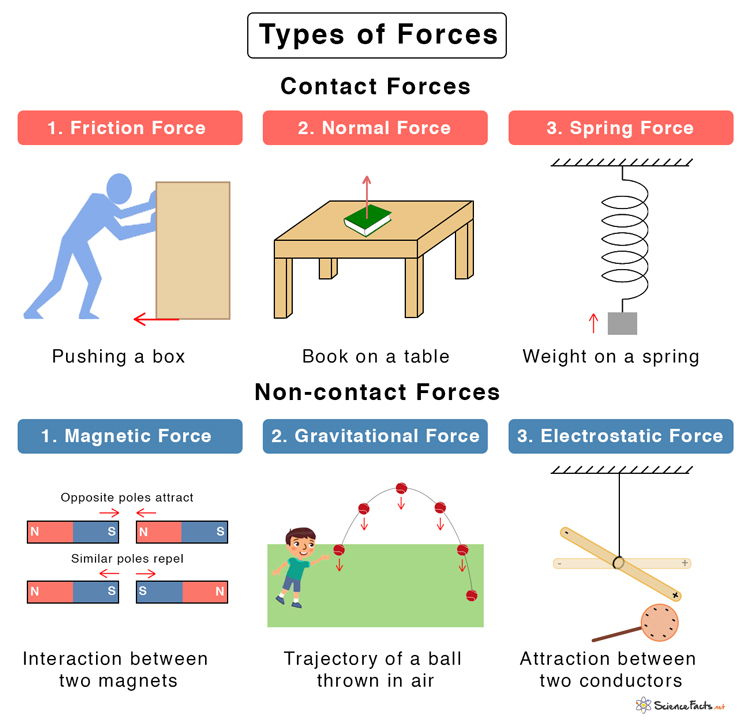
The distinction is about whether touch is required for that particular force, not simply whether the objects happen to be touching at this moment. Earth can pull a book gravitationally even while the book touches the floor.
Identifying forces in a whole situation
In everyday scenes, several forces often act on one object at once. The most reliable approach is to choose one object and keep your attention on it. Then identify what touches it, what can influence it without touching, and which force each source exerts. Do not include a force merely because you recognise its name.
Consider a bag hanging motionless from a rope. The rope touches and pulls the bag upward, so tension is a contact force on the bag. Earth pulls the bag downward, so gravity is a non-contact force on the bag. The rope may also touch a hook, but the hook does not directly touch the bag; when listing forces on the bag, the relevant contact force comes from the rope. Nothing about the bag being motionless makes either force disappear.
Now consider a paper clip resting on a table while a magnet is held just above it, without touching it. Earth exerts gravity on the clip. The table exerts a normal contact force on it. The magnet exerts a non-contact magnetic force on it. If the clip begins to move, its contacts may change, so the forces you identify must match the specific moment you are describing.
These examples reveal a useful habit: say “force on the object from the source.” It prevents you from accidentally mixing forces on different objects or assuming that every force in a scene acts on the object you chose.
Key takeaways
A force is a push or pull arising from an interaction. Contact forces include an applied push, a surface’s normal force, friction, tension, spring force, upthrust, and air resistance. Non-contact forces include gravity, magnetic force, and electrostatic force. To identify forces accurately, focus on one object, name the source of each force, and decide whether that force requires touch.
In the next lesson, you’ll use the forces you have identified to determine whether they are balanced and, if not, the direction of the net force.