Recommended resources
The freely available resources this lesson will direct you to.
Welcome back! In our last lesson, we introduced the powerful Divide and Conquer strategy and saw how Merge Sort uses it to approach sorting more efficiently than the algorithms we studied earlier. We learned that Merge Sort works by recursively dividing an array into single-element subarrays and then merging them back together in sorted order.
Today, we're going to zoom in on the most crucial part of this process: the "merge" step. Our goal is to implement the merge helper function, which takes two already sorted arrays and combines them into a single, final sorted array. Mastering this function is the key to unlocking the power of Merge Sort.
1. The Logic of Merging
Imagine you have two decks of cards, each sorted by number. How would you combine them into a single sorted deck? You'd likely place both decks face up, compare the top card of each deck, take the smaller one, and place it on your new pile. You'd repeat this until one deck is empty, and then you'd simply place the rest of the other deck on top of your new pile.
This is exactly the logic of the merge algorithm. We use three pointers, or indices, to keep track of our position:
- An index
ifor the first sorted array. - An index
jfor the second sorted array. - An index
kfor the final, merged array.
We compare the elements at i and j, copy the smaller one to position k in the result, and advance the appropriate indices.
This process is illustrated beautifully in the following diagram.
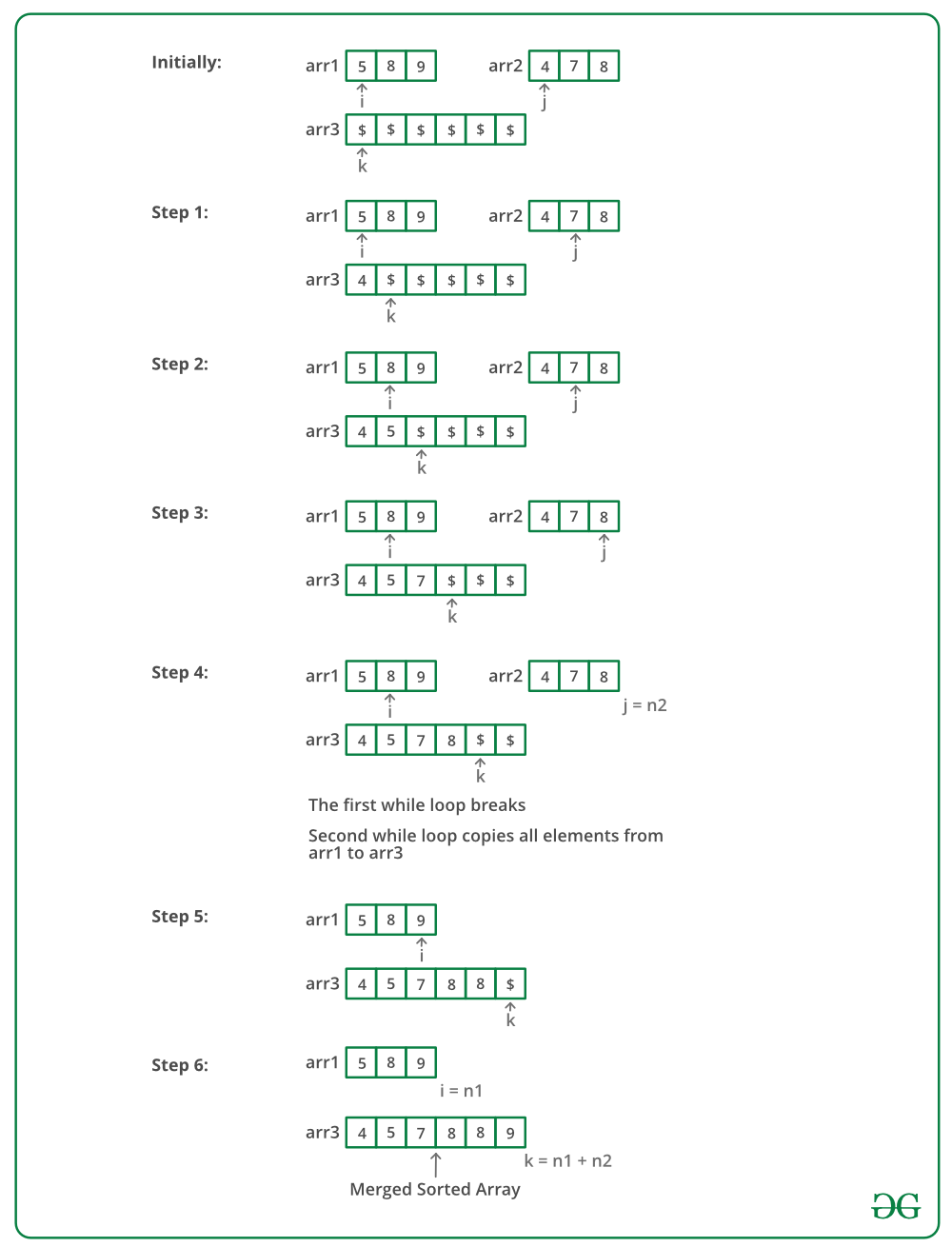
2. A Simple Implementation: Merging Two Separate Arrays
Let's start by implementing the simplest version of this logic: a function that takes two separate, sorted arrays and merges them into a third, newly created array. This will help us solidify the core algorithm before we adapt it for the specific needs of Merge Sort.
The following video provides an excellent walkthrough of creating such a function in C.
Merge Two Sorted Arrays | C Programming Example
Watch this video from Portfolio Courses, "Merge Two Sorted Arrays | C Programming Example". It demonstrates the exact logic we've just discussed.
Pay close attention to these parts: Function setup: Note how the function is defined and how the three index variables (i, j, k) are initialized. Main merge loop: This while loop is the heart of the algorithm. It runs as long as there are elements left in both input arrays to compare. Cleanup loops: These two while loops handle the "leftovers." Once the main loop finishes, one of the input arrays will be empty, but the other may still have elements. These loops copy those remaining elements. It's important to understand that only one of these two loops will ever run in a single call to merge.
After watching, the core structure of the C code should be clear. It consists of three main parts:
- A
whileloop that compares elements from both arrays and copies the smaller one. - A
whileloop to copy any remaining elements from the first array. - A
whileloop to copy any remaining elements from the second array.
3. Adapting the merge Function for Merge Sort
In the context of the full Merge Sort algorithm, we aren't merging two completely separate arrays. Instead, we are merging two adjacent, sorted subarrays that exist within a single, larger array.
For example, if our main array is arr = {2, 8, 1, 7}, after the first recursive calls, it might look like arr = {2, 8, 1, 7} but we conceptually treat arr[0...1] (which is {2, 8}) and arr[2...3] (which is {1, 7}) as two separate sorted subarrays that need to be merged. The goal is to merge them back into the original array arr so it becomes {1, 2, 7, 8} in the range [0...3].
To do this without losing data (since we are writing back into the same array we are reading from), we must first copy the two subarrays into temporary helper arrays. Then, we can use our merging logic to place the elements from these temporary arrays back into the original array in sorted order.
The following article provides an excellent C implementation and a step-by-step visual guide.
Merge Sort (With Code in Python/C++/Java/C)
This article from Programiz contains a clear C implementation of the merge function designed specifically for Merge Sort, along with a fantastic visual breakdown.
First, read the section "Writing the Code for Merge Algorithm" to see the C function void merge(int arr[], int p, int q, int r). Here, p, q, and r are indices defining the start, middle, and end of the subarrays. Next, carefully study the section "Merge( ) Function Explained Step-By-Step". The diagrams here are extremely helpful for visualizing how the temporary arrays (L and M) are used and how the indices i, j, and k work together to reconstruct the main array arr.
4. Code Breakdown and Practice
Let's consolidate what you've learned into a complete, runnable C program. The code below contains the merge function as described in the Programiz article, along with a main function to test it.
#include <stdio.h>

// A helper function to print an array
void printArray(int arr[], int size) {
    for (int i = 0; i < size; i++)
        printf("%d ", arr[i]);
    printf("\n");
}

// Merges two subarrays of arr[].
// First subarray is arr[p..q]
// Second subarray is arr[q+1..r]
void merge(int arr[], int p, int q, int r) {
    // 1. Calculate sizes and create temporary arrays
    int n1 = q - p + 1;
    int n2 = r - q;

    int L[n1], M[n2];

    // 2. Copy data from the main array to temporary arrays L[] and M[]
    for (int i = 0; i < n1; i++)
        L[i] = arr[p + i];
    for (int j = 0; j < n2; j++)
        M[j] = arr[q + 1 + j];

    // 3. Merge the temporary arrays back into arr[p..r]
    int i = 0; // Initial index of first subarray
    int j = 0; // Initial index of second subarray
    int k = p; // Initial index of merged subarray

    // Main merge loop
    while (i < n1 && j < n2) {
        if (L[i] <= M[j]) {
            arr[k] = L[i];
            i++;
        } else {
            arr[k] = M[j];
            j++;
        }
        k++;
    }

    // 4. Copy the remaining elements of L[], if there are any
    while (i < n1) {
        arr[k] = L[i];
        i++;
        k++;
    }

    // 5. Copy the remaining elements of M[], if there are any
    while (j < n2) {
        arr[k] = M[j];
        j++;
        k++;
    }
}

int main() {
    // Create an array with two sorted subarrays: {1, 5, 10} and {2, 6, 9}
    int arr[] = {1, 5, 10, 2, 6, 9};
    int size = sizeof(arr) / sizeof(arr[0]);

    // Define the indices for the merge function:
    // p = 0 (start of first subarray)
    // q = 2 (end of first subarray)
    // r = 5 (end of second subarray)
    int p = 0;
    int q = 2;
    int r = 5;

    printf("Original array: \n");
    printArray(arr, size);

    merge(arr, p, q, r);

    printf("Array after merge: \n");
    printArray(arr, size);

    return 0;
}
Your Task:
- Copy this code into your development environment.
- Compile and run it. Verify that the output is a single sorted array:
1 2 5 6 9 10. - Experiment! Change the values in
arrto test other cases. For example, tryint arr[] = {4, 8, 12, 1, 3, 5};and see if it works correctly. Make sure the subarrays you create are individually sorted.
This hands-on exercise is crucial for confirming your understanding of how the function operates on the underlying array data.
Conclusion
In this lesson, we dissected the core mechanism of Merge Sort. You've now built the engine that drives this efficient algorithm.
Key Takeaways:
- The
mergeoperation combines two sorted arrays by iteratively comparing their elements and picking the smaller one. - The logic relies on three indices: one for each input array and one for the output array.
- When used in Merge Sort, we merge adjacent subarrays. This requires creating temporary arrays to hold the data before merging it back into the original array.
- The C implementation involves four key parts: creating and populating temporary arrays, a main comparison loop, and two cleanup loops for any leftover elements.
Preview of the Next Lesson:
We now have the merge helper function ready. The next step is to build the mergeSort function that orchestrates the "divide" part of the strategy. To do that, we first need to formally understand and practice recursion, the technique of a function calling itself. In the next lesson, we will dive into recursion and then use it to complete our implementation of Merge Sort.