Recommended resources
The freely available resources this lesson will direct you to.
Welcome to the lesson! In our previous session, we explored the concept of recursion, defining it by its two core components: a base case and a recursive step. We now have all the necessary building blocks to assemble one of the most efficient sorting algorithms.
Today, we will implement the full mergeSort algorithm. You will see how the "divide-and-conquer" strategy is perfectly realized through recursive function calls. By the end of this lesson, you will have written the mergeSort function in C, combining the power of recursion with the merge helper function we've already designed.
1. The Recursive Logic of Merge Sort
Recall that Merge Sort works by:
- Divide: Breaking the array into two halves.
- Conquer: Recursively sorting each half.
- Combine: Merging the two sorted halves back into one sorted array.
Recursion is the mechanism that drives the "conquer" step. The process continues until the arrays can't be divided any further. This gives us the two critical components for our recursive function:
- Base Case: An array with one or zero elements is, by definition, already sorted. This is our stopping condition. In terms of array indices
leftandright, this occurs whenleft >= right. - Recursive Step: If the array has more than one element (
left < right), we:- Calculate the middle index
mid. - Call
mergeSorton the left half (fromlefttomid). - Call
mergeSorton the right half (frommid + 1toright). - Call our
mergefunction to combine the two (now sorted) halves.
- Calculate the middle index
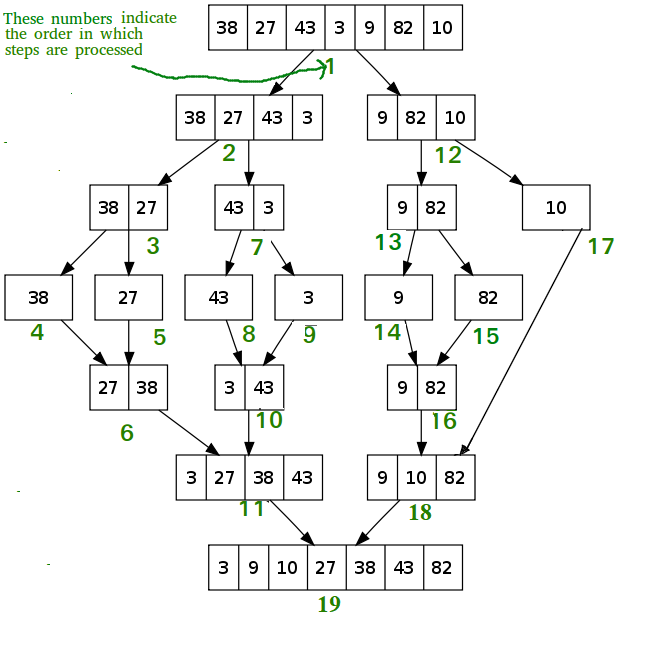
The following diagram provides a fantastic overview of this entire process, from the initial division down to single elements to the final merging sequence.
2. Implementing the mergeSort Function in C
With the logic clear, let's translate it into a C function. The mergeSort function will orchestrate the recursive calls. Its main job is to keep splitting the array until it hits the base case, at which point the merge function begins its work on the way back up the call stack.
Let's study the C code for the main mergeSort function.
Merge Sort (With Code in Python/C++/Java/C)
This section from the Programiz article "Merge Sort Algorithm" provides the complete C implementation. We will focus on the mergeSort function itself.
Find the C code block at the end of the article. Read the mergeSort function carefully. Notice how the if (l < r) condition directly implements our base case and recursive step. void mergeSort(int arr[], int l, int r) { if (l < r) { // Find the middle point int m = l + (r - l) / 2; // Recursively sort the two halves mergeSort(arr, l, m); mergeSort(arr, m + 1, r); // Merge the sorted halves merge(arr, l, m, r); } } The calculation int m = l + (r - l) / 2; is a robust way to find the middle index, which helps prevent potential overflow errors if l and r were very large numbers.
To see this code being constructed and explained live, the following video provides a great walkthrough.
Merge Sort | C Programming Example
The video "Merge Sort | C Programming Example" by Portfolio Courses walks through the C implementation. We'll focus on the part that implements the recursive function.
Watch the segment from implementing the recursive function. The author calls it mergeSortRecursion, but the logic is identical to what we've just seen. Pay attention to how the if (l < r) condition wraps the recursive calls, ensuring the process will eventually stop.
3. Tracing the Execution Flow
To truly understand how recursion works here, it's helpful to trace the sequence of function calls. The function first calls itself all the way down one branch (the left side) until it hits the base case. Then it backs up, completes the other branch (the right side), and performs a merge. This repeats until the entire array is sorted.
The following video provides one of the clearest traces available for how the indices change and how the array is processed.
In this video, "Merge Sort Algorithm" by Abdul Bari, you'll see a masterful trace of the algorithm's execution.
First, review the pseudocode and recursive structure: Algorithm Pseudocode. Next, and most importantly, watch the detailed trace of how mergeSort recursively divides the array using indices: Tracing the Algorithm. This visualization will help connect the code to the conceptual model.
4. Hands-on Practice: Bringing It All Together
Now it's time to assemble the complete program and see it run. The code below includes the main function, our new mergeSort function, and the merge function from our previous work.
Your task is to add printf statements to trace the execution yourself. This is a powerful debugging and learning technique that makes the abstract flow of recursion visible.
#include <stdio.h>

// Merges two subarrays of arr[].
// First subarray is arr[p..q]
// Second subarray is arr[q+1..r]
void merge(int arr[], int p, int q, int r) {
    // Create temporary arrays
    int n1 = q - p + 1;
    int n2 = r - q;
    int L[n1], M[n2];

    // Copy data to temp arrays L[] and M[]
    for (int i = 0; i < n1; i++)
        L[i] = arr[p + i];
    for (int j = 0; j < n2; j++)
        M[j] = arr[q + 1 + j];

    // Merge the temp arrays back into arr[p..r]
    int i = 0; // Initial index of first subarray
    int j = 0; // Initial index of second subarray
    int k = p; // Initial index of merged subarray

    while (i < n1 && j < n2) {
        if (L[i] <= M[j]) {
            arr[k] = L[i];
            i++;
        } else {
            arr[k] = M[j];
            j++;
        }
        k++;
    }

    // Copy the remaining elements of L[], if there are any
    while (i < n1) {
        arr[k] = L[i];
        i++;
        k++;
    }

    // Copy the remaining elements of M[], if there are any
    while (j < n2) {
        arr[k] = M[j];
        j++;
        k++;
    }
    // Task Part 2: Add a printf here to see when merging happens.
    printf("--- Merged subarray from %d to %d ---\n", p, r);
}

// Main function to implement merge sort
void mergeSort(int arr[], int l, int r) {
    if (l < r) {
        // Task Part 1: Add a printf here to trace the division.
        printf("Splitting array from index %d to %d\n", l, r);

        int m = l + (r - l) / 2;

        mergeSort(arr, l, m);
        mergeSort(arr, m + 1, r);

        merge(arr, l, m, r);
    }
}

// Function to print an array
void printArray(int arr[], int size) {
    for (int i = 0; i < size; i++)
        printf("%d ", arr[i]);
    printf("\n");
}

// Driver program to test above functions
int main() {
    int arr[] = {6, 5, 12, 10, 9, 1};
    int arr_size = sizeof(arr) / sizeof(arr[0]);

    printf("Given array is \n");
    printArray(arr, arr_size);

    mergeSort(arr, 0, arr_size - 1);

    printf("\nSorted array is \n");
    printArray(arr, arr_size);
    return 0;
}
Your Task:
- Copy the code into your development environment.
- Add a
printfstatement at the beginning of themergeSortfunction to show thel(left) andr(right) indices. This will show you each time the array is "split." - Add another
printfat the end of themergefunction to announce which subarray has just been merged. - Compile and run the program.
- Compare the output trace to the tree diagram we saw earlier. You should see the
Splitting...messages correspond to the downward paths of the tree, and theMerged...messages correspond to the upward, combining paths.
Conclusion
Congratulations! You have successfully implemented the mergeSort algorithm in C. By combining the power of recursion with a clever merging strategy, we've created a highly efficient sorting algorithm from the ground up.
Key Takeaways:
- The
mergeSortfunction uses recursion to implement the "divide and conquer" strategy. - The base case for the recursion is a subarray of size 1 or 0 (
l >= r), which is inherently sorted. - The recursive step involves finding the midpoint, calling
mergeSorton both halves, and then callingmergeto combine the results. - Tracing the execution with
printfstatements is a practical way to visualize the call stack and understand the algorithm's flow.
Preview of the Next Lesson:
Now that we've implemented four sorting algorithms (Bubble, Selection, Insertion, and Merge Sort), how do they stack up against each other? In our next lesson, we will analyze the time and space complexity of Merge Sort, formally proving its O(n log n) efficiency. We will then compare the performance characteristics of all the sorting algorithms covered so far to understand when to use each one.