Recommended resources
The freely available resources this lesson will direct you to.
- The Science of Making & Breaking Habits: How to Change Your Life in 1 Monthwww.youtube.com
- Habit Stacking - Create Your Perfect Routinewww.youtube.com
- How to Build New Habits by Taking Advantage of Old Onesjamesclear.com
- How Habit Stacking Can Turn Learning Into an Effortless Daily Routinewww.techclass.com
Hello! Welcome back to our module on building sustainable learning habits.
In our last lesson, we deconstructed habits into the cue-routine-reward loop. We established that the cue is the non-negotiable first step—the trigger that launches an automatic behavior. This insight is the foundation for today's lesson. If an existing habit already has a powerful, built-in cue, why not leverage it?
Today, your learning outcome is to apply 'habit stacking' to integrate new learning activities into your existing daily routines. This is a practical, low-friction strategy for overcoming procrastination and building the consistency you're aiming for.
For a UI/UX designer, this process is akin to designing an intuitive user flow. Instead of forcing a user (or in this case, yourself) to navigate to a new screen from scratch, you're placing the next critical action directly after a task they've just completed. It's about creating a seamless transition that reduces decision fatigue and makes the next step feel effortless.
What is Habit Stacking?
Habit stacking is a technique popularized by James Clear, author of Atomic Habits. The core idea is simple: you "stack" a new habit you want to build on top of a current, well-established habit. The completion of your current habit becomes the cue for the new one.
The basic formula is:
After [CURRENT HABIT], I will [NEW HABIT].
This works because your existing habits are already hardwired into your brain. By linking the new behavior to this solid neural pathway, you're not starting from zero; you're simply extending a path that already exists.
To see this in action, let's hear James Clear explain the concept himself.
The Science of Making & Breaking Habits: How to Change Your Life in 1 Month
In this clip from a conversation with Mel Robbins, James Clear explains the logic and application of habit stacking with several clear examples.
Please watch the segment from 01:15:38 to 01:18:41. Pay close attention to how he frames the connection between an existing behavior (like making coffee) and a new desired behavior (like meditating).
As Clear explains, you are using the momentum of one behavior to launch you into the next. This creates a chain reaction.
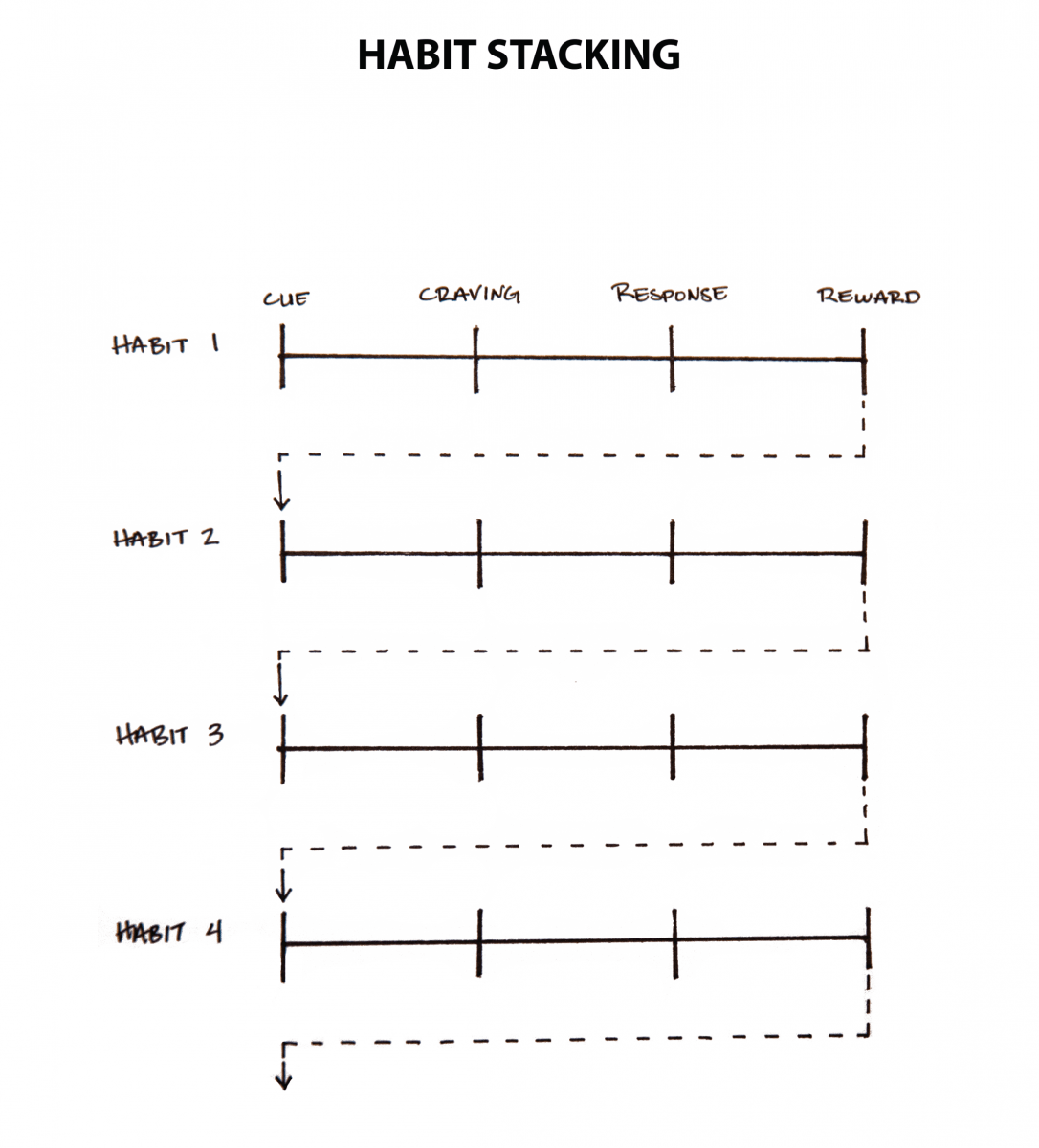
How to Build a Learning Habit Stack: A Step-by-Step Guide
Now, let's move from theory to application. Building a successful habit stack for your learning goals involves a clear, methodical process.
Step 1: Identify Your "Anchor" Habits
First, you need to identify the existing, automatic habits that will serve as the foundation for your stack. These should be things you do every single day without fail.
Let's read a short article that provides excellent examples and a framework for identifying these anchors and applying them specifically to learning.
How Habit Stacking Can Turn Learning Into an Effortless Daily Routine
This article from TechClass, 'How Habit Stacking Can Turn Learning Into an Effortless Daily Routine,' provides a practical guide to creating learning-focused habit stacks.
Please read the section 'How to Build a Learning Habit Stack,' focusing on steps 1 and 2: 'Identify Your Anchor Habits' and 'Choose a Learning Habit You Want to Build.' Make a quick mental list of your own anchor habits as you read.
Your anchor habits are likely simple things like:
- Waking up / Turning off your alarm
- Brushing your teeth
- Making your morning coffee or tea
- Eating lunch
- Finishing your workday and closing your laptop
- Changing out of work clothes
Step 2: Start Small (The Two-Minute Rule)
A common mistake is to stack a large, intimidating new habit onto an existing one. This creates friction and makes the stack likely to fail. The key is to make the new habit so small that it's almost impossible to say no to.
This is where the Two-Minute Rule comes in: your new habit should take less than two minutes to do.
- Instead of "learn data analysis," your habit is "watch one 2-minute video on Python syntax."
- Instead of "master advanced prototyping," your habit is "open Figma and practice one new animation feature for two minutes."
- Instead of "read a book on UX strategy," your habit is "read one page."
The goal isn't to master the skill in two minutes. The goal is to master the habit of showing up. A habit must be established before it can be improved.
Step 3: Create Your Specific Stack
Now, combine your anchor habit with your two-minute learning habit using the formula. The key here is specificity. A vague cue leads to failure.
Let's turn to a short text from James Clear to understand why precision is so important.
How to Build New Habits by Taking Advantage of Old Ones
This excerpt from James Clear's article on habit stacking explains the core formula and provides crucial advice on how to choose the right trigger.
Read the sections 'Habit Stacking Examples' and 'Finding the Right Trigger,' up to the subheading 'The Next Step'. Pay special attention to his point about vague vs. specific cues, like his push-up example.
As Clear notes, "When I take a break for lunch" is a poor cue. It's ambiguous. "When I close my laptop for lunch" is a highly specific, actionable trigger.
Here are some well-formed examples for your goals:
-
Vague: After work, I will practice coding.
-
Specific: After I shut down my work computer, I will immediately open my code editor and complete one 'Codecademy' exercise.
-
Vague: In the morning, I will review UX principles.
-
Specific: After my coffee maker finishes brewing, I will review one flashcard on a UX law from my Anki deck.
Test your understanding!
It's time to design your first habit stack.
- List 3 reliable "anchor" habits you perform every single day (e.g., "sit down at my desk with coffee," "put my dinner plate in the dishwasher," "get into bed").
- Choose one small, 2-minute learning habit you want to build (e.g., "read one paragraph about A/B testing," "sketch one UI component," "define one data analysis term").
- Combine them into a specific habit stack using the formula: "After [SPECIFIC CURRENT HABIT], I will [SMALL NEW HABIT]."
Share your habit stack.
Show answer
There is no single correct answer, but a strong one will be highly specific and start small. For example:
- Anchor Habits:
- Finishing my morning stand-up call.
- Pouring my afternoon tea.
- Plugging my phone in to charge at night.
- Small Learning Habit: Review my notes on JavaScript functions for two minutes.
- Habit Stack: "After I plug my phone in to charge for the night, I will immediately open my laptop and spend two minutes reviewing my notes on JavaScript functions."
This is a great stack because the cue ("plug my phone in") is a specific, unmissable event, and the new habit is short and clearly defined.
Conclusion
You now have a powerful, actionable method for weaving new learning routines into the fabric of your daily life. Habit stacking is not about finding more time or summoning more willpower; it's about being a smarter architect of your behaviors.
Key Takeaways:
- Habit stacking uses an existing habit as the cue for a new one, following the formula: "After [CURRENT HABIT], I will [NEW HABIT]."
- This technique lowers the "activation energy" to start a new behavior, making it an effective tool against procrastination.
- For the stack to be successful, the cue must be highly specific, and the new habit should be very small (follow the Two-Minute Rule).
- The goal is to automate the act of starting. Once the habit of showing up is established, you can gradually expand its duration and difficulty.
What's Next?
You've learned how to start a habit, but how long does it take for it to become automatic? What does that journey look like, and what happens when you inevitably miss a day? In our next lesson, we will examine the habit formation curve to set realistic expectations for achieving consistency and learn how to get back on track when you slip up.