Recommended resources
The freely available resources this lesson will direct you to.
Introduction
In our last few lessons, we explored the landscape of right-libertarianism, from the minimal state envisioned by minarchists to the stateless society proposed by anarcho-capitalists. While these philosophies differ on the legitimacy of government, they share a common foundation: a strong belief in both self-ownership and the right to acquire and hold private property through Lockean-style appropriation.
Today, we pivot to a fascinating and distinct branch of the libertarian family tree: left-libertarianism. This philosophy challenges a core assumption of the right-libertarian world. It begins by asking a simple but profound question: We all own ourselves, but who owns the Earth? While right-libertarians argue that natural resources like land, oil, and minerals can be claimed by the first person to mix their labor with them, left-libertarians offer a radically different answer.
This lesson will explain the core tenets of left-libertarianism and its distinctive view of natural resource ownership. You will learn how this ideology combines a fierce commitment to individual liberty with a deeply egalitarian approach to the planet's common wealth, leading to surprising and influential policy proposals.
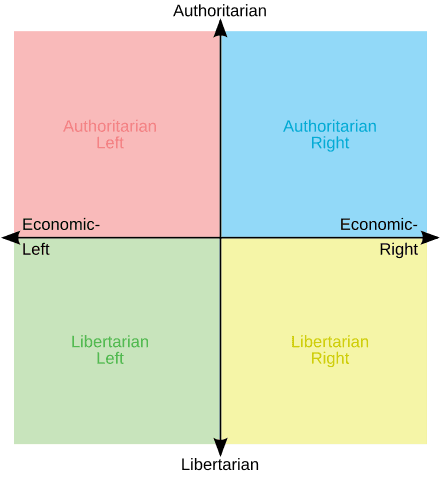
To help orient ourselves, let's look at the "Political Compass," a common tool for mapping ideologies. Right-libertarianism, which emphasizes economic freedom, typically falls in the bottom-right quadrant (Libertarian Right). Left-libertarianism, as the name suggests, finds its home in the bottom-left quadrant (Libertarian Left), blending a libertarian skepticism of authority with a leftist concern for equality regarding natural resources.
The Core of Left-Libertarianism: Self-Ownership plus Common Resources
At its heart, left-libertarianism is defined by two central principles:
- Full Self-Ownership: Just like the right-libertarians we have studied, left-libertarians hold that every individual has absolute moral ownership over their own body, mind, and labor. The non-aggression principle holds true: no one may initiate force against another's person or justly acquired property.
- Egalitarian Ownership of Natural Resources: This is the crucial point of divergence. Left-libertarians argue that natural resources—everything not created by human effort, such as land, minerals, oceans, and the air—initially belong to everyone in some egalitarian manner.
The logic is straightforward: since no human created the Earth, no single person can claim exclusive ownership of a piece of it without compensating the rest of humanity, who are its collective co-owners.
To see this distinction clearly, let's turn to a brief academic definition.
[PDF] Stanford Encyclopedia of Philosophy
This excerpt from the Stanford Encyclopedia of Philosophy, written by political philosopher Peter Vallentyne, provides a concise, authoritative distinction between left- and right-libertarianism.
Please read the introductory section, from the beginning. Focus on how both branches endorse self-ownership but differ fundamentally on the appropriation of "unowned natural resources."
As the reading makes clear, while a right-libertarian might see an unowned oil field as "finders, keepers," a left-libertarian sees it as the common property of all people. Therefore, anyone who wants to extract that oil owes a payment—a "rent"—to society for the privilege of using that shared asset.
Georgism: The Land Belongs to the People
The most famous and historically significant form of left-libertarianism is Georgism, named after the 19th-century American economist and social reformer Henry George. He was deeply troubled by a paradox he observed: as societies grew wealthier and more advanced, poverty and inequality seemed to worsen.
George identified the root of the problem as the private ownership of land. He argued that as a community develops—building roads, schools, and businesses—the value of the surrounding land increases dramatically. This increase in value is not created by the landowner, who may do nothing at all, but by the collective efforts of society. Yet, the landowner reaps the windfall profits through higher rents and sale prices.
A modern-day video essay explains this core problem with a vivid example from London.
The Power of Land Georgism 101
This video from the channel BritMonkey, titled "The Best Idea That Will Never Happen: Georgism 101," introduces the problem of unearned land value.
Please watch the first three minutes, from the introduction. Notice how the value of an abandoned tube station increases not because of anything its owner does, but because of the productive activity of the neighbors.
George's proposed solution was as elegant as it was radical: a Land Value Tax (LVT). This would be a single tax on the unimproved rental value of land. It is crucial to understand what this means:
- The tax is based only on the value of the land itself, as determined by its location and surrounding natural resources.
- The tax explicitly does not apply to improvements made on the land, such as buildings, factories, farms, or houses.
By taxing land value, society could capture the wealth it collectively creates. At the same time, by abolishing other taxes on labor (income tax), capital (capital gains tax), and trade (sales tax), it would unleash productive economic activity. Let's see how the same video explains George's proposal.
The Power of Land Georgism 101
This segment explains the mechanics of the Land Value Tax (LVT).
Watch the clip from George's solution. Pay close attention to the distinction between the value of the land and the value of the buildings on it, and which of the two is taxed.
The Practical Case for LVT
The appeal of Georgism extends beyond its moral claims. Proponents argue it would have powerful, positive effects on the economy and society. Because the LVT makes it expensive to hold valuable land without using it productively, it would discourage land speculation and "land banking."
This has several practical benefits:
- Affordable Housing: It would pressure owners of vacant lots in cities to either build housing on them or sell to someone who will, increasing the housing supply and lowering prices.
- Efficient Land Use: It would encourage owners to use land for its most productive purpose. A sprawling surface parking lot in a city center would become economically unviable, incentivizing the owner to build a multi-story garage or an apartment building.
- Economic Growth: By replacing taxes on production and work with a tax on unearned wealth, it rewards hard work and innovation while penalizing passive rent-seeking.
This next clip details these practical arguments and addresses a common question: "Won't landlords just pass the tax on to tenants?"
The Power of Land Georgism 101
This part of the video outlines the practical benefits of an LVT and debunks a common myth about it.
First, watch the section on practical benefits, which covers everything from the housing crisis to urban sprawl. Then, watch the explanation of why LVT can't be passed on to tenants. The key idea is that rent is already set at the maximum a tenant can pay, so a tax on the landlord's profit cannot be easily added on top.
What Happens to the Money? The Citizen's Dividend
So, what does a left-libertarian society do with all the revenue collected from the Land Value Tax? The answer gets to the heart of the ideology's egalitarian component.
First, the revenue could be used to fund the legitimate, limited functions of government (what minarchists call the "night-watchman state"). Since this revenue is derived from society's common wealth, it eliminates the need for coercive taxation of individuals' labor and property.
If there is a surplus after funding essential services, Georgists propose distributing it equally to every member of society in the form of a Citizen's Dividend or Universal Basic Income. This is the mechanism for returning the value of the commons to its rightful owners: the people.
The Power of Land Georgism 101
This final segment from BritMonkey's video explains the concept of the Citizen's Dividend and gives real-world examples.
First, watch from what happens to the money to understand how the revenue is used for public services and distributed back to the public. Then, see how these principles have been applied in practice in Alaska and Singapore.
The Alaska Permanent Fund is a striking real-world example. The state of Alaska collects revenues from oil extraction (a natural resource) and distributes a portion of it directly to every resident each year. This is a purely Georgist idea in action.
Beyond Georgism: A Spectrum of Left-Libertarianism
While Georgism is the most well-known form of left-libertarianism, the underlying principle—that natural resources are common property—can be applied in different ways. Philosophers in this tradition debate exactly how to calculate the payment owed to society.
To understand this internal spectrum, let's look at two main approaches identified by philosopher Peter Vallentyne.
[PDF] Left-Libertarianism: A Primer - Peter Vallentyne
This excerpt from Peter Vallentyne's academic primer on left-libertarianism distinguishes between two ways of calculating the payment for using natural resources.
Please read the two short paragraphs that define these approaches. First, read the definition of Georgist libertarianism. Then, read the definition of the full-benefit-taxation approach.
Let's break down that distinction:
- Georgist Libertarianism: This is the view we've been discussing. An individual pays society for the competitive market value (the rent) of the natural resources they use. They get to keep any additional profit they generate through their own talent, effort, or innovation. This view is more focused on rewarding production.
- Full-Benefit-Taxation Libertarianism: This is a more strongly egalitarian version. Here, an individual must pay back not only the rent for the resources but also any "excess" profit they gain from using them, especially if that profit comes from an unchosen advantage (like being born with a rare talent for finding oil). This view aims to neutralize the effects of luck to a greater degree.
These different approaches show that even within left-libertarianism, there is a rich debate about the precise balance between individual effort and our collective inheritance.
Conclusion
This lesson has introduced a branch of libertarianism that combines a radical commitment to individual liberty with an equally radical commitment to the common ownership of the planet. While agreeing with right-libertarians on the principle of self-ownership, left-libertarians diverge dramatically on the question of natural resources, arguing they belong to all of us.
Here are the key takeaways:
- Left-Libertarianism's Core Idea: It is a political philosophy that pairs full self-ownership with the principle that natural resources are owned in an egalitarian manner.
- Compensation for Use: Anyone who claims exclusive use of a natural resource (like land or oil) must pay society for that privilege, as they are using a common asset.
- Georgism and the LVT: The most prominent application of this idea is the Land Value Tax, which taxes the unimproved value of land and uses the revenue to replace other taxes and fund public services or a citizen's dividend.
- Economic and Social Goals: Proponents argue that this system is not only morally just but also highly efficient, encouraging productive land use, preventing speculative bubbles, and reducing inequality without punishing work or investment.
We have now seen how libertarian thought contains both right-wing and left-wing expressions. So far, all the branches we've examined—minarchism, anarcho-capitalism, and left-libertarianism—operate within a framework of markets and private property, even if they disagree on the initial distribution. In our next lesson, we will explore mutualism, a form of libertarian socialism that challenges the capitalist model itself, advocating for a stateless society based on worker-owned firms and free association.