Recommended resources
The freely available resources this lesson will direct you to.
Hello! Welcome to our final lesson in the module on identical particles and second quantization.
In our previous lessons, we developed the powerful formalisms of second quantization and Wick's theorem. These tools allow us to handle systems with many identical particles in a systematic way, particularly for calculating properties of the ground state. Today, we'll shift our focus from static properties to a dynamic process: scattering. We will explore how the fundamental principle of particle indistinguishability leaves a dramatic and measurable signature on the outcome of a collision.
This lesson directly addresses the learning outcome: Apply scattering theory to identical particles and analyze symmetry effects on cross-sections. We will see how the requirement to symmetrize or antisymmetrize the total wavefunction leads to quantum interference effects that have no classical analogue.
1. Indistinguishability in Scattering: Two Paths to the Same Outcome
Let's consider the scattering of two identical particles in their center-of-mass (CM) frame. They approach each other, interact, and then fly apart. In a typical scattering experiment, we place a detector at a specific angle to the incoming beam axis and count the particles arriving there.
For distinguishable particles, the situation is simple: if our detector at clicks, it means the incoming projectile was deflected by . The other particle, the target, recoils in the opposite direction, , to conserve momentum.
However, if the particles are identical, we have a profound ambiguity. When a particle hits our detector at angle , we have no way of knowing if:
- The projectile was scattered by (and the target recoiled to ).
- The projectile was scattered by (and the target recoiled to ).
Because the particles are fundamentally indistinguishable, these two outcomes are not just similar; they are the same physical event, and both possibilities must be accounted for.
In classical mechanics, we would simply add the probabilities (i.e., the cross-sections) for these two outcomes. But in quantum mechanics, we must add the probability amplitudes first, and then find the probability. This is the origin of interference.
To build our understanding, let's review this core concept.
The following notes from '12 - Scattering Theory' by Richard Fitzpatrick provide a concise introduction to the central idea of indistinguishability in the center-of-mass frame.
Please read the short sections titled 'Scattering of Identical Particles - I' and 'Scattering of Identical Particles - II'. Focus on how the classical approach of adding cross-sections differs from the quantum mechanical requirement of handling wavefunctions.
2. Symmetrized Scattering Amplitudes
Let's formalize this. The asymptotic form of the relative wavefunction for a scattered particle, far from the scattering center, is the sum of an incoming plane wave and an outgoing spherical wave:
Here, is the scattering amplitude, and the differential cross-section for distinguishable particles is simply .
For identical particles, the total spatial wavefunction must have a definite symmetry under particle exchange, which in the CM frame corresponds to inverting the relative coordinate vector: . This inversion changes the scattering angle as .
The properly symmetrized or antisymmetrized asymptotic wavefunctions for the relative coordinate must therefore be constructed from the two indistinguishable outcomes: scattering at and scattering at .
- Spatially Symmetric Wavefunction : The scattering amplitude is the sum of the individual amplitudes.
- Spatially Antisymmetric Wavefunction : The scattering amplitude is the difference of the individual amplitudes.
This leads directly to the differential cross-sections:
- Symmetric Case:
- Antisymmetric Case:
Notice the three terms in each expression. The first two, , represent the "classical" result where we add the probabilities. The third term, , is the purely quantum interference term.
3. Applications: Bosons and Fermions
The choice between the symmetric and antisymmetric spatial wavefunction is dictated by the spin of the particles and their statistics (boson or fermion), as dictated by the spin-statistics theorem.
Case 1: Identical Spin-0 Bosons
- Examples: Scattering of alpha particles ( nuclei), nuclei, or pions.
- Symmetry Rule: The total wavefunction must be symmetric. Since the particles are spinless, the spin part of the wavefunction is trivially symmetric. Therefore, the spatial part must be symmetric.
- Cross-section: We must use . The interference is constructive.
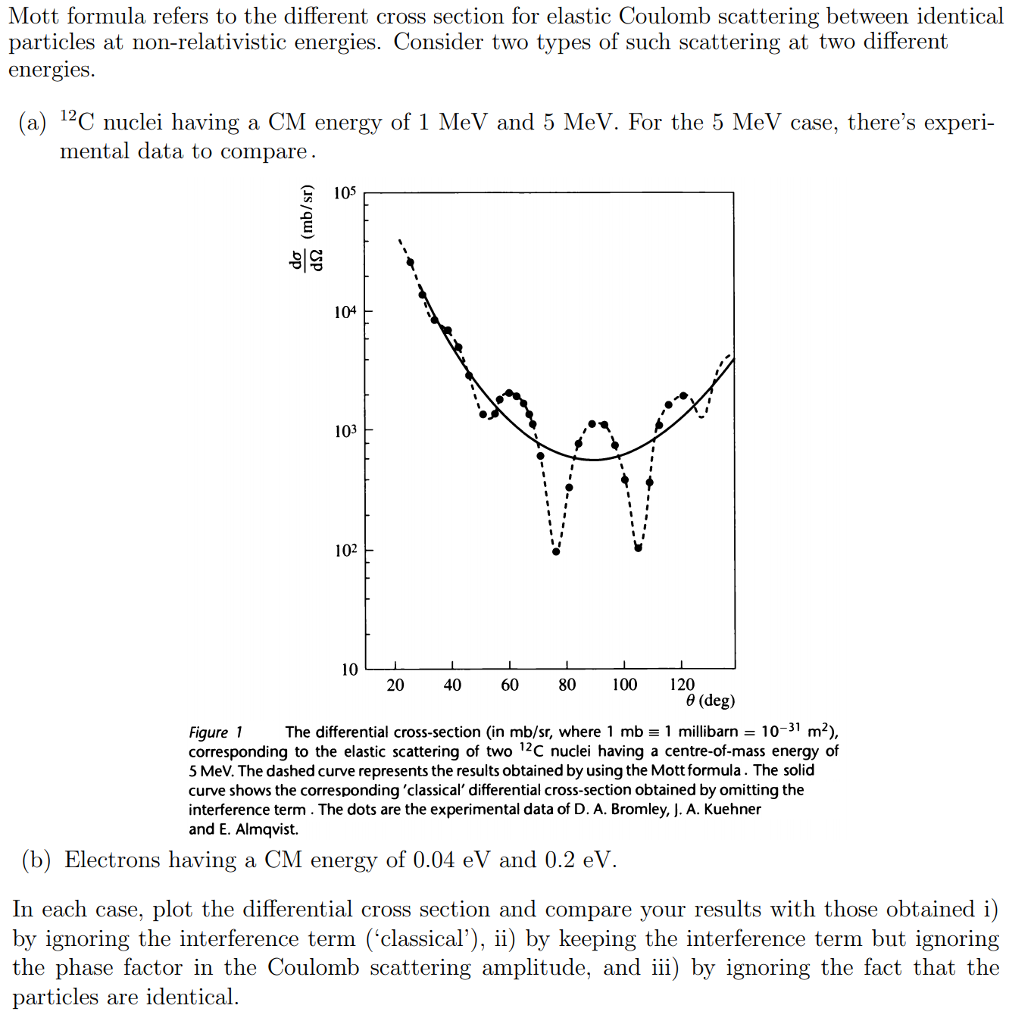
Let's look at the special angle . Here, , so the cross-section becomes:
The classical prediction would be . The quantum result is twice as large! This is a direct consequence of constructive interference.
This is not just a theoretical curiosity; it is confirmed by experiment. The image below shows data for the elastic scattering of two Carbon-12 nuclei (spin-0 bosons).
Case 2: Identical Spin-1/2 Fermions
- Examples: Electron-electron scattering (Mott scattering), proton-proton scattering.
- Symmetry Rule: The total wavefunction must be antisymmetric. The required symmetry of the spatial part now depends on the symmetry of the spin part.
- The total spin of two spin-1/2 particles can be (singlet, antisymmetric spin state) or (triplet, symmetric spin state).
-
Spin Singlet State (): The spin wavefunction is antisymmetric. To make the total wavefunction antisymmetric, the spatial part must be symmetric.
Just like bosons, fermions in a singlet state exhibit constructive interference, with scattering at enhanced by a factor of 2 over the classical result. -
Spin Triplet State (): The spin wavefunction is symmetric. To make the total wavefunction antisymmetric, the spatial part must be antisymmetric.
Now, the interference is destructive. At , we find a remarkable result:
Identical fermions in a triplet spin state cannot scatter at 90 degrees in the CM frame. This complete suppression is a purely quantum mechanical effect stemming from the Pauli exclusion principle applied to a dynamical process.
Scattering of Unpolarized Beams
In many experiments, the beams are unpolarized, meaning all possible spin configurations are equally likely. For two spin-1/2 particles, there are total spin states: one singlet state and three triplet states. The differential cross-section is the statistically weighted average:
Test your understanding!
Substitute the expressions for and into the formula for the unpolarized cross-section and simplify it. What is the value of the unpolarized cross-section at ? How does it compare to the classical result?
Show answer
Let's plug in the expressions:
\begin{align*}
\frac{d\sigma_{\text{unpol}}}{d\Omega} &= \frac{1}{4}|f(\theta) + f(\pi - \theta)|^2 + \frac{3}{4}|f(\theta) - f(\pi - \theta)|^2 \
&= \frac{1}{4}\left( |f(\theta)|^2 + |f(\pi-\theta)|^2 + 2\text{Re}[f^(\theta)f(\pi-\theta)] \right) \
&\quad + \frac{3}{4}\left( |f(\theta)|^2 + |f(\pi-\theta)|^2 - 2\text{Re}[f^(\theta)f(\pi-\theta)] \right) \
&= \left(\frac{1}{4}+\frac{3}{4}\right)\left(|f(\theta)|^2 + |f(\pi-\theta)|^2\right) + \left(\frac{2}{4}-\frac{6}{4}\right)\text{Re}[f^(\theta)f(\pi-\theta)] \
&= |f(\theta)|^2 + |f(\pi - \theta)|^2 - \text{Re}[f^(\theta)f(\pi-\theta)]
\end{align*}
At , the classical term is and the interference term is . The total is:
This is exactly half of the classical prediction.
For a more detailed derivation and an intuitive picture based on a thought experiment by Feynman, I recommend the following reading.
Scattering of identical particles
The document 'Scattering of identical particles' by Prof. Suzuki provides a comprehensive treatment of this topic. It includes detailed derivations, the application to different spin values, and an excellent intuitive explanation using Feynman's thought experiment.
Please read sections 3, 5, 6, and 7. Section 3 ('Scattering of identical particles') sets up the problem and derives the key results for fermions. Section 5 ('Feynman’s thought experiment...') provides a brilliant physical argument for why and when interference occurs by considering whether the particles' spin states make them distinguishable or not. Sections 6 and 7 generalize the formulas for fermions and bosons with arbitrary spin, providing a complete picture.
Conclusion
This lesson concludes our module on identical particles by showing a direct, dynamic consequence of their indistinguishability. While second quantization and Wick's theorem gave us the abstract tools to handle these systems, scattering theory shows us their tangible effects in the laboratory.
Key Takeaways:
- Scattering of identical particles leads to quantum interference because the two possible scattering paths (particle 1 at or particle 2 at ) are indistinguishable.
- The nature of the interference depends on the required symmetry of the spatial wavefunction, which is determined by particle statistics (boson/fermion) and the total spin state.
- Bosons (spin-0) always have a symmetric spatial wavefunction, leading to constructive interference. Scattering at 90° in the CM frame is enhanced.
- Fermions (spin-1/2) can be in a spin singlet (antisymmetric) or triplet (symmetric) state.
- Singlet state requires a symmetric spatial part (constructive interference).
- Triplet state requires an antisymmetric spatial part (destructive interference), leading to zero scattering at 90°.
- For unpolarized beams, the final cross-section is a statistical average over the possible spin states, resulting in modified interference effects.
Preview of the Next Module:
We have now established the fundamental principles and formalisms for dealing with many identical particles. In our next module, "Many-Body Mean-Field and Correlation Methods," we will apply these tools to one of the most important problems in quantum physics: finding the ground state of a system of many interacting electrons. Our first lesson will be to derive the Hartree-Fock equations using the variational principle, which represents the best possible single-determinant approximation for the many-body ground state. The exchange interaction, which we've seen manifest here as an interference term, will reappear as a crucial component of the Hartree-Fock energy.