Recommended resources
The freely available resources this lesson will direct you to.
Hello! Welcome to the final lesson in your course on philosophy. In our last session, we saw how to apply the powerful tools of modal logic to evaluate metaphysical claims, uncovering the surprising category of the "necessary a posteriori." We continue this capstone work today by turning our analytic lens to a topic at the heart of your interests: the philosophy of mathematics.
Today, you will learn to compare how a Platonist and a Fictionalist would interpret the truth of a specific mathematical theorem. We will use Fermat's Last Theorem as our primary case study. This isn't just an abstract discussion; it's an application of philosophical analysis to the very nature of truth in mathematics, a field you know well. This debate forces us to ask fundamental questions: What are we talking about when we talk about numbers? And what does it mean for a mathematical theorem to be true?
1. The Central Conflict: Do Numbers Exist?
Let's begin with a proposition you're very familiar with, like the statement of Euclid's theorem: "There are infinitely many prime numbers." On the surface, this seems like a straightforward, true statement. But for a philosopher, this sentence raises a profound question: for it to be true, must there exist things called "prime numbers"?
This question is the dividing line between two major schools of thought in the philosophy of mathematics: Platonism and Fictionalism. To get a feel for these opposing views, let's start with a short video.
Do numbers EXIST? - Numberphile
The video 'Do numbers EXIST?' from the Numberphile channel offers an excellent, clear overview of the central positions. It will introduce you to Mathematical Platonism and its main competitor, which includes Fictionalism.
Please watch the segments on Platonism (00:25 - 03:15) and Fictionalism (05:13 - 08:09). As you watch, focus on: The Platonist claim that numbers are real, abstract objects. The Fictionalist claim that mathematical statements are a useful but ultimately false story.
This video sets the stage for the two positions we will explore in detail. Let's formalize them.
2. The Two Positions: Realism vs. Anti-Realism
This debate is, at its core, a disagreement about ontology (what exists) and semantics (what our statements mean). The Stanford Encyclopedia of Philosophy entry on Fictionalism provides a rigorous definition of the two views.
Fictionalism in the Philosophy of Mathematics
To get the precise definitions, we will use the Stanford Encyclopedia of Philosophy article 'Fictionalism in the Philosophy of Mathematics'.
Please read the first two paragraphs of the introduction. Focus on the definitions provided for Platonism (points a and b) and Fictionalism (points a, b, and c).
As the reading clarifies, the positions are:
Mathematical Platonism (or Realism)
- Ontological Thesis: Abstract mathematical objects (like numbers, sets, functions) exist independently of our minds, space, and time.
- Semantic Thesis: Mathematical statements (e.g., '3 is prime') are true because they accurately describe these abstract objects and the relations between them.
For a Platonist, mathematics is a process of discovery. The mathematical realm is a real, albeit abstract, landscape that mathematicians explore. The main appeal of this view is that it takes mathematical truth and objectivity at face value. The main challenge, as you saw in the video, is epistemological: How can we, as physical beings in spacetime, have knowledge of a causally inert, non-spatiotemporal realm? This is famously known as Benacerraf's epistemological challenge, which you encountered in Module 10.
Mathematical Fictionalism (a form of Nominalism/Anti-Realism)
- Semantic Agreement: Fictionalists agree with Platonists on how to interpret mathematical statements. They should be read at face value, as purporting to be about abstract objects.
- Ontological Disagreement: There are no such things as abstract mathematical objects.
- Conclusion about Truth: Therefore, our mathematical statements are, strictly speaking, not true.
For a Fictionalist, mathematics is a process of invention or derivation. We create a useful "story" or "fiction" with certain axioms and rules, and a theorem is "correct" if it follows from those rules. To understand this better, let's watch one more short video.
What if all of mathematics is just an elaborate fiction?
The video 'What if all of mathematics is just an elaborate fiction?' explains this 'story' analogy and introduces the work of a key figure in modern fictionalism, Hartry Field.
Please watch from the beginning to 05:55. Pay attention to how the analogy with literary fiction works and how Field addresses the 'indispensability argument'—the claim that math must be true because it's indispensable to science.
The Fictionalist view seems radical. If mathematical statements are false, why are they so incredibly useful and reliable? Fictionalists like Hartry Field argue that mathematics is a "conservative" tool: it's a convenient, powerful shorthand for making complex claims about the physical world, but it doesn't add any new physical content. It helps us get from one physical truth to another more efficiently, but it's not itself a body of truths about an abstract realm.
3. Case Study: Interpreting Fermat's Last Theorem
Now, let's apply these two philosophies to a concrete example that you, with your mathematical background, will find very familiar: Fermat's Last Theorem.
The theorem states:
For any integer , the equation has no solutions in non-zero integers.
After centuries of effort, this was famously proven by Andrew Wiles in 1994. The question for us is: What does it mean to say that "Fermat's Last Theorem is true"?
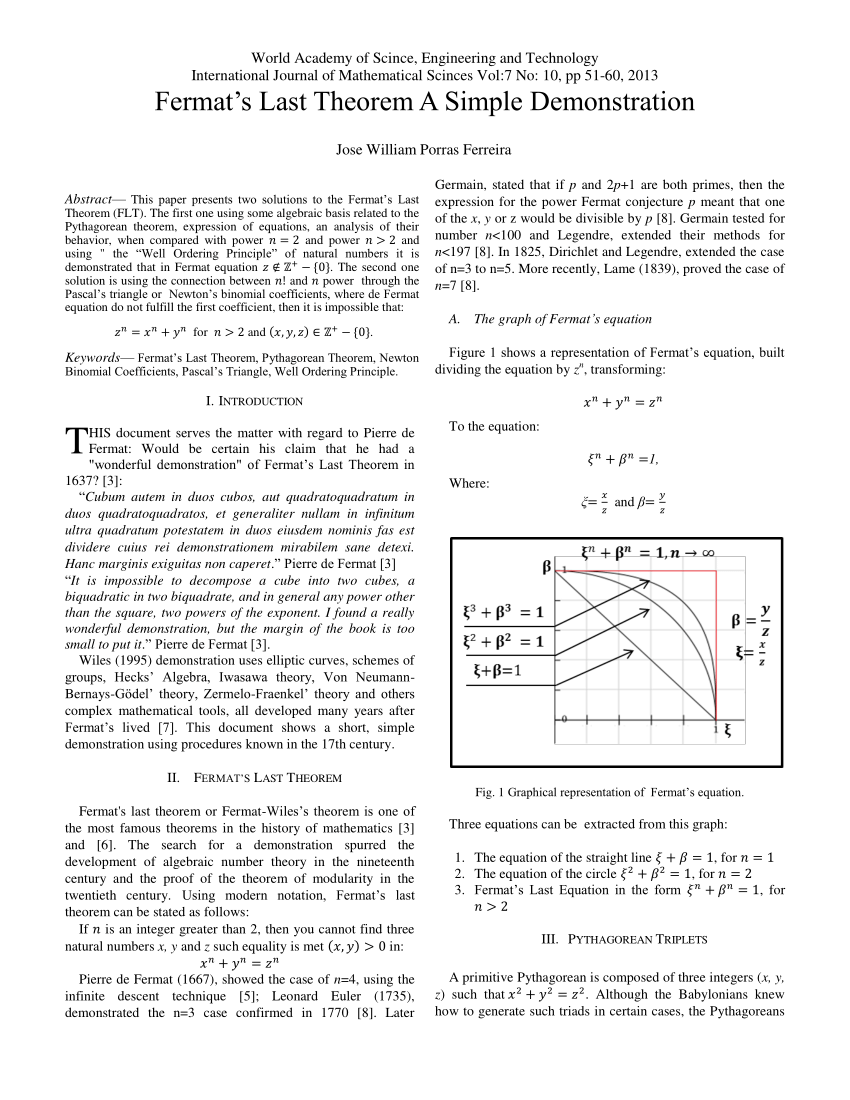
Let's break down how each philosophy interprets this situation.
The Platonist Interpretation
For a Platonist, the statement "Fermat's Last Theorem is true" means that in the objective, mind-independent realm of mathematical objects:
- The numbers (integers), the operations of addition and exponentiation, and the relation of equality all exist as abstract objects or structures.
- The relationship described by the theorem is a factual state of affairs within that realm. It was true long before Fermat conjectured it and long before Wiles proved it.
- Andrew Wiles's proof was an incredible act of discovery. He constructed a logical pathway that allowed human minds to gain access to this pre-existing, eternal truth about the structure of the number system.
For the Platonist, the truth of the theorem is absolute and external. It describes a feature of reality.
The Fictionalist Interpretation
For a Fictionalist, the interpretation is quite different. The statement "Fermat's Last Theorem is true" is, literally speaking, false. Why? Because the statement's truth would require the existence of objects—integers—and the fictionalist denies that such abstract objects exist.
However, this doesn't mean the statement is meaningless or that Wiles's proof was pointless. The Fictionalist re-interprets the claim:
- The statement is not literally true, but it is "true-in-the-story-of-mathematics" or "correct according to the fiction of arithmetic."
- This means that the theorem is a logical consequence of the axioms we accept as the foundation of arithmetic (e.g., the Peano axioms or their set-theoretic equivalents in ZFC).
- Andrew Wiles's proof was an act of derivation. He showed that this complex proposition logically follows from the starting rules of the mathematical "game". He didn't discover a fact about an external world; he revealed a deep consequence hidden within the structure of the fiction we have created.
For the Fictionalist, the "truth" of the theorem is internal to a system we constructed. Its power comes not from describing an abstract reality, but from its consistency within a highly useful, elegant, and powerful formal story.
4. Comparison and Summary
Here is a table summarizing the core differences in their interpretations:
| Aspect | Mathematical Platonism | Mathematical Fictionalism |
|---|---|---|
| Ontology | Integers exist as abstract objects. | Integers are fictions; they do not exist. |
| Truth of FLT | The theorem is literally true. It describes a fact about the abstract realm of numbers. | The theorem is literally false (since numbers don't exist), but it is correct within the story of mathematics. |
| Nature of Proof | An act of discovery. Wiles uncovered a pre-existing, eternal truth. | An act of derivation. Wiles showed the theorem is a logical consequence of our axioms. |
| Source of Objectivity | The mind-independent structure of the Platonic realm. | Consistency and logical consequence within an axiomatic system (the "story"). |
Test your understanding!
Goldbach's Conjecture states that "Every even integer greater than 2 is the sum of two primes." It has been verified for vast numbers but remains unproven.
How would a Platonist and a Fictionalist describe the current truth status of this conjecture?
Show answer
-
A Platonist would say that Goldbach's Conjecture is already either true or false. In the timeless, abstract realm of numbers, it is a determinate fact whether all even integers have this property. Our epistemic limitation—our lack of a proof—does not change this underlying metaphysical reality. We just don't know which it is yet.
-
A Fictionalist would say that the statement is currently literally false (like all mathematical statements referring to numbers). The more interesting question is whether it is "true-in-the-story-of-mathematics". Currently, we do not know if it is a consequence of our accepted axioms. It's possible that the statement is undecidable within our current axiomatic system (like the Continuum Hypothesis in ZFC). For the Fictionalist, there is no guarantee of a determinate "truth" waiting to be found; its status depends entirely on its relationship to the axioms of our chosen fiction.
Conclusion
This lesson has been a capstone exercise in applying philosophical analysis. By taking a statement whose mathematical truth is beyond dispute—Fermat's Last Theorem—we've seen how fundamental philosophical commitments about existence and meaning lead to starkly different interpretations of what that truth consists in.
Key Takeaways:
- Platonism interprets mathematical truth as a description of a real, mind-independent, abstract realm. This intuitively captures the objectivity of mathematics but faces a difficult epistemological challenge.
- Fictionalism interprets mathematical truth as correctness within a useful, human-constructed "story" or formal system. This avoids the ontological and epistemological problems of Platonism but must explain the incredible applicability of a "fiction."
- When applied to Fermat's Last Theorem, a Platonist sees a discovered fact of an abstract reality, while a Fictionalist sees a complex derivation within a formal game.
This brings our course to a close. You began by exploring the ancient roots of philosophy with Plato and his Theory of Forms—a direct ancestor of modern Platonism. You journeyed through centuries of philosophical development, acquiring the tools of modern logic, modal reasoning, and philosophical analysis. Today, you applied those tools to a debate that stands at the intersection of your core interests: metaphysics and the foundations of mathematics.
You have successfully moved from being a student of philosophy's history to being a practitioner of its methods. Congratulations on completing this journey