Recommended resources
The freely available resources this lesson will direct you to.
Welcome to your seventh lesson in the "Accounting Foundations" module.
In our previous lessons, we focused on the mechanics of the accounting cycle: we learned how to analyze transactions, record them in a journal, and then post them to T-accounts to track the balance of each account. This is the "how" of day-to-day accounting.
Today, we will take a step back to understand the "why." Accounting is not just a random set of rules; it is governed by a framework of fundamental principles that ensure financial information is reliable, consistent, and comparable across different companies and over time. Understanding these principles is what separates a bookkeeper from a professional accountant.
This lesson addresses the learning outcome: Identify fundamental accounting principles (going concern, consistency, accrual basis) and their purpose. We will explore three of the most important pillars of accounting, which form the foundation for everything we will do from this point forward.
1. The Rules of the Game: An Overview of Accounting Principles
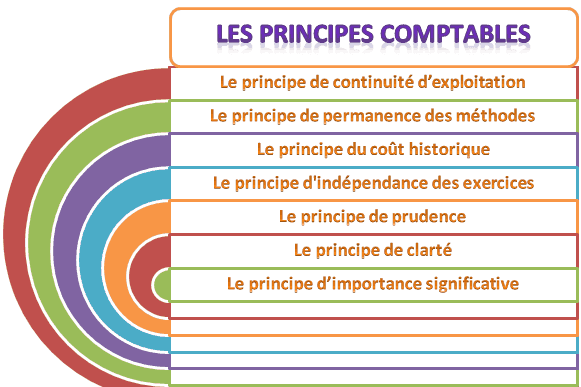
In Morocco, the primary set of accounting rules is known as the Code Général de la Normalisation Comptable (CGNC). This code outlines several fundamental principles that all companies must follow when preparing their financial statements. These principles ensure that when you look at a company's balance sheet or income statement, you can trust that it presents a fair and consistent picture of the business's reality.
The image below lists the seven key principles according to the Moroccan accounting framework. We will focus on three of them in this lesson, but it's useful to see them all together.
2. The Going Concern Principle (Principe de continuité d'exploitation)
The first, and perhaps most fundamental, assumption in accounting is that a business will continue to operate for the foreseeable future. This is the going concern principle. It assumes the business is not on the verge of bankruptcy or liquidation.
Purpose and Implication:
Why does this matter? This assumption allows us to record assets at their original cost and depreciate them over their useful lives. If we didn't assume the business would continue, we would have to value all assets at their immediate sale price (liquidation value), which would present a very different and less useful picture of the company.
- Example: A Moroccan SME buys a new machine for 500,000 MAD. The machine is expected to last 10 years. Thanks to the going concern principle, the company can spread the cost of this machine over those 10 years (a process called depreciation, which we will study later). Without this principle, the company might have to record the machine at its immediate resale value, say 350,000 MAD, on the day of purchase, which wouldn't accurately reflect the value it brings to the ongoing operations.
To get a quick overview of this concept, please watch the following short clip.
8 Accounting Principles & Concepts | Full Guide + Free PDF #accounting #accountingprinciples
This clip from Educationleaves provides a concise explanation of the going concern concept.
Watch the section from 01:11 to 01:41. Focus on how the assumption of continuing operations affects the valuation of assets.
The image below, from a Moroccan professional source, gives the formal definition of this principle. It states that an enterprise must prepare its financial statements with the perspective that it will continue its activities normally.

3. The Accrual Basis of Accounting (Principe de spécialisation des exercices)
This is one of the most important concepts that distinguishes professional accounting from simple cash tracking. The accrual basis dictates that transactions are recorded in the period in which they occur, not necessarily when cash is exchanged.
The Moroccan principle of spécialisation des exercices (independence of fiscal years) is built on this idea. It means that each financial year should include only the revenues and expenses that relate to that specific year, regardless of when the money was paid or received.
This overarching principle breaks down into two key components:
- Revenue Recognition: Revenue is recorded when it is earned (e.g., when a service is completed or goods are delivered), not when the customer pays.
- Matching Principle: Expenses are recorded in the same period as the revenues they helped to generate.
Purpose and Implication:
The goal is to provide a more accurate picture of a company's profitability during a specific period. If you only recorded cash transactions, you might think a month was unprofitable just because clients paid late, or highly profitable just because you paid all your bills in the next month.
The following video provides an excellent, detailed explanation of the accrual concept.
Accrual Concept EXPLAINED - By Saheb Academy
In this video, Saheb Academy explains the accrual concept with clear examples and contrasts it with the cash basis of accounting. This will solidify your understanding of this core idea.
Please watch the video from the beginning until 06:25. Pay close attention to the rent expense example (recognizing an expense when incurred) and the sales revenue example (recognizing revenue when earned).
To reinforce this, the following reading material breaks down how the accrual basis applies to revenues and expenses.
Accounting Basics: In-Depth Explanation with Examples
This text from AccountingCoach, titled 'Accounting Basics: In-Depth Explanation with Examples', provides clear, practical examples of applying the revenue recognition and matching principles.
Please read the two subsections titled 'A. Revenues' and 'B. Expenses'. Focus on how revenues are recorded when earned and how expenses are matched with those revenues.
4. The Consistency Principle (Principe de permanence des méthodes)
The consistency principle states that once a company adopts an accounting method, it should continue to use that same method from one period to the next.
Purpose and Implication:
Consistency is essential for comparability. If a company constantly changed how it valued its inventory or calculated depreciation, it would be impossible for managers, investors, or banks to compare financial statements from different years and identify meaningful trends. Performance could appear to improve or worsen simply due to a change in accounting method, not because of a real change in the business's operations.
If a company has a valid reason to change methods, it is allowed, but it must be disclosed in the financial statements, along with the justification and the financial impact of the change.
Watch this final short clip for a clear summary of this principle.
8 Accounting Principles & Concepts | Full Guide + Free PDF #accounting #accountingprinciples
This clip from Educationleaves explains why consistency is a key principle in accounting.
Watch the section from 01:41 to 02:09. Note the importance of being able to compare financial statements over time.
Test your understanding!
Consider a small Moroccan IT consulting firm, "InfoSolutions SARL".
-
In December 2023, InfoSolutions completed a project for a client and sent an invoice for 25,000 MAD. The client paid the invoice in January 2024. According to which principle should the revenue be recorded in December 2023?
-
For the past three years, InfoSolutions has been calculating depreciation on its computers using the straight-line method. In 2024, the accountant decides that another method looks better and changes it without telling anyone. Which principle has been violated?
-
InfoSolutions buys a high-end server for 80,000 MAD, expecting it to be used for the next 5 years. The accountant records it as an asset on the balance sheet. What principle justifies this treatment, rather than recording the full 80,000 MAD as an expense in the year of purchase?
Show answer
-
The revenue should be recorded in December 2023. This is dictated by the accrual basis (specifically, the revenue recognition part of the principe de spécialisation des exercices). The revenue was earned when the project was completed, not when the cash was received.
-
The consistency principle (principe de permanence des méthodes) has been violated. The company should use the same accounting methods year after year to ensure comparability. Any change must be justified and disclosed.
-
The going concern principle (principe de continuité d'exploitation) justifies this. Because the business is assumed to continue operating, the server is an asset that will provide benefits for 5 years, and its cost can be spread over that period. If the business were liquidating, the server would be treated differently.
Professional Terminology: French & English
| Terme Professionnel (French) | Accounting English | Meaning |
|---|---|---|
| Principe de continuité d'exploitation | Going Concern Principle | The assumption that a business will continue to operate indefinitely. |
| Principe de spécialisation des exercices | Accrual Basis / Matching Principle | Transactions are recorded in the period they occur, matching revenues with the expenses that generated them. |
| Principe de permanence des méthodes | Consistency Principle | The company must use the same accounting methods from one period to the next. |
| Comptabilité d'engagement | Accrual Accounting | Accounting system based on the accrual principle. |
| Comptabilité de caisse | Cash-Basis Accounting | An alternative system where transactions are only recorded when cash is exchanged. |
Conclusion
You have now learned the "rules of the game" that govern all of accounting. These principles are not abstract theories; they have very practical consequences for how we record transactions and report financial results.
Key Takeaways:
- Accounting is governed by a set of fundamental principles to ensure financial information is reliable and comparable.
- The Going Concern Principle allows us to treat a business as an ongoing entity, justifying the long-term valuation of assets.
- The Accrual Basis requires us to record revenues when earned and expenses when incurred, providing an accurate measure of profitability for a period.
- The Consistency Principle ensures that financial statements are comparable over time by requiring the use of the same accounting methods.
Preview of the Next Lesson
Now that we understand both the mechanics of posting to T-accounts and the principles that guide us, we are ready for the next step in the accounting cycle. In our next lesson, we will take the final balances from all our T-accounts and assemble them into a crucial document called a Trial Balance (Balance générale). This will be our first major verification step to ensure that our debits still equal our credits after all transactions for the period have been posted.