Recommended resources
The freely available resources this lesson will direct you to.
Welcome to your fourth lesson in the "Accounting Foundations" module.
In our previous lessons, we built the core engine of accounting: we defined the accounting equation, classified accounts into five types, and learned the universal rules of debit and credit. You now understand the logic of how transactions affect accounts.
Today, we will learn about the accountant's primary tool for organizing this information in the Moroccan context. The learning outcome for this lesson is to explain the purpose and structure of the Moroccan Chart of Accounts (Plan Comptable Général Marocain - PCGM). Think of the PCGM as the official dictionary and address book for every possible financial event in a company. Mastering its structure is the final step before we can start recording transactions like a professional.
1. What is the Plan Comptable and Why is it Necessary?
The Plan Comptable Général Marocain (often abbreviated as PCGM or simply Plan Comptable) is more than just a list of accounts. It is a comprehensive, mandatory framework that dictates how all companies in Morocco must classify, record, and present their financial information.
Its primary purposes are to ensure:
- Standardization (
Normalisation): It provides a common accounting language. When one accountant talks about "Ventes de marchandises," another accountant knows exactly what they mean. - Transparency (
Transparence): It ensures financial statements are clear and reliable for external parties like investors, banks, and the government. - Comparability (
Comparabilité): It allows for the financial statements of different companies to be compared meaningfully. It also allows for a company's performance to be compared over different periods. - Legal Compliance (
Conformité): Using the PCGM is a legal requirement in Morocco for almost all businesses.
To get a formal definition, let's look at an article from a Moroccan consulting firm.
Le plan comptable marocain : définition et utilisation
The article 'Le plan comptable marocain : définition et utilisation' provides a concise overview of the PCGM's role and importance.
Read the introductory paragraphs (before 'Expertise comptable...') and the 'Foire aux questions' section, specifically the answers to 'Qu’est-ce que le plan comptable marocain?' and 'Quelles sont les principales obligations comptables d’une entreprise au Maroc?'. Focus on understanding its mandatory nature and its role in ensuring reliable financial reporting.
As the article confirms, the PCGM is the foundation upon which trustworthy financial reporting is built. It is inspired by the French system but adapted to the Moroccan economic and legal environment.
2. The Overall Structure: The Account Classes
The PCGM organizes all accounts into a logical, decimal-based system built around ten "Classes." Each class groups accounts of a similar nature. For general accounting, we are primarily concerned with the first eight classes.
These classes are divided into two main categories that directly correspond to the financial statements you will learn to build:
- Balance Sheet Accounts (
Comptes de Bilan): Classes 1 to 5 - These accounts represent what a company owns (Assets) and owes (Liabilities and Equity) at a specific point in time. - Income Statement Accounts (
Comptes de GestionorComptes de Produits et Charges - CPC): Classes 6, 7, and 8 - These accounts track a company's financial performance (revenues and expenses) over a period of time.
The image below provides a clear visual summary of the main classes.
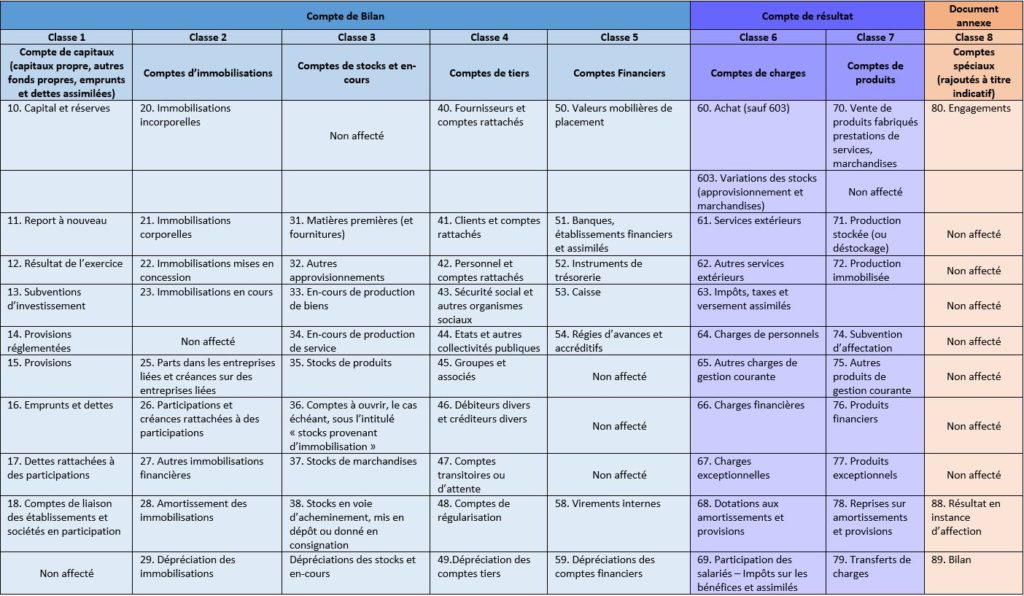
Let's break down these classes, connecting them to the account types you already know:
- Classe 1:
Comptes de Financement Permanent- Contains Equity (e.g.,
Capital social) and long-term Liabilities (e.g.,Emprunts). This represents the stable, long-term resources of the company.
- Contains Equity (e.g.,
- Classe 2:
Comptes d'Actif Immobilisé- Contains long-term Assets, also known as fixed assets (e.g.,
Matériel de transport,Constructions,Logiciels). These are resources the company uses for more than one year.
- Contains long-term Assets, also known as fixed assets (e.g.,
- Classe 3:
Comptes d'Actif Circulant- Contains short-term Assets (e.g.,
Stocks de marchandises,Clients,TVA récupérable). These are assets expected to be converted to cash or used up within a year.
- Contains short-term Assets (e.g.,
- Classe 4:
Comptes de Passif Circulant- Contains short-term Liabilities (e.g.,
Fournisseurs,Personnel,Etat, TVA facturée). These are debts the company expects to pay within a year.
- Contains short-term Liabilities (e.g.,
- Classe 5:
Comptes de Trésorerie- Contains the most liquid Assets like cash (
Caisse) and bank balances (Banque), as well as short-term bank loans or overdrafts, which are Liabilities.
- Contains the most liquid Assets like cash (
- Classe 6:
Comptes de Charges- Contains all Expenses incurred by the business (e.g.,
Achats de marchandises,Salaires,Loyer).
- Contains all Expenses incurred by the business (e.g.,
- Classe 7:
Comptes de Produits- Contains all Revenues earned by the business (e.g.,
Ventes de marchandises,Produits financiers).
- Contains all Revenues earned by the business (e.g.,
- Classe 8:
Comptes de Résultats- This is a special class used at the end of the accounting period to calculate the final profit or loss.
Classes 9 (Comptes Analytiques) and 0 (Comptes Spéciaux) are for cost accounting and other special purposes, which are beyond the scope of our current focus on general financial accounting.
3. The Decimal Codification: How to Read Account Numbers
The true power of the PCGM lies in its decimal codification. Every account has a unique number that tells you exactly where it fits in the structure. This hierarchy works as follows:
Classe (1 digit) -> Rubrique (2 digits) -> Poste (3 digits) -> Compte Principal (4 digits)
This can be broken down even further into Comptes divisionnaires (5 digits) and Sous-comptes (6+ digits) for more detail.
To understand this structure in detail, the following document is an excellent guide.
le-pcge-plan-comptable-general-des-entreprises
The document 'Le PCGE Plan Comptable Général des Entreprises' explains the structure and codification system in a very clear, step-by-step manner. We will focus on the sections explaining the classes and the numbering logic.
Please read sections 'a) Les classes du bilan' through '4) La codification des comptes'. Pay close attention to the examples provided, such as the breakdown of account '2355 : matériel informatique'. This will show you how to decode any account number you encounter.
Let's reinforce this with an example from the resource: Account 2355 - Matériel informatique
- The first digit, 2, tells you it's in Classe 2 (
Actif immobilisé). You immediately know it's a long-term Asset. - The first two digits, 23, identify the Rubrique 23 (
Immobilisations corporelles). This narrows it down to a tangible fixed asset. - The first three digits, 235, point to the Poste 235 (
Mobilier, matériel de bureau et aménagements divers). - Finally, the full number, 2355, specifies the Compte Principal as
Matériel informatique.
This systematic approach means that once you understand the classes, you can instantly get a sense of what an account represents just by looking at its number.
Test your understanding!
Using the logic of the codification system, analyze the account 7111 - Ventes de marchandises au Maroc.
- What Class does it belong to? What does this tell you about its nature (Asset, Liability, Revenue, etc.)?
- Based on your answer above, would an increase in this account be recorded as a Debit or a Credit?
Show answer
- The account number starts with a 7, so it belongs to Classe 7 -
Comptes de Produits. This means it is a Revenue account. - In the previous lesson, we learned that Revenue accounts are on the right side of the expanded accounting equation (
Assets + Expenses = Liabilities + Equity + **Revenues**). Therefore, to increase a Revenue account, you Credit it.
4. Smart Patterns to Help You Navigate
The PCGM was designed with logical patterns that make it easier to remember and use. Recognizing these patterns will significantly accelerate your learning.
le-pcge-plan-comptable-general-des-entreprises
Let's return to the 'Le PCGE' document to uncover these useful patterns. This is one of the most practical parts of understanding the chart of accounts.
Read the section 'b) Les particularités de la codification'. Focus on the 'codification constante' (e.g., what a 4 or 8 in the second position means) and the 'parallélisme' between charge/product and asset/liability accounts.
Here are some of the most helpful patterns mentioned in the resource:
-
Parallelism in Charges (6) and Products (7): The second digit often aligns.
61are Operating Expenses (Charges d'exploitation);71are Operating Revenues (Produits d'exploitation).63are Financial Expenses (Charges financières);73are Financial Revenues (Produits financiers).- This logic extends further:
6111isAchats de marchandises(an expense), while7111isVentes de marchandises(a revenue).
-
Parallelism in Assets and Liabilities:
3455isEtat, TVA **récupérable**(a receivable from the state, an Asset).4455isEtat, TVA **facturée**(a payable to the state, a Liability).- Notice the numbers are identical except for the Class (3 for Asset, 4 for Liability).
-
Meaningful Digits:
- A
9in the second position of an asset account (e.g.,29xx,39xx) almost always signifies aProvision pour dépréciation(a provision for the decrease in value of that asset). - An
8in the second position of a fixed asset class (e.g.,28xx) signifiesAmortissement(Depreciation).
- A
You are not expected to memorize the entire chart of accounts—no accountant does. The goal is to understand the structure so you can navigate it efficiently to find the correct account for any transaction.
Conclusion
You have now explored the accountant's roadmap: the Plan Comptable Général Marocain. With this structured knowledge, you are no longer just dealing with abstract concepts of "assets" or "expenses," but with specific, numbered accounts like 2340 - Matériel de transport and 6125 - Achats de fournitures de bureau.
Key Takeaways:
- The PCGM is the mandatory accounting framework in Morocco, ensuring standardization, transparency, and comparability.
- It is structured into 10 Classes, with Classes 1-5 for the Balance Sheet and Classes 6-8 for the Income Statement.
- The decimal codification provides a powerful hierarchy (Class -> Rubrique -> Poste -> Compte) that reveals the nature of an account from its number.
- Logical patterns and parallelisms exist within the codification, making the system easier to understand and use.
Preview of the Next Lesson
The foundational theory is now complete. You have all the necessary components: the equation, the five account types, the debit/credit rules, and the chart of accounts. In our next lesson, we will finally begin the most practical skill of all: recording basic business transactions in a double-entry journal format. We will take simple business events and translate them into the formal language of accounting.