Recommended resources
The freely available resources this lesson will direct you to.
- Troubleshooting Methodology | CompTIA IT Fundamentals+ (FC0-U61) | Part 35 of 38www.youtube.com
- A 9-Step Troubleshooting Process That Works for Almost Any IT Issuewww.youtube.com
- Troubleshooting Methodology: A Learning Pathsre.google
- Troubleshoot with Cloud PC monitoring (preview) | Microsoft Learnlearn.microsoft.com
Welcome back. Last time, you turned a vague report into a problem statement that separates expected behavior, actual behavior, scope, environment, and reproduction steps. That statement tells you what is known without claiming to know the cause.
Today you’ll use those observations to form a short list of testable hypotheses and decide which one to investigate first. This is a familiar transition in SaaS support: a customer needs progress, but “try a few fixes” is less useful than choosing a check that will narrow the possibilities. Allow about 35–40 minutes, including the reading and video.
A hypothesis is a possible explanation, not a diagnosis
Suppose a customer says, “The export failed because Safari is broken.” The failure may be real, but the proposed cause is still unverified. A useful hypothesis states what might account for the observation and what else you would expect to see if it were true:
The thirty-day export fails because something about this browser’s handling of that export differs from other supported browsers. If so, the same account, report, and date range may work in another browser.
That prediction makes the idea investigable. It also leaves room for a surprising result: if the export fails in both browsers, you should lower the priority of a Safari-specific explanation rather than defend it.
Google’s Troubleshooting Methodology: A Learning Path describes this as repeatedly using observations and knowledge of the system to propose and test possible causes. Read its short explanation of the method and its practical guidance on choosing informative tests. You do not need to know Google’s infrastructure; focus on the reasoning pattern.
Troubleshooting Methodology: A Learning Path
Read the Google SRE chapter for its distinction between an observation, a possible cause, and evidence that could support or weaken that cause.
In “Theory,” start with the troubleshooting model. Then go to “Test and Treat”: begin where it introduces a short list of possible causes, and read the test guidance through the final bullet about tests that are only suggestive. Notice especially why a useful test separates possibilities and why its result might not be conclusive.
The diagram accompanying that chapter is a helpful reminder that troubleshooting is not a straight line ending with your first guess:
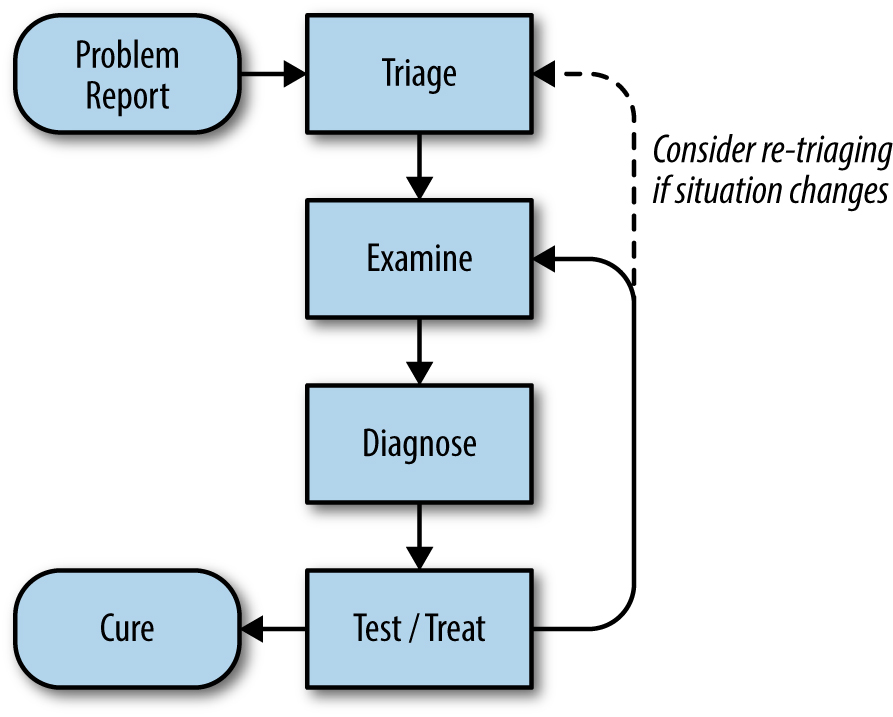
The six-layer model from the start of this module—client, network, API, application, data, and third party—helps you generate candidates. But a layer is not yet a testable hypothesis. “It’s the application” does not predict much. “The application’s thirty-day export path fails for this report across accounts, while the seven-day path works” predicts a pattern you could look for.
Turn the export report into a short list
Return to the fictional case from the previous lesson. In the production web app, support tried to export the Weekly usage report for account A-104 in Safari 17 on macOS 14. Last 30 days displayed “Export failed” and produced no file on three attempts. Last 7 days downloaded a file on one attempt. Other accounts, reports, and browsers were not tested.
Start with what this evidence actually distinguishes. The seven-day success makes “exports never work in this session” less plausible. It does not establish that Safari is fine for every export, or that the thirty-day option is broken for everyone. The three failures make the reported thirty-day behavior more credible in this environment; they do not tell us which component caused it.
Here are three reasonable, competing explanations:
- Account-specific data or configuration: Something associated with
A-104causes its thirty-day export to fail. Data included in that range or an account setting could matter; the present evidence cannot distinguish those possibilities. - Shared thirty-day processing problem: This report’s thirty-day export path fails across accounts, regardless of anything unusual about
A-104. - Browser-specific behavior: The thirty-day export fails in Safari but succeeds in another supported browser for the same account.
These are deliberately more precise than “data issue,” “application bug,” and “client issue.” Each predicts a different pattern of success and failure. None is established by the current ticket.
The ACI Learning video Troubleshooting Methodology | CompTIA IT Fundamentals+ (FC0-U61) | Part 35 of 38 demonstrates the transition from several possibilities to a small set of theories. Its example concerns DNS, a service used to look up network names. You do not need to run or understand the commands shown; watch how a comparison changes the investigators’ confidence without guaranteeing that they have found the only cause.
Troubleshooting Methodology | CompTIA IT Fundamentals+ (FC0-U61) | Part 35 of 38
Watch ACI Learning’s discussion of forming and testing a theory to see how troubleshooters use one result to reconsider competing explanations.
Watch the theory and test. Focus on why comparing two lookup results is more informative than repeatedly trying the same failing action, and on the presenters’ caution that the result does not guarantee a complete diagnosis.
A practical phrasing pattern is: “If this explanation is true, I would expect [observable pattern]. If I instead see [different pattern], I will weaken or revise it.” You do not have to predict every outcome perfectly. You do have to specify what information would change your mind.
Prioritize the next check, not the most confident-sounding story
When several hypotheses fit the evidence, ranking them by gut feeling alone is difficult. Instead, ask which safe, available check will separate them most efficiently. Consider four factors together:
- Fit: Does the hypothesis account for the observed successes and failures without extra assumptions?
- Information gained: Would the result meaningfully change which explanations remain plausible?
- Cost and safety: Can you make the observation promptly, with appropriate access, without changing customer data or settings?
- Impact: Does the possible scope call for an immediate broader check or escalation?
For the export case, a high-value next check—if support has an authorized test account—is to try Weekly usage, Last 30 days, in the same browser, but in that other account. Keep the report, range, browser, and production environment the same. This comparison is attractive because it may separate an account-specific pattern from a broader thirty-day pattern. It does not require declaring either cause correct in advance.
| Possible result in the authorized second account | How to update the hypotheses |
|---|---|
| The thirty-day export succeeds | An account-specific explanation becomes more plausible; a shared failure across accounts becomes less plausible. The result does not yet tell you whether data, configuration, or another account difference matters. |
| The thirty-day export fails | A shared thirty-day problem becomes more plausible. Two accounts failing still does not prove every account is affected or identify the failing component. |
A browser comparison can then address a different question. Try the same account, report, and range in another supported browser, if one is available. A success there would strengthen a browser-related explanation; failure there would weaken a Safari-only explanation. Either outcome still needs careful interpretation because browsers can interact differently with a server-side problem.
Notice the order is conditional, not a rigid checklist. If you lack authorized access to a second account but can safely use another browser, the browser comparison may be the best available next check. If several independent customers are reporting the same failure now, checking existing cases or service-health information and reassessing scope may be more urgent than either comparison. “No one else has reported it” is not the same as “no one else is affected.”
This distinction matters in a support role: investigation priority asks which check will teach you the most next; case urgency asks how quickly the customer impact needs attention. A widespread, time-sensitive failure may require coordination while the cause remains uncertain.
Record predictions and revise them as evidence arrives
A compact hypothesis note in Freshdesk or Jira can keep the investigation from drifting into unrelated fixes:
Known:
A-104/ Weekly usage / Safari 17: Last 30 days failed 3/3; Last 7 days succeeded 1/1. Other accounts and browsers untested.
Leading alternatives: Account-specific data or configuration; shared thirty-day processing; browser-specific behavior.
Next check: If authorized, try Last 30 days for Weekly usage in a second account using the same browser. Record account, time, and visible result.
Interpretation: Success would shift attention toward differences involvingA-104; failure would increase concern about a broader pattern. Neither result alone establishes root cause.
This note makes the proposed action understandable to a colleague and gives you a way to learn from a negative result. If a hypothesis loses support, that is progress: you have narrowed the investigation.
Be wary of two common leaps. First, correlation is a clue, not a cause. The failure appears with the thirty-day choice, but that choice could change the amount of data, the records included, or the code path used. Second, a check may be suggestive rather than definitive. A successful export in another account supports an account-related pattern, but accounts differ in more than one way.
For now, the task is to choose and justify the next observation—not to make configuration changes or attempt a repair. The next lesson will show how to run a controlled troubleshooting test, changing one relevant variable at a time so its result is easier to interpret.
Key takeaways
A testable hypothesis is a possible explanation with an observable prediction, not a restatement of the symptom or a confident diagnosis. Build a small set from the evidence, including what still works and what remains untested. Prioritize a safe check that will distinguish plausible explanations, then update your ranking when the result arrives—even if it contradicts your initial preference.
That habit turns “I think I know what’s wrong” into an investigation another support engineer can follow and continue.