Recommended resources
The freely available resources this lesson will direct you to.
Hello. This course focuses on making your meetings, presentations, dashboards, and verbal updates useful to the people who must act on them. In this first module, you will build the foundations of executive communication: identifying the outcome you need, judging what the audience needs to know, and getting to the point concisely.
Today’s foundation is a planning question: What should be different after this communication? Before choosing slides or opening a spreadsheet, you will learn to define a specific decision, action, or alignment goal. That choice will give the rest of your preparation a direction.
Start with the outcome, not the material
Suppose you have noticed that pipeline coverage has weakened in one region. You have a dashboard, a spreadsheet of opportunity changes, and several possible explanations. “Walk executives through the pipeline data” describes your material, but not what the meeting should accomplish. Even “make them aware of the decline” leaves a question: what should they do with that awareness?
A useful goal names a change you can recognize at the end of the conversation. The room might decide whether to investigate the decline, assign someone to check the data, or agree on how to interpret it in the next forecast. These are different outcomes. Each calls for different preparation.
The Moxie Institute’s 10 Tips for Impressive Presentations to Senior Leadership and Executives puts the intended outcome at the start of presentation planning. Read the short passages below for the distinction between having a topic and making an explicit ask.
10 Tips For Impressive Presentations To Senior Leadership And Executives
Read the Moxie Institute’s guidance to see why an executive presentation should be built around what the room needs to do, rather than everything the presenter knows.
In “The Moxie Executive Presentation Framework,” start at “Most executive presentations fail not because the presenter lacks knowledge” and read through the first numbered item, ending “Every other element of the presentation should serve this decision.” Focus on the planning principle. Then, under “10 Communication Behaviors,” find “Be explicit about what the room needs to decide.” Start at “One of the most underused moves in executive presentations” and stop at “a signal of your own preparation.” Read the explicit ask for the difference between a decision, an approval, an awareness update, and a request for feedback.
This principle applies even if you are giving a two-minute verbal update rather than a formal presentation. Your topic might be forecast accuracy; your communication goal might be to get agreement on which forecast definition everyone will use. The goal determines which facts matter.
Choose the right kind of outcome
A decision, an action, and alignment are related, but they are not interchangeable.
A decision goal seeks a choice from someone with authority. For the pipeline example: “By the end of the review, obtain a yes-or-no decision on a two-week diagnostic in the affected region.” This is appropriate if there is enough information to define the proposed diagnostic and the executive can authorize it. It does not require pretending you already know why coverage fell.
An action goal seeks a concrete next step, usually with an owner and a time. For example: “By the end of the review, have the commercial leader assign an owner to check opportunity-stage changes and report findings on Friday.” Here the immediate need is not a strategic verdict. It is to get the work needed for one underway.
An alignment goal seeks a shared position that will guide later decisions. Imagine finance and sales are using different definitions of qualified pipeline. A suitable goal is: “By the end of the review, agree on the definition both groups will use in the next forecast and when they will revisit the trend.” Alignment means more than everyone saying they are “on the same page”; you should be able to name the point of agreement.
The distinction helps you avoid two common mistakes. One is asking for approval before the evidence supports a choice. The other is ending with general agreement when somebody actually needs to make a decision or take responsibility for a task. If the data is not ready for a substantive decision, say what is ready: perhaps a diagnostic assignment or agreement on the evidence required.
A compact planning sentence is:
By the end of this interaction, I want the relevant person or group to decide, do, or agree on a specific thing, with a clear scope or next point of review.
This is a preparation tool, not a script you must recite. Its value is that it exposes vague aims. “Discuss the dashboard” does not fill in the sentence. “Agree which coverage measure will appear in next month’s forecast” does.
Ask for something the audience can actually provide
Specificity includes knowing whose contribution is needed. An executive who can authorize resources may not be the person who will inspect opportunity records. A leader who can bring groups into agreement may not control the relevant budget. One person can play several roles; titles alone do not tell you which role matters in this conversation.
Nancy Duarte’s How to Write a Call to Action That’s Persuasive describes calls to action in terms of what audience members can contribute. Its examples extend beyond executive settings, but the underlying test is useful here: does your ask fit what this audience can actually do?
How to Write a Call to Action That's Persuasive
Read Nancy Duarte’s explanation of why an audience needs a concrete role, then examine the four kinds of contribution people might make.
In “What is a call to action in writing?”, start at “A well-constructed and delivered presentation changes minds and ignites action” and read through “these tasks must be completed in order to bring your ideas to fruition.” Focus on the concrete task. In “How to write a call to action: Start with your audience,” read from “Before creating your calls to action in writing your persuasive speech” to “Let's break this down,” focusing on audience roles. Then, under “4 examples of call to action in persuasive writing,” read the four numbered examples from “Doers are the worker bees of an organization” through “ready to make something new,” focusing on possible contributions.
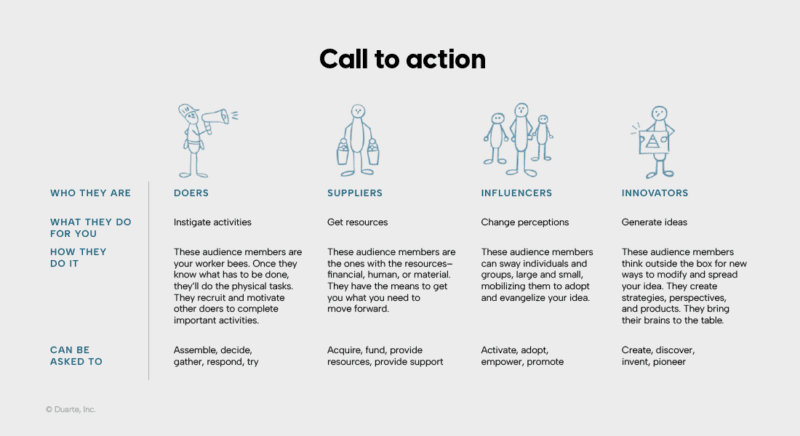
Return to the pipeline example. If you need the executive to release analyst capacity, ask for that authorization rather than asking them to perform the analysis. If you need two leaders to use the same definition, ask them to settle the definition rather than approve an unrelated project. If you do not know who has authority, your immediate goal may be to identify the decision owner. That is more useful than making a polished request to the wrong person.
Duarte discusses the call to action as part of a persuasive presentation. Here, you are working one step earlier: define the intended ask before you build the communication. Once defined, you can make it clear to the audience during the conversation and return to it when closing.
When the meeting cannot yet make the decision
A formal meeting is not always the first time an idea should be discussed. A brief conversation beforehand can reveal that your proposed decision is too broad, the evidence is incomplete, or a key stakeholder understands the issue differently. In that case, your immediate communication goal may be to gather feedback or establish alignment so that a later decision is well framed.
Watch this short excerpt from Harvard Business Review’s The Real Meeting Happens Before the Meeting. Treat it as a reason to check readiness and perspectives, not as a rule that every decision is settled privately.
The Real Meeting Happens Before the Meeting
Watch Harvard Business Review’s “The Real Meeting Happens Before the Meeting” to see how preliminary conversations can clarify a proposal before a formal decision discussion.
Watch the meeting setup, from the opening example through the description of informal messages and more structured pre-meetings. Notice how feedback can change the proposal—and therefore what it is reasonable to ask the formal meeting to decide.
For instance, you may initially intend to ask for a broad change to the forecasting process. After speaking with the people responsible for finance and sales inputs, you discover that they disagree about one metric’s definition. The next executive update may be better aimed at agreement on that definition, not approval of the entire process change. You have not abandoned the larger business aim; you have identified the outcome the next conversation can credibly achieve.
A final check before you prepare the slides
Before building a deck, opening a dashboard, or drafting a verbal update, test your goal against four questions:
- Is there an observable end state? “Understand the issue” is hard to verify. “Agree which measure to use” is not.
- Is the ask within this audience’s authority or influence? If not, identify who needs to participate.
- Is it supported by what you know now? Do not ask for a major intervention when the immediate need is to validate the signal.
- Is the scope clear? “Approve a diagnostic in one region for two weeks” is a more answerable request than “fix pipeline coverage.”
A clear goal does not guarantee a yes. A reasoned no, or a deferral with a named missing piece of evidence and a next review point, can still move the issue forward. Your job is to make the requested outcome explicit enough that the room can respond meaningfully.
Key takeaway
Executive communication starts with an intended outcome, not a collection of material. Decide whether this interaction should produce a choice, a concrete next step, or a shared position; name the people involved and make the scope specific. That goal becomes your guide for what to include—and what to leave out.
In the next lesson, you will look more closely at how different executive responsibilities shape the information people need before they can respond to your ask.