Recommended resources
The freely available resources this lesson will direct you to.
- Don't use AI for research until you've watched this...NEW Ruleswww.youtube.com
- What is generative AI and how does it work? – The Turing Lectures with Mirella Lapatawww.youtube.com
- Ten simple rules for optimal and careful use of generative AI in science | PLOS Computational Biologyjournals.plos.org
- Generative AI policies for journalswww.elsevier.com
Hello. This final module of the course considers what happens when an AI tool enters a research workflow. The central question is not simply whether a tool is useful. It is whether its use is permitted, whether the information you give it is protected, whether its output can be trusted, and whether a person remains responsible for the work.
By the end of this lesson, you should be able to evaluate a proposed use of AI on those grounds and specify what must be checked, recorded, and disclosed. Plan on about 40–45 minutes, including the short video and readings.
An assistant can produce content without establishing evidence
Generative AI can draft text, suggest references, write code, and create images. Those capabilities can save time, but a fluent answer is not necessarily a checked answer. In research, the distinction matters: a plausible reference might not exist, a summary might omit a contrary finding, and working code might implement the wrong analysis.
What is generative AI and how does it work? – The Turing Lectures with Mirella Lapata
Watch “What is generative AI and how does it work?” from The Royal Institution, presented by Mirella Lapata, for a short introduction to what these tools produce and why convincing text still needs checking.
Watch the definition for the kinds of content generative AI can create. Then go to language modeling, where the speaker explains prediction from context. Focus on the implication for research: generating a likely continuation is different from verifying a claim against evidence.
That distinction does not mean AI is never useful in research. It means you must define its role before deciding whether to use it. Asking a tool for possible search terms is a different proposal from asking it to decide what the literature proves. The first may provide leads for you to investigate; the second risks transferring scholarly judgment to a system that cannot take responsibility for it.
The FOCUS framework offers a useful way to organize this judgment across the life of a project.

Read the opening two rules of the FOCUS framework in PLOS Computational Biology. They establish the first question in any evaluation: what, exactly, is the tool being asked to do?
Under “Ten simple rules for the responsible use of generative AI,” find “Before using GenAI in your research.” Read “Rule 1. Clearly define research goals and scope where GenAI will be used” and “Rule 2. Understand the capabilities and limitations of AI tools,” from goals to limits. Stop before Rule 3. Notice why defining a narrow task makes both its benefits and its risks easier to assess.
A defined task makes evaluation possible. “Use AI for my paper” is too vague: it says nothing about inputs, outputs, or who will make decisions. “Suggest headings for an author-written draft, without receiving confidential material or changing its claims” is specific enough to check against a policy and to verify afterward.
First check permission, then protect the input
There is no universal rule saying that all research uses of AI are allowed—or that all are forbidden. Requirements may come from a research institution, funder, journal, project agreement, or rules governing particular data. A permitted use under one journal’s policy may be restricted under another’s. Check the rules that apply to the proposed task before entering material into a tool. If they are unclear, seek clarification rather than assuming that a common practice is authorized.
Next ask what the tool would receive. An unpublished manuscript, identifiable participant information, a confidential review assignment, or someone else’s proprietary material may be protected even if your intended output seems harmless. The risk lies partly in the input: pasting material into a service may expose or transfer it under terms you have not checked. Removing names does not necessarily remove all identifying or confidential details.
A publisher policy gives concrete examples of how permission and confidentiality interact:
Generative AI policies for journals
Read selected parts of Elsevier’s journal policy as an example of a binding publisher-specific rule, not a rule for every research venue. Focus on both the information supplied to a tool and the task assigned to it.
In “Responsible use of AI tools,” read from privacy and rights; stop before “Disclosure.” Under “For reviewers,” find “The use of generative AI and AI-assisted technologies in the journal peer review process.” Read from the review restriction. Finally, in “What is a private AI tool?”, read the definition beginning private tool and the checks from privacy checks.
A tool advertised as “private” is not automatically suitable. You need to verify what happens to inputs: whether they are retained, reused, shared, or used for training, and whether the terms preserve the necessary rights. More importantly, a tool’s privacy features do not override a separate prohibition on uploading a submitted manuscript. Permission for the task and protection for the input are distinct requirements; both must be satisfied.
Verify the output; retain human judgment
Passing the first two checks only makes a proposed use potentially acceptable. You must still establish whether its output is reliable enough for its intended role.
Verification should match what the tool produced. For a suggested citation, locate the original work and check that the bibliographic details and attributed claim are real. For a literature summary, read the relevant sources yourself and look for omissions or distorted emphasis. For generated analysis code, inspect what it calculates and test its results against known cases or an independent check. For edited prose, compare it with the underlying evidence to ensure the meaning has not shifted. Simply asking the same tool whether its answer is correct is not independent verification.
Return to the FOCUS framework for the rules on checking outputs, preserving scientific judgment, and reporting AI use.
Under “While using GenAI in your research,” read “Rule 6. Validate and iterate AI-generated outputs” and “Rule 7. Maintain scientific rigor in AI contributions,” from validation and rigor. Then, under “After using GenAI in your research,” read “Rule 9. Disclose AI usage transparently” and “Rule 10. Adhere to formal and community guidelines for GenAI usage,” from disclosure and rules. Focus on what researchers must still be able to explain and defend.
The governing principle is assistance without transferred accountability. A human researcher must be able to explain the methods, defend the interpretation, correct errors, and answer questions about the finished work. An AI tool cannot accept those responsibilities as an author or reviewer. Disclosure does not make an unchecked conclusion reliable, just as careful checking does not excuse a policy violation.
It helps to keep three judgments separate when evaluating a proposal:
- Prohibited: a controlling policy rules out the task or input. Do not proceed merely because the output might be useful.
- Conditional: the task may be allowed, but only after protecting inputs, independently checking outputs, and meeting reporting requirements.
- Permitted after checks: the applicable rules allow it, the input is appropriate, and people have completed the necessary verification and documentation.
“Permitted” is therefore not a verdict on the tool in general. It is a verdict on a particular use, with particular material, under particular rules.
Disclose the contribution at the right level
Transparent reporting tells readers what role AI played; it does not credit AI with authorship. The detail and location depend on both the use and the applicable policy. A tool that helped prepare prose may require a declaration or acknowledgment. A tool used in data processing or analysis may need to be described in Methods so others can understand what was done. Rules for AI-assisted figures may impose additional restrictions or require a caption disclosure.
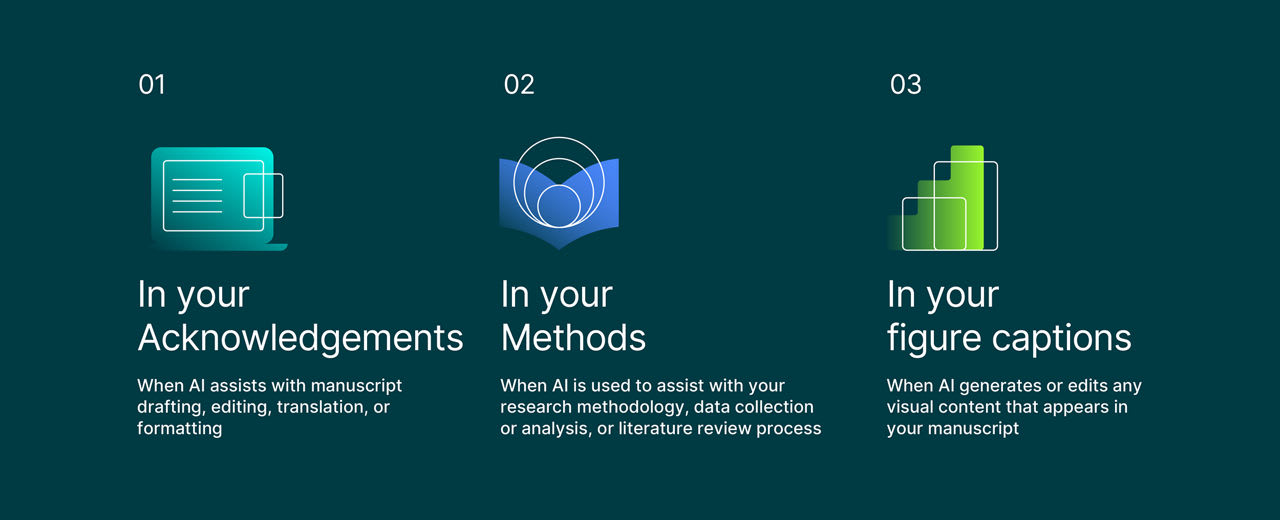
Elsevier’s policy, for example, specifies a separate AI declaration for substantive manuscript-preparation assistance and a Methods description for AI used in the research process. It makes an exception to the declaration requirement for basic grammar, spelling, and punctuation checks. Do not extend that exception to every kind of rewriting or every publisher.
Generative AI policies for journals
Read Elsevier’s specific disclosure and record-keeping instructions. Compare them with the broader principle from FOCUS: report enough for others to understand the tool’s contribution and your oversight.
In “Disclosure,” read from where to disclose; stop before the recommended statement format. Then read the “Authorship” paragraph from human authorship. Near the end of the policy, find the guidance beginning “Yes, authors can use AI tools to help organize literature and suggest sources.” Read from reference checks. After the lists of appropriate and inappropriate manuscript-preparation uses, read the final paragraph from usage records.
A useful disclosure answers: Which tool and version was used, for what task, in which part of the work, and what did people check or change? The Methods section may need additional detail—such as how AI-assisted analysis was performed and validated—so the research process is understandable. Keep an appropriate record of the tool, prompts or settings, outputs, and consequential edits or checks, subject to confidentiality and the project’s record-keeping rules.
For example, if a policy requires disclosure of substantive drafting assistance, a statement might say: “During manuscript preparation, we used [tool and version] to propose an organization for an author-written draft. We checked the revised structure and wording against the underlying sources and results, edited the manuscript, and take responsibility for the final content.” That statement identifies a limited contribution and human oversight. It would not adequately describe AI used to generate analysis code; that use belongs in the account of the research methods where the applicable policy requires it.
A compact way to evaluate any proposal
Consider a proposal to ask AI for papers relevant to a research question. “Finding papers” sounds modest, but a sound evaluation still has several parts. First, check whether the relevant rules permit that use. Next, decide whether the prompt would reveal protected project information. Then treat the returned titles and summaries as leads, not sources: retrieve the papers, verify that they exist and support the claims attributed to them, and assess what the list may have missed. A researcher must decide what the literature establishes. Finally, document and disclose the tool’s actual contribution as the applicable policy requires.
You can use the same questions for another proposal without assuming the answer will be the same:
- Permission: Do the rules governing this task allow it?
- Input: May this material be given to this particular tool under its terms?
- Output: What independent evidence or test will verify the result?
- Responsibility: Who will make and defend the research decisions?
- Transparency: What use, oversight, and records must be reported or retained?
If one of these questions has no satisfactory answer, revise the proposal before proceeding. A safer input, a narrower task, a different tool, or a human-led method may resolve the problem; disclosure alone will not.
Conclusion
Responsible AI use in research is not defined by whether a tool sounds sophisticated or produces polished work. It requires an allowed task, a protected input, an independently checked output, and people who remain accountable. Accurate records and a disclosure suited to the actual contribution allow others to understand how the work was produced.
This closes the course’s progression from core integrity principles to decisions about contemporary research tools. The same underlying commitments remain: represent evidence honestly, preserve traceability, give credit accurately, and make important research decisions answerable to people.