Recommended resources
The freely available resources this lesson will direct you to.
- The Statement of Stockholders' Equitywww.youtube.com
- FA6 - Preparing the Statement of Changes in Equitywww.youtube.com
- 1.4 Financial Statements: Statement of Stockholders’ Equity – Accounting, The Language of Businessboisestate.pressbooks.pub
- 14.4 Compare and Contrast Owners’ Equity versus Retained Earnings - Principles of Accounting, Volume 1: Financial Accounting | OpenStaxopenstax.org
Welcome back. In the last lesson, you calculated net income and other comprehensive income (OCI) from a period’s activity. You also saw why dividends are neither expenses nor part of comprehensive income. Now we’ll put those results where they belong: in a statement of changes in equity that explains how each equity balance moved from the beginning of a period to the end.
This is a practical financial-reporting skill for USA CMA preparation. Allow about 35–40 minutes to watch, read, and follow the worked statement.
What the statement explains
A balance sheet gives equity balances at one date. If retained earnings rose between two balance sheets, the balances alone cannot tell you whether the company earned substantial income, declared large dividends, or both. The statement of changes in equity supplies that missing period-by-period explanation.
Read the opening paragraph of OpenStax’s Section 14.4, under “Statement of Stockholders’ Equity.” Read
Read OpenStax’s explanation to establish what a full statement of stockholders’ equity adds to a retained earnings calculation.
In Section 14.4, find the subsection “Statement of Stockholders’ Equity.” Read the opening explanation, beginning with the comparison to a retained earnings statement and ending with the distinction from the balance sheet. Notice how accounts run across the columns while the period’s events run down the rows.
Edspira’s The Statement of Stockholders’ Equity shows that structure first with two equity accounts, then with additional accounts in a company statement.
The Statement of Stockholders' Equity
Watch Edspira’s The Statement of Stockholders’ Equity to see how beginning balances, period activity, and ending balances fit together.
Watch the basic statement for the role of net income and dividends in retained earnings. Continue with the fuller statement to identify contributed capital, accumulated other comprehensive income, and treasury stock. The examples illustrate the layout; we’ll prepare our own statement from transaction data below.
The governing idea is a reconciliation for every column:
First identify which account a transaction changes. Then calculate each ending balance. Finally, check that the total equity column reconciles too.
Put each event in the right column
The ABC Corporation illustration shows a common full-statement layout. Its “xxx” entries are placeholders showing where amounts belong, not figures to calculate with.
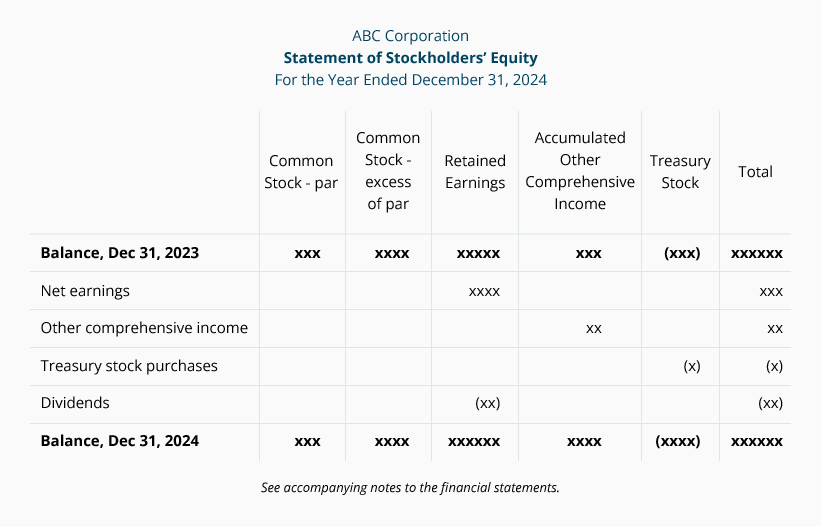
The main columns have different jobs:
- Common stock and additional paid-in capital (APIC) record capital contributed when the company issues shares. For shares with a stated par value, common stock receives the par-value portion; APIC receives the excess issue price. An investor buying existing shares from another investor does not create a new share issuance by the company.
- Retained earnings accumulate net income or loss, less dividends declared and any other applicable adjustments. For the ordinary period activity we’ll use here:
- Accumulated other comprehensive income (AOCI) holds the cumulative balance of OCI items. Add the current period’s signed OCI, not the period’s comprehensive income, to this column. Net income has already gone to retained earnings.
- Treasury stock reflects shares the company has repurchased. When recorded at cost, it is shown as a deduction from equity. A repurchase increases the treasury stock deduction; it does not ordinarily subtract the purchase price from the common-stock column.
For a cash dividend, the declaration reduces retained earnings. If the declared dividend remains unpaid at period-end, a dividend payable also exists. Paying that payable later reduces cash and the liability; it does not reduce equity a second time.
These distinctions matter because several events can all involve cash without having the same equity effect. Receiving cash from a new share issue increases contributed capital. Repurchasing shares reduces total equity through treasury stock. Paying a dividend that was already declared changes cash and a liability, but not total equity at the payment date.
Prepare a statement from transaction data
Suppose Meridian Company provides the following information for 2025. Dollar amounts in the statement will be shown in thousands.
At December 31, 2024, Meridian’s balances were common stock $20,000, APIC $30,000, retained earnings $15,000, AOCI $1,000, and treasury stock at cost $4,000. Treasury stock is a deduction, so beginning total equity was $62,000.
During 2025, Meridian:
- Issued 1,000 shares with a $2 par value for $12 per share.
- Reported $8,000 net income and a $600 OCI loss, with the OCI amount already stated after any related tax effects.
- Declared $2,500 cash dividends, still unpaid at December 31.
- Repurchased its own shares for $1,500, recorded as treasury stock at cost.
Start with the issuance. Meridian received $12,000 in total: $2,000 belongs in common stock (1,000 shares at $2 par), and the remaining $10,000 belongs in APIC. Net income adds $8,000 to retained earnings, while the dividend declaration subtracts $2,500 from that same column. The OCI loss subtracts $600 from AOCI. The repurchase adds $1,500 to the treasury stock deduction.
Now place those movements in a statement. All amounts in the table are $000s; parentheses indicate reductions to a column or total.
Meridian Company
Statement of Changes in Stockholders’ Equity
For the Year Ended December 31, 2025
| Common stock | APIC | Retained earnings | AOCI | Treasury stock | Total equity | |
|---|---|---|---|---|---|---|
| Balance, Dec. 31, 2024 | 20 | 30 | 15 | 1 | (4) | 62 |
| Shares issued | 2 | 10 | — | — | — | 12 |
| Net income | — | — | 8 | — | — | 8 |
| OCI loss | — | — | — | (0.6) | — | (0.6) |
| Dividends declared | — | — | (2.5) | — | — | (2.5) |
| Treasury shares repurchased | — | — | — | — | (1.5) | (1.5) |
| Balance, Dec. 31, 2025 | 22 | 40 | 20.5 | 0.4 | (5.5) | 77.4 |
Read both down and across. Down the retained earnings column, the calculation is $15,000 plus $8,000 minus $2,500, giving $20,500. Down AOCI, the $1,000 opening balance less the $600 OCI loss gives $400. Across the ending row, add the positive balances and subtract treasury stock:
An independent check uses the total equity column. Beginning equity of $62,000 increased by $12,000 of share issuance and $8,000 of net income, then decreased by the $600 OCI loss, $2,500 dividend declaration, and $1,500 repurchase:
Both routes reach the same ending amount, which belongs in the equity section of Meridian’s December 31, 2025 balance sheet.
Keep the reporting boundaries clear
A useful final check is to ask whether you have mixed up an activity amount with an accumulated balance. Meridian’s $600 OCI loss is 2025 activity; its $400 ending AOCI is a balance built across periods. Likewise, $8,000 is this year’s net income, while $20,500 is ending retained earnings. Neither ending balance substitutes for this year’s activity in the reconciliation.
Also check the statement’s heading: it covers the year ended December 31, 2025, because it reports changes over time. The opening and closing rows refer to specific dates. That combination is exactly why this statement links one balance sheet date to the next.
Key takeaways
To prepare a statement of changes in equity, bring forward each beginning equity balance, assign every period event to the correct account, calculate the ending balance of each column, and reconcile total equity independently. Net income and dividends affect retained earnings; OCI affects AOCI; share issuances affect contributed capital; and treasury-share purchases increase the treasury stock deduction.
Next, you’ll prepare a statement of cash flows using the indirect method. It will answer a different question: how cash changed during the period, rather than how equity changed.