Recommended resources
The freely available resources this lesson will direct you to.
- Message Queues in System Design Interviews w/ Meta Staff Engineerwww.youtube.com
- System design from First Principle[11/15] : Kafka vs RabbitMQ vs SQS — Async Systemwww.youtube.com
- Message queues vs HTTPS in microservices, part 1www.cloudamqp.com
- Kafka vs RabbitMQ - A Head-to-Head Comparison for 2025www.projectpro.io
Introduction
In our last few lessons, we've designed services that communicate directly via REST APIs and persist their state in carefully chosen databases. This synchronous, request-response model is the backbone of many systems you've likely built. However, as we move toward building larger, more resilient distributed systems, the limitations of this tight coupling become apparent. What happens when a downstream service is slow or fails? The entire chain can grind to a halt, leading to cascading failures and a poor user experience.
This lesson addresses that very problem. We will explore the world of asynchronous communication, a fundamental pattern for building scalable and robust microservices architectures. You will learn how message queues, such as RabbitMQ and Kafka, act as intermediaries that decouple services, allowing them to communicate without being tightly bound in time. This shift from a "phone call" to a "text message" model is a critical step in your journey from implementing features to designing resilient systems.
1. The Perils of Synchronous Communication
Imagine a typical e-commerce application. When a user places an order, several things need to happen: the payment must be processed, the inventory must be updated, a shipment must be created, and a confirmation email must be sent. In a purely synchronous architecture, the Order Service would make a direct API call to the Payment Service, wait for a response, then call the Inventory Service, wait again, and so on.
This tight, temporal coupling—where services are locked together in time—creates several significant problems.
Message queues vs HTTPS in microservices, part 1
This article from CloudAMQP uses a retail store example to clearly illustrate the drawbacks of synchronous, HTTPS-based communication.
Read the section Tight coupling. As you read, focus on the three main drawbacks the author identifies: the inability to isolate faults, long response times, and inflexibility.
As the article highlights, if any single service in the chain fails or is slow, the entire order process stalls. The user is left staring at a loading spinner, and a single bug in the Notification Service could prevent new orders from being processed at all. This is the essence of a brittle system.
2. The Asynchronous Shift: Decoupling Services
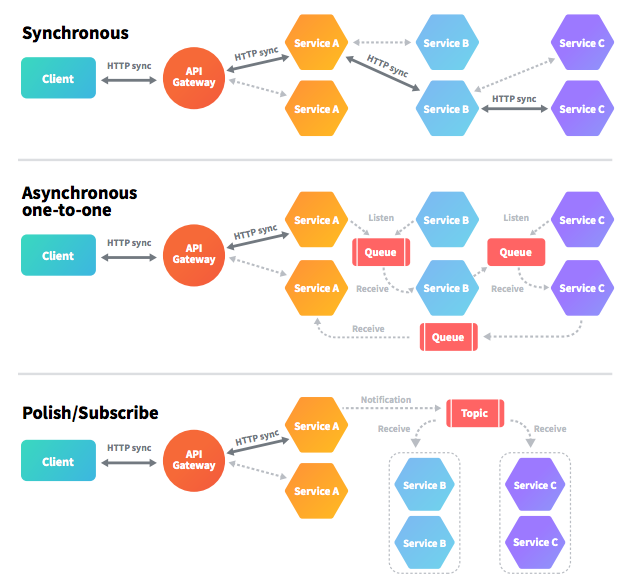
The solution to temporal coupling is to break the direct link between services. Instead of one service calling another and waiting, it publishes a message (an event) to an intermediary. This is the core idea of asynchronous, event-driven architecture.
A fantastic mental model for this is to contrast a phone call with a text message.
System design from First Principle[11/15] : Kafka vs RabbitMQ vs SQS — Async System
This video from FAANG Senior Engineer provides an excellent conceptual introduction to asynchronous systems, contrasting them with their synchronous counterparts.
Watch the segment from the mental model explanation. The "phone call vs. text message" analogy is a powerful way to understand the shift from a blocking, synchronous model to a decoupled, asynchronous one.
By introducing a message queue, we change the architecture from a series of phone calls to a series of text messages.
- Producer: A service that creates a message and sends it to the queue. In our example, the
Order Serviceis the producer. - Message Queue: A buffer that stores messages.
- Consumer: A service that subscribes to the queue, pulls messages from it, and processes them. The
Payment,Inventory, andNotificationservices would be consumers.
Now, when an order is placed, the Order Service simply writes a message like "Order 123 Placed" to the queue and immediately returns a success response to the user. The other services (the consumers) pick up this message from the queue at their own pace and perform their respective tasks.
The benefits are immediate:
- Improved User Experience: The user gets a fast response.
- Fault Isolation: If the
Notification Serviceis down, messages for it will simply accumulate in the queue. It doesn't block the processing of new orders. The system is more resilient. - Load Leveling: If you experience a sudden traffic spike (the "hug of death" moment), the queue acts as a shock absorber. Instead of overwhelming your consumer services and crashing the system, messages pile up in the queue. The work gets done, just with a delay.
Message Queues in System Design Interviews w/ Meta Staff Engineer
This video from Hello Interview uses a photo-sharing app to demonstrate how a message queue solves the exact problems of latency, fragility, and bursty traffic.
Watch the motivating example from the start to see a practical application. Then, watch the formal explanation of the message queue concept, focusing on the term decoupling.
3. Core Mechanics of Message Queues
While the concept is straightforward, implementing a reliable asynchronous system requires understanding a few critical mechanics.
Delivery Guarantees and Idempotency
What happens if a consumer pulls a message, starts working, and then crashes? To prevent losing the message, queues don't delete a message until the consumer sends an acknowledgment (ACK) confirming it has successfully processed it.
This leads to a guarantee of at-least-once delivery. The queue ensures the message will be delivered, but network glitches or consumer crashes might cause it to be delivered more than once.
This has a profound implication: your consumers must be idempotent. An idempotent operation is one that can be performed many times without changing the result beyond the initial application.
- Not Idempotent:
UPDATE user_posts SET count = count + 1(Running this twice increments the count by two). - Idempotent:
UPDATE user_posts SET count = 54(Running this twice still results in a count of 54).
In system design, you must ensure your consumers can handle duplicate messages without causing incorrect behavior, often by checking if a task has already been completed before executing it.
Message Queues in System Design Interviews w/ Meta Staff Engineer
This video explains the crucial concepts of acknowledgements and delivery guarantees.
Watch the section on how queues work to understand acknowledgements. Then, pay close attention to the explanation of delivery guarantees. The distinction between at-least-once, at-most-once, and exactly-once delivery is a key topic in system design interviews, with "at-least-once delivery with idempotent consumers" being the most common and practical pattern.
Poison Pills and Dead-Letter Queues (DLQ)
What if a message is malformed and causes the consumer to crash every time it's processed? This is known as a "poison pill." If not handled, the consumer will be stuck in an infinite loop of fetching, crashing, and retrying, blocking all other messages.
The solution is the Dead-Letter Queue (DLQ). After a configurable number of failed attempts, the message is moved from the main queue to a DLQ. This allows the main queue to keep flowing, while engineers can inspect the messages in the DLQ later to debug the problem. This is a critical pattern for building robust, production-grade systems.
4. Queues vs. Streams: Two Messaging Models
The term "message queue" is often used broadly, but it's important to distinguish between two main paradigms: task queues and message streams.
-
Task Queues (e.g., RabbitMQ, Amazon SQS): These operate like a to-do list for a pool of workers. A message represents a discrete job (e.g., "resize image 123"). Once a consumer picks up a job and completes it, the message is deleted. This model is excellent for work distribution, where you want to spread tasks across multiple workers and ensure each task is done exactly once (by one worker).
-
Message Streams (e.g., Apache Kafka, AWS Kinesis): These work like an immutable, append-only log. A message represents an event that occurred (e.g., "user signed up"). Events are not deleted when read; they persist for a configurable retention period. Multiple, independent consumer groups can read from the same stream, each keeping track of its own position (offset). This model is powerful for event broadcasting, where a single event needs to be consumed by multiple different systems (e.g., analytics, notifications, fraud detection) and for use cases that require replayability.
System design from First Principle[11/15] : Kafka vs RabbitMQ vs SQS — Async System
This video offers a brilliant mental model for differentiating between queues and streams.
Watch the section from the beginning of the explanation. The analogy of a task queue as a "post office" and a message stream as an "infinite scroll of paper" is an extremely effective way to grasp the different use cases and semantics of each.
5. A Look at Kafka and RabbitMQ
While there are many messaging systems, Kafka and RabbitMQ are two of the most popular, and they embody the two different architectural philosophies we just discussed.
Kafka vs RabbitMQ - A Head-to-Head Comparison for 2025
This article provides a detailed comparison of Kafka and RabbitMQ, highlighting their architectural differences and ideal use cases.
To understand the core differences, read the following sections: Start with the brief introductions to RabbitMQ and Kafka to get a high-level sense of each. Read the section on Architectural Differences. This directly contrasts RabbitMQ's routing-based model with Kafka's log-based model. Next, read Push/Pull - Smart/Dumb. This explains the fundamental difference in how consumers get messages: RabbitMQ (smart broker) pushes messages to consumers, while in Kafka (dumb broker), consumers are responsible for pulling messages. Finally, review the summary at the end: Who is the Winner?. This reinforces that the choice depends entirely on the use case.
In short:
- RabbitMQ is a traditional message broker. It is a "smart broker" that can perform complex message routing to different queues based on rules. It is ideal for distributing tasks to workers and for transactional scenarios.
- Kafka is a distributed streaming platform. It is a "dumb broker" that acts as a high-throughput, persistent log of events. Consumers are "smart" and manage their own reading progress. It is ideal for high-volume data streaming, log aggregation, and any scenario where multiple systems need to react to the same stream of events.
Conclusion
Today, you've learned how asynchronous communication with message queues is a powerful architectural pattern for building decoupled, resilient, and scalable systems. By moving from synchronous "phone calls" to asynchronous "text messages," you can isolate services from each other's failures and handle unpredictable traffic loads gracefully.
Key Takeaways:
- Synchronous communication creates tight temporal coupling, making systems brittle and prone to cascading failures.
- Message queues decouple services, allowing producers and consumers to operate independently and at their own pace.
- Queues act as a buffer for load leveling, absorbing traffic spikes and improving system stability.
- "At-least-once" delivery is the standard guarantee, which requires consumers to be idempotent to handle duplicate messages safely.
- Dead-Letter Queues (DLQs) are a critical pattern for handling "poison pill" messages that consistently fail.
- Task Queues (like RabbitMQ) are for work distribution, while Message Streams (like Kafka) are for broadcasting events and enabling replayability.
In our system design journey, we've enabled services to communicate directly (REST) and indirectly (message queues). We've also addressed data persistence. The next step is to improve performance and reduce the load on these components. In our upcoming lesson, we will explore various caching strategies to make our applications faster and more efficient.