Recommended resources
The freely available resources this lesson will direct you to.
Introduction
Welcome to the next lesson in your journey through System Design Foundations. In our previous discussion, we focused on improving application speed and reducing backend load through various caching strategies. You learned how to leverage in-memory caches, CDNs, and database-level caching to make your services faster. However, even the fastest server has its limits. When user traffic grows exponentially, a single machine, no matter how optimized, will eventually become a bottleneck.
This lesson addresses that fundamental challenge by tackling the concept of scalability. We will explore the two primary strategies for handling increased load: vertical scaling and horizontal scaling. You will learn to explain the core principles of each approach and, more importantly, analyze their distinct trade-offs in terms of performance, cost, resilience, and complexity. Mastering this topic is crucial for moving from a developer who implements features to a senior developer who architects systems capable of growing with the business.
1. Two Paths to Scalability
Imagine your application is a single, popular restaurant. As more customers arrive, the kitchen gets overwhelmed, and service slows down. You have two options:
- Vertical Scaling: Upgrade your single kitchen with a bigger stove, more counter space, and faster chefs.
- Horizontal Scaling: Keep the original kitchen and open several more identical kitchens next to it, with a host directing customers to the one with the shortest line.
In system design, this analogy maps directly to how we handle server load.
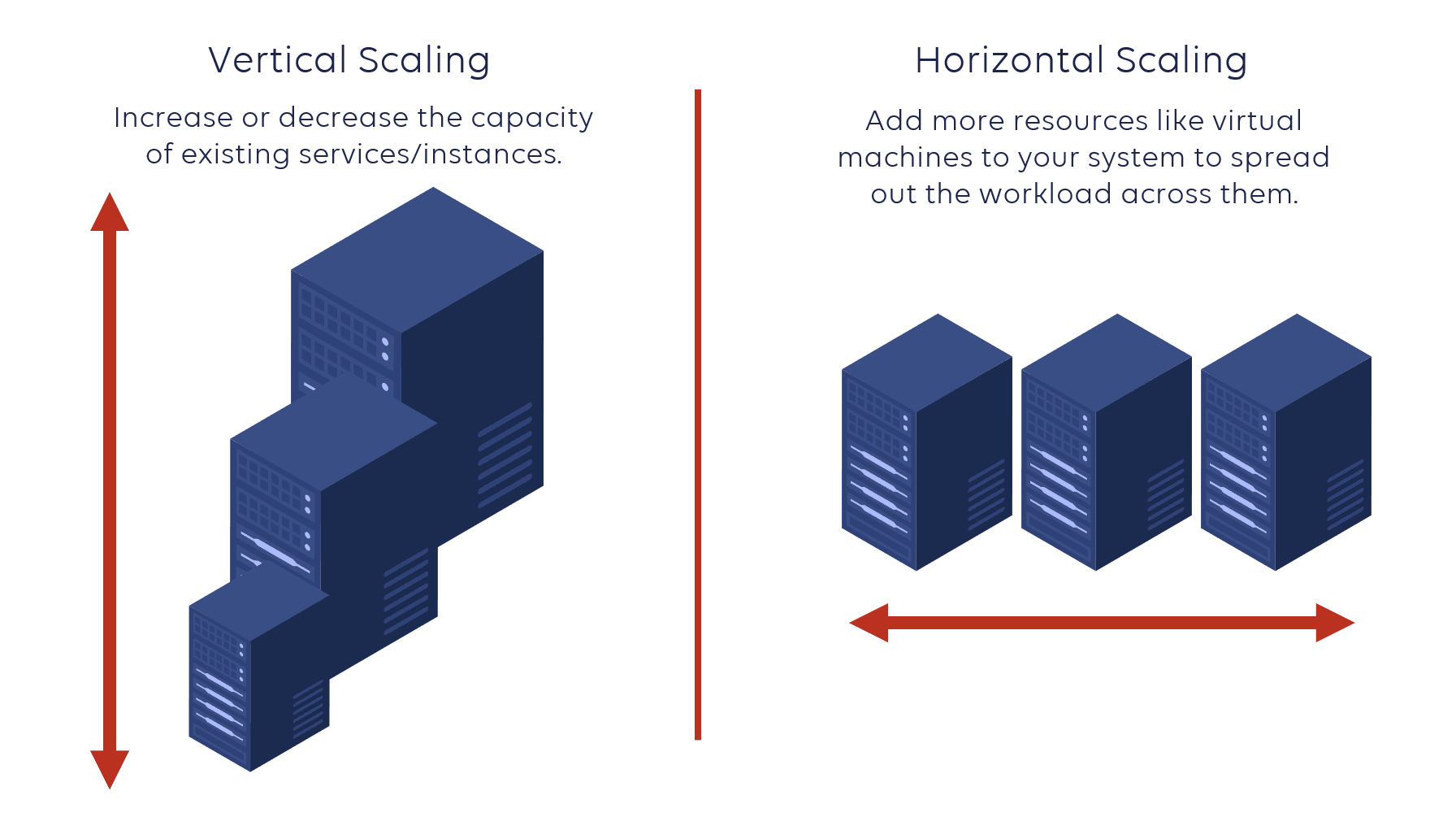
- Vertical Scaling (Scaling Up): This strategy involves increasing the resources of a single server. You make the machine more powerful by adding more CPU cores, increasing RAM, or upgrading to faster storage (like NVMe SSDs).
- Horizontal Scaling (Scaling Out): This strategy involves adding more servers to your system. Instead of one powerful server, you run multiple, often less-powerful, servers that work together to handle the load.
This diagram clearly illustrates the difference:
To solidify these definitions, the following reading provides concise explanations with helpful analogies.
Horizontal scaling vs vertical scaling: Choosing your strategy
This article from DigitalOcean offers clear, easy-to-understand definitions of both scaling strategies.
Please read the first two sections: What is horizontal scaling? and What is vertical scaling?. Pay attention to the highway and bridge analogies, as they provide a strong mental model for each approach.
2. The Core Trade-Offs
Choosing a scaling strategy is not about picking the "better" one; it's about understanding the deep-seated trade-offs that impact your system's architecture. A senior developer must be able to articulate these trade-offs to make informed decisions.
The video below provides a fantastic, concise breakdown of the five most important differences.
System Design BASICS: Horizontal vs. Vertical Scaling
Gaurav Sen is well-regarded for his clear system design explanations. In this segment, he directly compares the two strategies across several critical dimensions.
Watch the section from the comparison of pros and cons. As you watch, focus on understanding the implications of each of these five points: Load Balancing: Why is it needed for one but not the other? Resilience: Which approach introduces a single point of failure? Communication: What is the performance difference between inter-process communication (IPC) and network calls? Data Consistency: Why is it easier to manage data on a single machine? Hardware Limits: Which strategy has a theoretical "ceiling"?
Let's summarize and expand on those key points:
| Feature | Vertical Scaling (Scale Up) | Horizontal Scaling (Scale Out) |
|---|---|---|
| Fault Tolerance | Low. Creates a single point of failure (SPOF). If the server fails, the entire application goes down. | High. The system is resilient. If one server fails, traffic can be redirected to others. |
| Complexity | Low. Simpler to manage as it's a single machine. No need for complex distributed system logic. | High. Requires a load balancer, and you must consider network latency and data synchronization. |
| Performance | High for single operations. Communication between processes (IPC) is extremely fast. | Potentially lower for individual operations due to network latency, but higher aggregate throughput. |
| Data Consistency | High. A single database on one machine can easily guarantee ACID transactions. | Lower/More Complex. Maintaining consistency across distributed databases is a significant challenge (this relates to the CAP theorem, which we'll cover later). |
| Scalability Limit | Finite. You will eventually hit a physical or cost limit on how powerful a single machine can be. | Theoretically infinite. You can keep adding more commodity servers to meet demand. |
As a developer with experience in Java and Spring Boot, you can see how this applies directly to application architecture. A traditional, stateful monolithic application might be simpler to manage on a single, vertically scaled server. In contrast, modern stateless microservices, like those you might build with Spring Boot, are designed from the ground up to be scaled horizontally.
3. The Financial Equation: Cost vs. Capacity
Beyond the technical trade-offs, the financial implications are often the deciding factor. The cost of scaling is not linear, and understanding this is essential for making business-aware architectural decisions.
- Vertical scaling initially seems cheaper and simpler, but it suffers from diminishing returns. The most powerful CPUs and largest amounts of RAM are disproportionately more expensive. Doubling the power costs more than double the price.
- Horizontal scaling may have a higher initial setup cost (e.g., configuring load balancers, deployment pipelines), but the cost of adding capacity grows linearly. Buying ten standard servers is often far cheaper than one "super" server with the equivalent total power.
The following video provides an excellent visual explanation of this economic principle.
System Design: What is Horizontal vs Vertical Scaling?
The channel "Be A Better Dev" uses clear examples and graphs to explain the cost dynamics of scaling.
Please watch these three segments: First, watch the explanation of vertical scaling, focusing on the single point of failure and the cost example for memory. Next, see how horizontal scaling solves these problems by adding more machines. Finally, and most importantly, study the cost comparison graphs. These graphs perfectly illustrate why vertical scaling becomes economically unfeasible at a certain point.
4. Making the Right Choice: A Decision Framework
So, how do you choose? Most modern, large-scale systems use a hybrid approach: they use reasonably powerful (vertically scaled) machines and then add many of them (horizontally scaled). However, when designing a new service or diagnosing a bottleneck, you need a framework for deciding where to focus your efforts.
Horizontal vs Vertical Scaling: A Developer's Guide
This comprehensive guide from DataCamp provides a structured way to think about making a scaling decision.
Read the section titled Decision framework. As you read, consider a system you've worked on and ask yourself these questions: Is my application stateless or stateful? Stateless services are easy to scale horizontally. Stateful services often benefit from vertical scaling to keep state co-located. What are my workload patterns? Unpredictable, spiky traffic is a perfect candidate for horizontal auto-scaling. Steady, predictable growth might be manageable with planned vertical scaling. What is my team's expertise? Does your team have experience with distributed systems (for horizontal scaling) or deep performance tuning on a single machine (for vertical scaling)? What is my failure tolerance? If your application cannot tolerate any downtime, the resilience of horizontal scaling is non-negotiable.
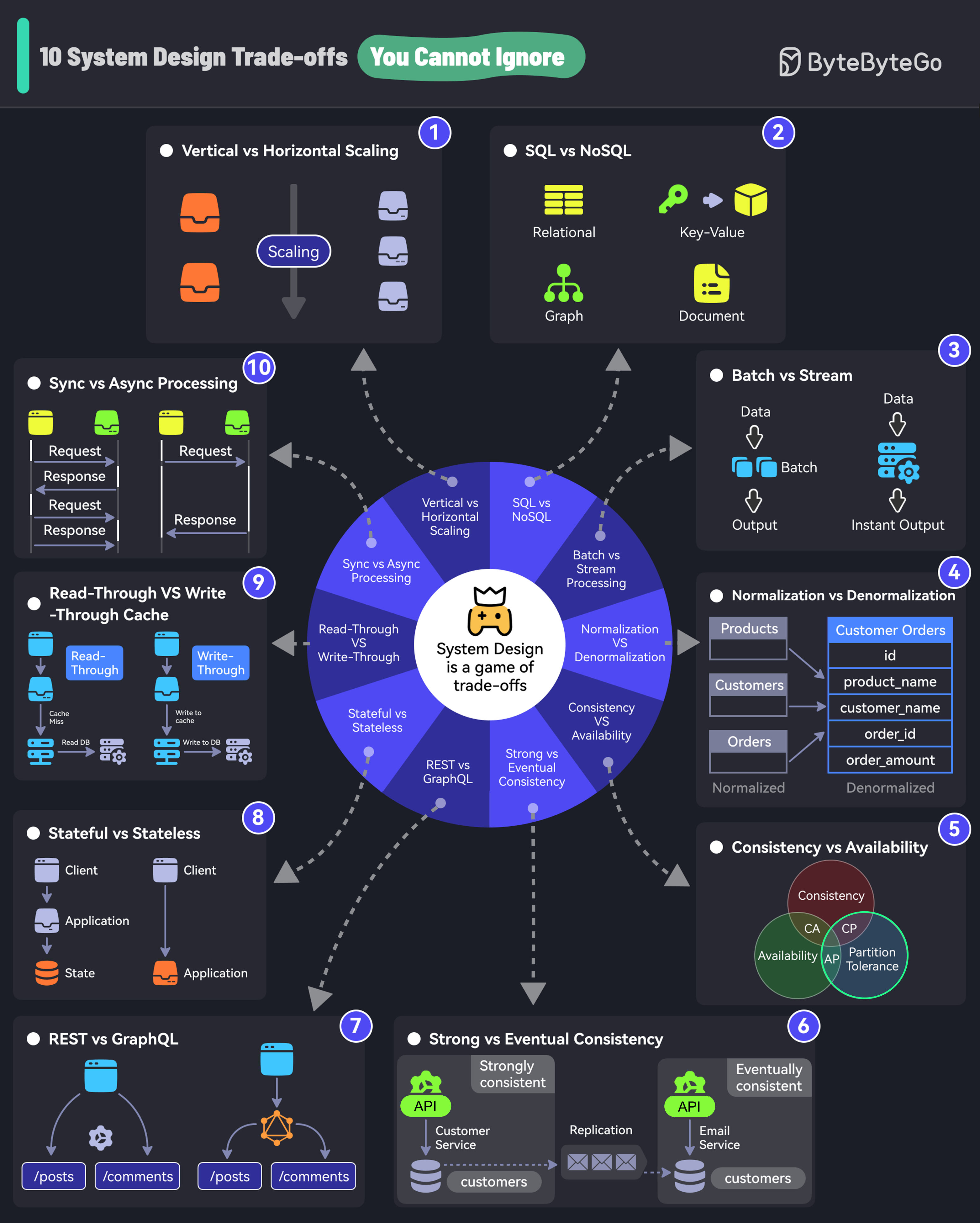
The choice is a series of trade-offs, as illustrated in this high-level diagram.
Conclusion
In this lesson, you've learned that scaling is not just about adding resources; it's a strategic architectural decision with profound consequences for cost, reliability, and maintainability. You are now equipped to explain the fundamental differences between making one server stronger (vertical) and adding more servers (horizontal).
Key Takeaways:
- Vertical Scaling (Scale Up): Involves adding more power (CPU, RAM) to a single server. It is simple to manage and offers high performance for self-contained tasks but creates a single point of failure and becomes extremely expensive at the high end.
- Horizontal Scaling (Scale Out): Involves adding more servers to a resource pool. It provides high availability and theoretically limitless scale at a linear cost but introduces the complexity of a distributed system (e.g., load balancing, data consistency).
- The Decision is Contextual: The right strategy depends on your application's architecture (stateless vs. stateful), traffic patterns, budget, and fault tolerance requirements.
- Hybrid is Reality: Most large-scale systems use a hybrid approach, leveraging both strategies to optimize for performance and cost.
We've established that for modern, resilient web applications, horizontal scaling is the dominant paradigm. However, this strategy is impossible without a crucial component: something to distribute incoming traffic intelligently across all your servers. In our next lesson, we will dive deep into the role of the load balancer.