Recommended resources
The freely available resources this lesson will direct you to.
- How to Write a Learning Objective in Just 5 Minutes!www.youtube.com
- How to Write SMART Objectiveswww.youtube.com
- Know Where You Are Going! Simple Steps to Writing SMART Learning Objectivesctl.jhsph.edu
- Learning Objectives | Center for the Advancement of Teaching Excellence | University of Illinois Chicagoteaching.uic.edu
Hello! This course will help you plan, build, and check printable learning materials for children under 13, with particular attention to visual maths and more demanding English work for capable young readers. We begin before choosing pictures, fonts, or a worksheet platform: what should a child be able to do after completing the activity?
In this lesson, you’ll write one measurable learning objective for a worksheet or activity. That objective will give you a way to decide what belongs on the page and, later, whether the worksheet helped.
Start with the child’s learning, not the page
It is easy to begin a worksheet by finding an appealing illustration or a set of questions. But a page can look engaging without giving you clear evidence of learning. Compare these two starting points:
Topic: Context clues
Objective: By the end of the worksheet, given four short story extracts, the learner will write a contextually plausible meaning for at least three of four underlined words, with a relevant clue recorded for each of those answers.
The topic names the area of study. The objective says what the child will produce, under what circumstances, and what would count as success. You could inspect the completed page and decide whether the objective was met.
Watch the selected parts of Lindsay O’Neill’s How to Write a Learning Objective in Just 5 Minutes! The video introduces objectives as statements about what learners can do and shows why writing that statement before designing an activity keeps the activity focused.
How to Write a Learning Objective in Just 5 Minutes!
Watch How to Write a Learning Objective in Just 5 Minutes! by Lindsay O’Neill for a concise explanation of observable outcomes and a useful structure for drafting them.
Watch observable outcomes for the distinction between learning in a child’s mind and evidence you can see. Then watch planning and structure: the speaker explains why to decide the goal before the activity and introduces audience, behavior, and optional conditions. Finish with vague verbs to hear why “understand” alone cannot tell you what to check.
The planning order matters for a printable. Once you know that a learner must infer a word’s meaning from context, you can provide short passages, a place to record each meaning, and space for evidence. Without that objective, it would be easy to fill the page with vocabulary matching that never asks children to use context.
Make the learning visible
A useful objective names a learner action, rather than an intention in the tutor’s mind. “Children will understand the character” describes something valuable, but you cannot see understanding directly. “The learner will explain a character’s feeling using a detail from the story” gives you a response you can examine.
The action verb is important, but it cannot do all the work. Identify what? In what material? How accurately? “Identify” becomes useful when you specify, for example, “identify the main idea in each of three short paragraphs.” For an open-ended response, you may need a quality criterion rather than a score: “explain the character’s likely feeling using one relevant detail from the passage.”
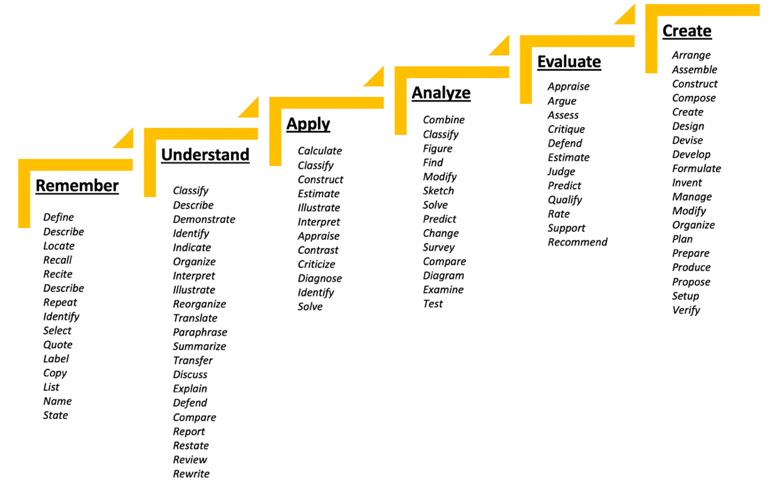
The image below offers verbs associated with six kinds of thinking in Bloom’s Taxonomy. Use it to brainstorm, not as a rule that every objective must climb to the top. A worksheet for an eight-year-old can appropriately ask for recall, application, or a supported inference, depending on what you want the child to learn. Some listed verbs can still be vague until you name the task and evidence.
Read the SMART definitions in Know Where You Are Going! Simple Steps to Writing SMART Learning Objectives. SMART gives you a brief check on whether an objective is specific, measurable, attainable, relevant, and time-bound.
Know Where You Are Going! Simple Steps to Writing SMART Learning Objectives
Read Know Where You Are Going! Simple Steps to Writing SMART Learning Objectives from the Johns Hopkins teaching and learning site to see how a clear objective sets a realistic, checkable target.
Near the beginning of the article, read the five SMART bullet points, from the definition of “Specific,” beginning with SMART criteria. Then, under “Identify the Need,” read the paragraph beginning “The first step to writing a SMART learning objective is remembering that learning is a change process” through expected outcomes. Pay particular attention to the difference between a measurable criterion and a numerical score: a score is useful when appropriate, but it is not required for every objective.
For a worksheet, “by the end of the worksheet” is often a sufficient timeframe. Attainable means checking whether the child has the prior skills and enough support to complete the task. An objective for capable readers might call for an evidence-based inference; the same wording would not automatically suit a child who is still learning to read the passage independently.
Build one objective you could actually check
A practical drafting pattern is:
By the end of [activity], given [material or support, if important], the learner will [one observable action and its precise target], meeting [a checkable success criterion].
You do not need to make the final sentence sound formulaic. The pattern is a check that you have supplied the essential information. Let’s use it for two kinds of worksheet.
English example. Suppose the broad aim is “improve reading comprehension.” That could mean many things, so narrow it to inferring unfamiliar words from a passage. A finished objective could be:
By the end of the worksheet, given four short story extracts, the learner will write a contextually plausible meaning for at least three of four underlined words, with a relevant clue recorded for each of those answers.
Here, write a meaning is the performance you can see. The short extracts are the condition. Three successful answers, each supported by a clue, are the criterion. A child who guesses three plausible meanings but supplies no relevant clues has not yet shown the particular skill this worksheet targets: using context.
Notice that “plausible” allows for more than one defensible wording. Consider: “The path was treacherous; loose stones slid beneath their shoes.” A child might write dangerous or hard to walk on safely. The second half of the sentence offers a clue that could support either answer. Measurable does not have to mean that only one exact phrase is acceptable.
Visual maths example. Suppose the broad aim is “learn multiplication.” Narrow it to connecting pictured equal groups with notation:
By the end of the worksheet, given six dot arrays, the learner will write a multiplication equation that matches the rows and total for at least five arrays.
You can check each equation against its picture. If the worksheet treats each row as one group, make that convention clear in the child-facing instructions. An array with three rows of four dots, for example, can be represented as three groups of four, with a total of twelve. The objective does not need to mention colours, clip art, or the design tool: those are choices you make to help the learner reach it, not the learning outcome itself.
In both examples, the criterion is chosen for the task; “three of four” and “five of six” are not universal pass marks. The important test is whether you can look at a response and make a fair, consistent judgment about the skill you intended to teach.
Keep the target small enough for one activity
A worksheet may have several questions or stages while serving one learning objective. Four different story extracts can all provide opportunities to practise contextual inference. Likewise, several arrays can reveal whether a learner can connect equal groups to equations.
Watch for an objective that quietly becomes a list of separate targets:
“The learner will identify unfamiliar words, write their definitions, punctuate sentences, and summarize the story.”
That asks you to judge several different skills. If your immediate purpose is contextual inference, keep the objective about inference. Other material might help the child practise it, but it should not obscure what success means.
Before settling on an objective, use this short check:
- Learner performance: Does it say what the child will do, rather than what you will teach?
- Specific target: Is it clear what the child will work on?
- Evidence: Could you check the child’s response or performance?
- Scope: Is it one achievable skill for this activity?
- Fit: Does the task suit the children’s current skills and the time available?
The objective is mainly a planning sentence for you. Child-facing instructions can be shorter and warmer; a later lesson will look at how to write those instructions for different age groups.
Takeaway
A measurable objective states one specific thing the learner will demonstrate and gives you a fair way to recognize success. Start with the skill, choose an observable performance, and make the target realistic for the child and activity. In the next lesson, you’ll use that objective to choose a suitable visual activity format—so the pictures and layout serve the learning rather than merely decorate the page.