Recommended resources
The freely available resources this lesson will direct you to.
Hello! In the previous lesson, convergence meant that terms eventually stayed close to a specified point in the space. The sequence , for example, converges to in but has no limit in . Completeness asks what we can conclude when the terms become close to one another, even before we know whether a suitable limit exists.
This lesson develops that distinction, proves completeness for familiar spaces, and constructs Cauchy sequences that reveal when a space is incomplete. The aim is not just to recognize the examples, but to see the proof pattern you can reuse.
Cauchy sequences: closeness without a proposed limit
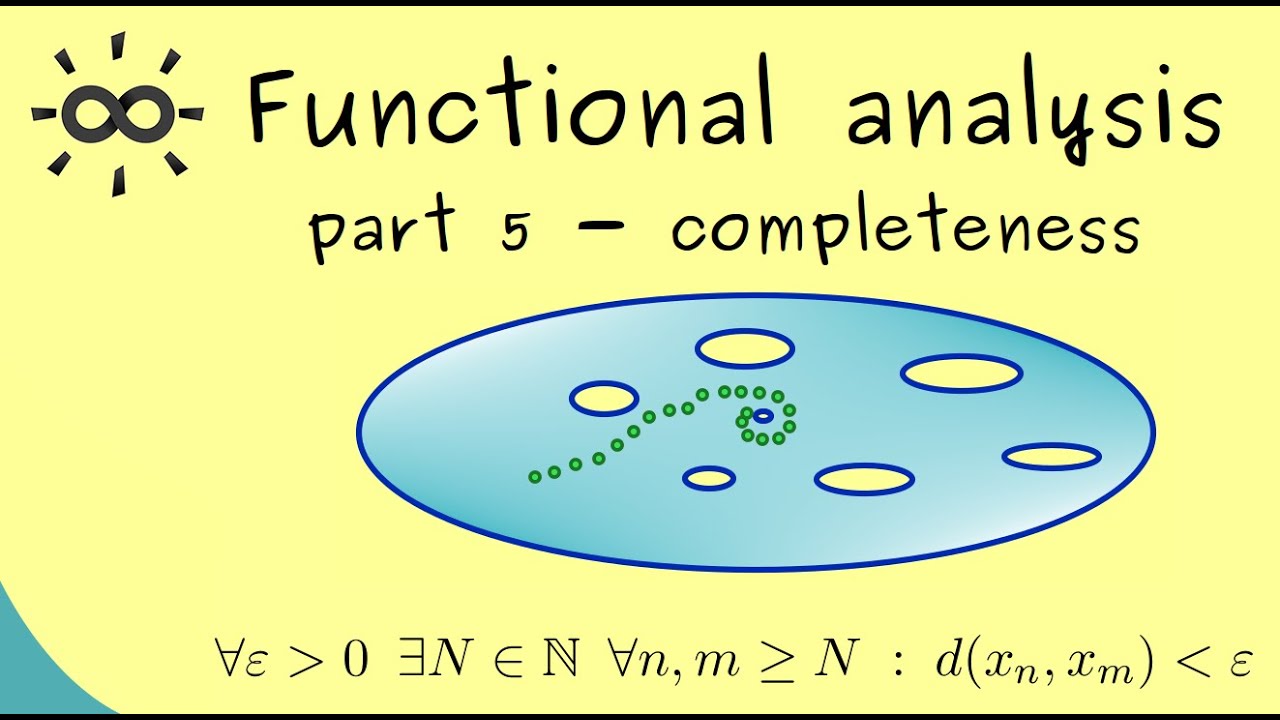
A sequence in a metric space is Cauchy if
Compare this with convergence: instead of comparing each late term with one fixed limit , we compare every pair of sufficiently late terms. The condition says nothing directly about where that tail might converge.
Watch the selected passages of Dr. Bevin Maultsby’s Cauchy sequences and complete metric spaces, Real Analysis II. They establish the definition, the fundamental one-way implication, and the meaning of completeness.
Cauchy sequences and complete metric spaces, Real Analysis II
Dr. Bevin Maultsby’s video contrasts Cauchy behavior with convergence and uses the triangle inequality to connect them.
Watch the definitions for the change from one late index to two. Then watch the triangle proof, paying attention to why the convergence bound is chosen as half the desired Cauchy bound. Finish with completeness: the key question is whether the limit belongs to the space under discussion.
Here is the implication at the heart of that proof. If , choose so that whenever . For any , the triangle inequality gives
Thus every convergent sequence is Cauchy, in every metric space. A space is complete if the converse holds there: every Cauchy sequence of its points converges to a point in that same space.
A quantifier trap is worth avoiding. It is not enough that consecutive terms become close. For the harmonic partial sums
we have . Yet
The pairs occur arbitrarily far along the sequence while remaining at least apart. The Cauchy definition requires control of all pairs beyond one cutoff.
Disproving completeness by finding a missing limit
To show that a space is not complete, one counterexample suffices: find a sequence whose terms all lie in the space, prove it is Cauchy in its metric, and prove it does not converge to any point of that space.
Consider with the usual distance inherited from . Let . Every term belongs to , and for ,
Given , choose ; this proves that is Cauchy in . But its limit in is . It cannot have some other limit in : convergence in the inherited metric would also be convergence in , where limits are unique. Hence is incomplete.
The same strategy works when the missing limit is less visible. Set with its usual metric and, for , define the rational decimal truncations
The defining property of the floor function gives
Consequently, for ,
So is Cauchy in , but it converges in to the irrational number . Uniqueness again rules out a rational limit. Thus is incomplete.
Watch how the video finds analogous missing-limit examples, then contrasts them with a complete discrete space.
Cauchy sequences and complete metric spaces, Real Analysis II
The same video turns the definition into a practical method: seek a limit outside the space, or show that the metric forces Cauchy sequences to stabilize.
Watch rational limits for a sequence of rational truncations with an irrational real limit. Then watch discrete spaces, focusing on what a Cauchy tail must look like when distinct points are always distance 1 apart.
“Missing points” is useful intuition, but the actual test remains the Cauchy definition plus a proof that no limit lies in the stated space. In particular, we used the larger space to locate each candidate limit, not to change the distances between the sequence terms.
Proving completeness: start with an arbitrary Cauchy sequence
A positive completeness proof has a different logical shape. Examples of convergent sequences are not enough: we must begin with an arbitrary Cauchy sequence and show that it converges in the space.
For the discrete metric, this proof is short and illuminating. Let be Cauchy and apply its definition with . There is an such that for all . Distinct points have distance , so every term with equals . The sequence is eventually constant and therefore converges to . Every discrete metric space is complete, regardless of how many points it has.
For Euclidean space, we build a limit coordinate by coordinate. Read Proposition 7.4.4 in Section 7.4.1, “Cauchy sequences and completeness,” of RA Completeness and compactness. Its proof reduces completeness of to the familiar completeness of .
RA Completeness and compactness
Read the proof of Proposition 7.4.4 for a model of how to prove completeness of an entire space, rather than verify convergence of a particular sequence.
In Section 7.4.1, find Proposition 7.4.4, “The space \mathbb R^n with the standard metric is a complete metric space.” Read from the coordinate proof through its final sentence, stopping before the discussion of continuous-function spaces. Track both directions of the argument: the metric bound makes each coordinate Cauchy, and the coordinate limits must then give convergence in the original metric.
Let us make the last step of that proof explicit. Suppose is Cauchy in Euclidean , with
For each coordinate ,
Thus is Cauchy in , and real completeness supplies a limit . The proposed vector limit is , which belongs to . Given , choose one cutoff large enough that
whenever exceeds that cutoff. We can use one cutoff because there are only finitely many coordinates. Then
This proves that Euclidean is complete. Notice where the underlying fact that is complete enters; coordinatewise Cauchy behavior alone does not manufacture real coordinate limits.
Closed subspaces: a reusable completeness test
There is a convenient way to extend these proofs. A closed subset of a complete metric space is complete under the inherited metric. Suppose is closed in a complete space , and let be Cauchy in . The inherited distances are unchanged, so the sequence is Cauchy in . Completeness of gives a limit . Every ball around contains a term of the sequence and hence meets ; therefore belongs to the closure of . Since is closed, , as required.
For a walkthrough of this proof, watch the final selected passage of the video. It also points out a subtlety: a limit of points in need not be an accumulation point of if, for example, the sequence is constant. Saying that the limit lies in the closure handles both cases at once.
Cauchy sequences and complete metric spaces, Real Analysis II
The video proves that closed subsets of complete spaces remain complete, providing a useful way to settle many examples without constructing limits from scratch.
Watch closed subsets. Focus on why the Cauchy condition survives passage to the larger space and why closedness brings its resulting limit back into the smaller one.
Since is complete, this immediately proves that , and indeed any closed subset of , is complete with the usual inherited metric. It also explains the contrast with : adding its missing endpoint changes the answer.
There is a converse when the ambient space is complete: if is complete under the inherited metric, then is closed in . To see why, take in the closure of and choose with . This sequence converges to in , so it is Cauchy in . Completeness of gives a limit . Both are limits in , hence . We have proved the useful criterion:
The ambient assumption matters. A space is always closed in itself, but , for example, is not complete.
Takeaways
Completeness closes the gap between two statements: convergence always implies Cauchy, while Cauchy implies convergence only in a complete space. To disprove completeness, exhibit one Cauchy sequence with no limit in the space. To prove it, start with an arbitrary Cauchy sequence and find its limit—directly, coordinatewise, or by placing it inside a known complete space and using closedness.
The proofs also show why naming the metric and the space is indispensable. The same rational truncations are Cauchy whether viewed in or , but only the latter contains their limit. In the next lesson, we will use sequences in a different role: testing whether a function between metric spaces is continuous.