Recommended resources
The freely available resources this lesson will direct you to.
Hello! Last lesson, you built a tracker that distinguishes seeing a chemistry chapter from explaining it, solving questions independently, revisiting it, and performing on a test. Some entries may still be “not assessed.” Today you’ll replace a few guesses with evidence.
You’ll run a closed-book diagnostic across chemistry topics you have previously encountered, then record the specific gaps it reveals. This is a small check, not a JEE mock test or a verdict on your ability. Allow about 45 minutes; the aim is to decide where your next revision block should go.
What a diagnostic can tell you
A familiar-looking page can create the impression that you remember its contents. An unaided attempt asks a different question: Can you retrieve an idea and use it now? Benjamin Keep demonstrates the blank-page version of this distinction using language study. Watch the method, not the language content; for today’s diagnostic, you will not study immediately beforehand, because you want to measure what remains from earlier learning.
How to do free recall (AKA active recall) - Language learning demonstration
Watch “How to do free recall (AKA active recall) - Language learning demonstration” by Benjamin Keep to see why the source stays closed until after an attempt.
In the recall attempt, notice the order: write what you can remember, then check omissions. In recognition versus retrieval, listen for why recognising an answer on the page is not the same as producing or applying it yourself.
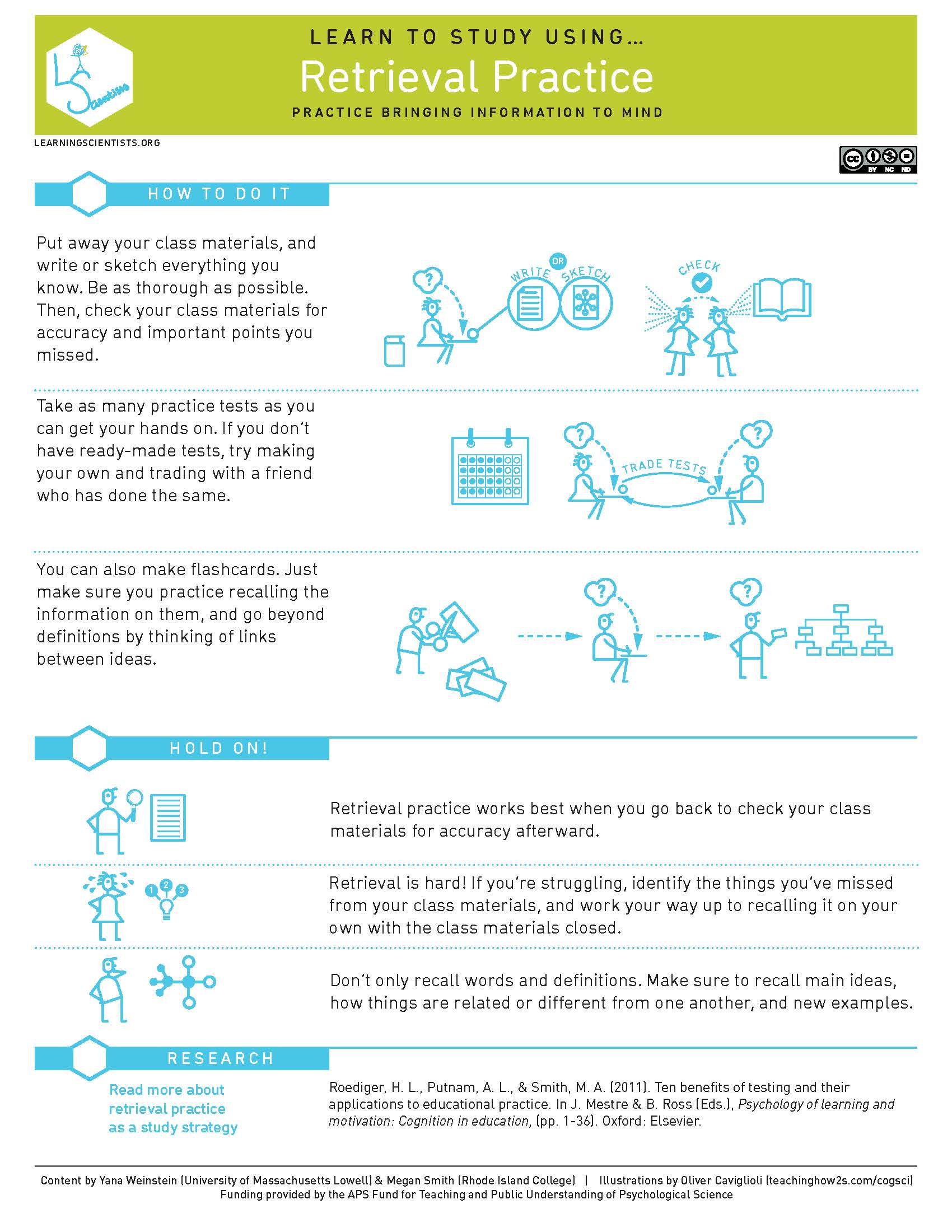
The retrieval-practice infographic reinforces one rule that matters here: check your materials after recalling, including the points you missed. The checking stage is part of learning, but it must not be mistaken for what you knew unaided.
Set up a fair 20-minute check
Use one sheet headed “Chemistry diagnostic — date.” Draw three columns: Question, Unaided attempt, and After checking. Keep the third column empty until the timer ends.
Your question sheet may remain visible; closed-book means no notes, explanations, worked examples, answer keys, or help from someone else while answering. Spend roughly two to three minutes per question. If you are stuck, write the step you can justify and mark where you stopped. If you have genuinely never studied a topic, mark it N (not yet studied) rather than treating it as forgotten.
Four questions come from the exercises in Some Basic Concepts of Chemistry, published by NCERT. Open the PDF only to locate the questions. Do not read the chapter explanation first.
SOME BASIC CONCEPTS OF CHEMISTRY
Use NCERT’s Chapter 1 exercises as the question sheet for the first four diagnostic entries. They test whether earlier mole and reaction ideas are available without a worked example beside them.
Go to Chapter 1, “Some Basic Concepts of Chemistry,” Exercises, on printed pages 25–27. Find question 1.1 near the beginning: attempt parts (i) and (ii) in molar masses. A few questions later, attempt 1.4(ii) in carbon combustion. On printed page 26, attempt 1.10(i) and (iii), beginning ethane counting. On printed page 27, attempt 1.25, the question beginning amount or concentration. Skip any of these that you have not previously studied; do not browse the surrounding worked material during the attempt.
Before starting, note these atomic masses if you need them: H = 1, C = 12, O = 16. You may use a calculator for arithmetic, but write the chemical setup yourself. These are diagnostic questions, so keep reading below only after you have finished the timed attempt.
Run the diagnostic
Set a 20-minute timer. Label your NCERT answers 1–4 in the order listed above. Then answer the following four prompts on the same sheet. They sample other chemistry topics you have encountered; they are not asking for advanced bonding or periodicity.
5. Atomic Structure: An atom has atomic number 11 and mass number 23. State its numbers of protons, neutrons, and electrons when neutral. What changes in its ion?
6. Chemical equations: Balance the skeleton equation . Check your result by counting each kind of atom on both sides.
7. Periodic properties: Which has the larger atomic radius, Mg or Ca? Give a reason involving electron shells.
8. Metals, non-metals, and bonding: In NaCl, identify the metal and non-metal and describe the basic bonding idea. How does that differ from bonding within an molecule?
Stop when the timer ends, even if a question is unfinished. On your sheet, circle any answer you felt unsure about before looking anything up. An accurate but uncertain answer is useful information: it may need a later recall check.
Check without erasing the evidence
Now fill the After checking column in a different colour or beneath a clear line. Keep your original attempts visible. The checks below are deliberately brief: their purpose is to locate gaps, not to teach all four chapters at once.
| Question | Check your unaided answer against this |
|---|---|
| 1. Molar masses | : ; : . |
| 2. Carbon combustion | of is . With , it permits , or , of . |
| 3. Ethane counting | Three moles of contain 6 mol of carbon atoms and 3 mol of ethane molecules, or approximately ethane molecules. |
| 4. Amount or concentration | specifies a total amount. specifies 0.50 mol per litre of solution; the total amount cannot be known without the solution volume. |
| 5. Atom and ion | Neutral: 11 protons, 12 neutrons, 11 electrons. The ion has 10 electrons; its proton and neutron counts do not change. |
| 6. Balancing | . Both sides have four Fe atoms and six O atoms. |
| 7. Radius | Ca has the larger atomic radius; its outer electrons occupy a shell farther out than Mg’s. |
| 8. Bonding | Na is a metal and Cl a non-metal. NaCl is described as ionic: oppositely charged ions are held together by electrostatic attraction after electron transfer. Within an molecule, the non-metal atoms form covalent bonds by sharing electrons. |
For each question, mark S if your independent answer and reasoning were sound, P if partly correct, G if you could not produce the needed idea, or N if it was not previously studied. Record a short observation beside every P or G: “used the wrong molar mass,” “could not start,” or “knew Ca was larger but could not explain why.” Do not replace an unaided P with S because the answer became clear while checking.
A result such as “3 of 7 previously studied questions sound” is more informative than treating all eight as a percentage if one was new to you. Equally, eight sound answers on this small check would be encouraging evidence for these prompts, not proof of timed JEE-level mastery.
Put the result to work
Return to the tracker you made last lesson. For each sampled chapter, add today’s date and the diagnostic observation under understanding or independent practice, whichever the attempt actually showed. Leave test mastery unassessed: a short, mixed, partly self-guided diagnostic is not an unfamiliar timed chapter test.
Choose one or two gaps, not eight new books, for your next action. If you missed question 2 because you could not connect oxygen mass to moles, a useful entry is: “Revisit the mole explanation in my primary source; then attempt two new combustion questions without notes.” If question 7 was marked N, its entry is simply “not yet studied”—it does not call for remedial revision. This is how the diagnostic helps you use your materials selectively rather than restarting every chapter that feels rusty.
For now, preserve the description of each mistake. In the next lesson, you’ll learn to classify errors more precisely so that a forgotten fact, a misunderstood idea, and an arithmetic slip lead to different responses.
Takeaway
A closed-book diagnostic separates what you can produce unaided from what looks familiar after you open a solution. Today’s useful output is not a score alone: it is a dated set of attempts, a distinction between gaps and not-yet-studied topics, and a small next action in your chapter tracker. That record gives your chemistry revision a starting point based on evidence rather than on how many resources you own.