Recommended resources
The freely available resources this lesson will direct you to.
- Statistics Lecture 4.7: Fundamental Counting Rule, Permutations and Combinationswww.youtube.com
- Permutation formula | Probability and combinatorics | Probability and Statistics | Khan Academywww.youtube.com
- 7.2 Permutations - Contemporary Mathematics | OpenStaxopenstax.org
- 3 Counting Techniques – STAT 414 | Introduction to Probability Theoryonline.stat.psu.edu
Hello! Last time, you used the multiplication principle to count outcomes assembled in stages. An ordered arrangement uses that same principle, with one important change: once an object occupies a position, it is no longer available for the next one.
In this lesson, you’ll count arrangements of distinct objects when you use either all of them or only some of them. The aim is to recognize why the count works, not just recall a formula. Allow about 35–40 minutes, including the video and reading.
What makes two arrangements different?
Suppose three distinct proposals, A, B, and C, must be placed in first, second, and third position. The list A–B–C differs from B–A–C: the same proposals appear, but their positions have changed. That is what order matters means.
The image lists every possible order of the three objects. Notice that each list uses every letter exactly once.
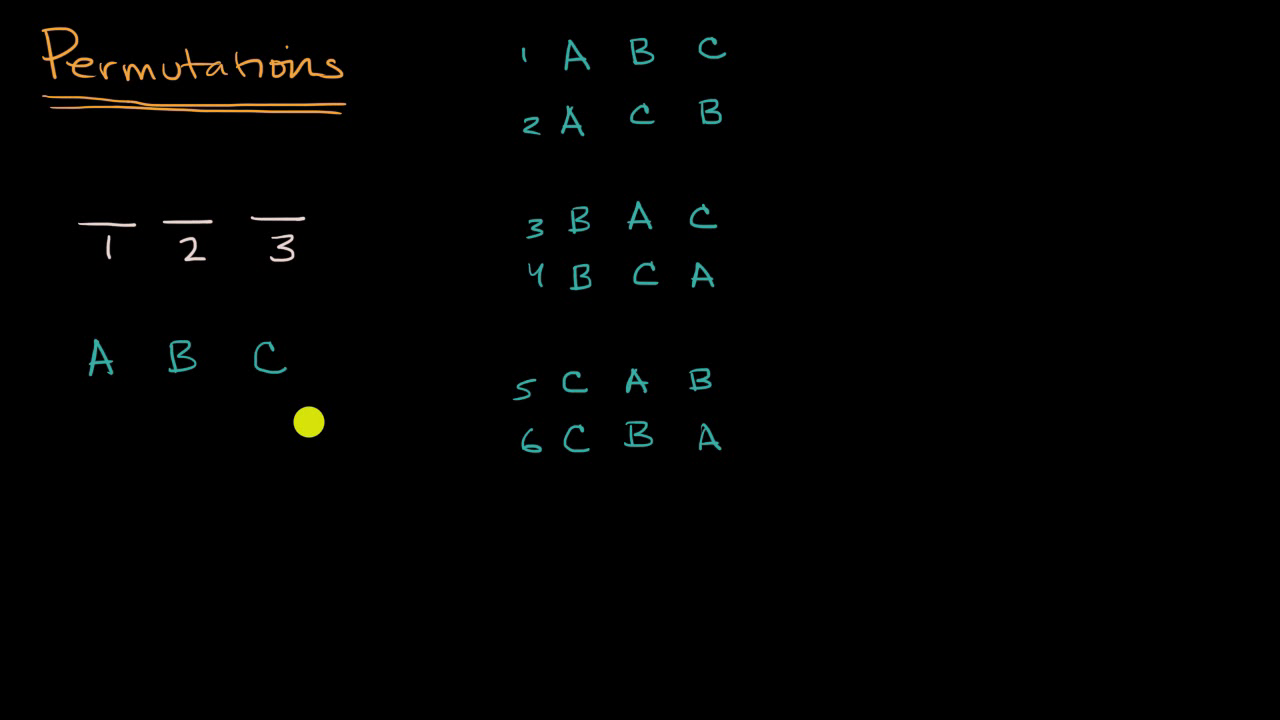
Rather than list the orders, fill the positions one at a time. There are three choices for first position. After any one of those choices, two objects remain for second position; the last position then has one choice. The multiplication principle gives .
The number of available objects shrinks, but the number of choices at each stage is consistent across branches. Regardless of which letter goes first, exactly two letters remain. That is why a single product counts every valid arrangement once.
Watch the opening of Khan Academy’s Permutation formula to see the same reasoning with five people and five seats.
Permutation formula | Probability and combinatorics | Probability and Statistics | Khan Academy
Khan Academy’s “Permutation formula” builds a full arrangement by filling one seat at a time. Watch for how the choice count changes after each seat is filled.
Watch five seats, from the introduction of the five people through the calculation of 120 arrangements. Focus on why the second seat has four choices regardless of who took the first.
Arranging every object: factorial
For distinct objects and labelled positions, successive positions have , then , and so on down to one available choice. We abbreviate the resulting product using a factorial:
Thus five distinct objects can be ordered in ways. The factorial is not a separate counting rule; it is shorthand for applying the multiplication principle to all the positions.
We also define . This agrees with the idea that there is exactly one way to arrange no objects: leave the arrangement empty. It will also make the formula for partial arrangements work when no objects are left over.
The conditions matter. Each object must be distinguishable from the others, each position must be identifiable, and an object can occupy at most one position. If swapping two entries does not create a different outcome, this count needs reconsideration.
Arranging only some of the objects
Now suppose there are eight distinct proposals, but you need a ranked list of only three. A complete outcome specifies which proposals occupy first, second, and third positions. It does not specify an order for the five proposals left off the list.
There are eight choices for first position, seven for second, and six for third:
Stop after three factors. Multiplying down to one would also arrange the five unlisted proposals, counting distinctions the question never asked for.
More generally, if you fill ordered positions from distinct objects, without using any object twice, the count is
There are factors in the descending product. The factorial expression says the same thing compactly: in , divide away the product of factors below . For the three-position example,
The quotient has another useful interpretation. Imagine first ordering all eight proposals. For any particular three-proposal prefix, the five proposals after it can be ordered in ways. Those full orders all give the same ranked top three. Dividing by removes those unwanted distinctions.
Continue the Khan Academy video for the move from full to partial arrangements and the derivation of the formula.
Permutation formula | Probability and combinatorics | Probability and Statistics | Khan Academy
Continue “Permutation formula” for the case where there are fewer seats than people. The video connects the descending product to factorial notation, then explains why reasoning from positions is more reliable than memorizing a formula.
Watch three seats for the direct count, then the factorial formula for its derivation. Finish with the reasoning about deciding when the formula applies.
Two boundary cases check the formula. If , you arrange every object and obtain . If , the only outcome is the empty list, and .
Translate the question before calculating
A permutation count applies only when changing the order changes the outcome. In the eight-proposal example, ranking A first and B second differs from ranking B first and A second. If the question merely asked which three proposals appear, those two lists would describe the same selection. We will count selections without order later in the module.
Likewise, check whether an object may be used more than once. A proposal already placed first cannot also be placed second, so the available choices shrink. If reuse were permitted, the count would follow a different pattern; that is the subject of the next lesson.
Read the applications in OpenStax’s 7.2 Permutations. They show that “ordered positions” need not look like seats in a row: different roles or different card positions can define the order.
7.2 Permutations - Contemporary Mathematics | OpenStax
Read OpenStax’s three applications to see how to identify ordered positions in a word problem.
In Section 7.2, find Example 7.7, “Applying Permutations.” Read the examples and solutions, starting with the two ranked students and ending with the three officer roles, just before “Your Turn 7.7.” For each case, identify what the positions represent and why exchanging the objects in two positions changes the outcome.
A restriction does not mean you should abandon position-by-position reasoning. Suppose one particular proposal must head the ranked list of three from eight. First position now has one choice; second has seven; third has six. The count is . Starting with an unrestricted permutation formula and ignoring the fixed first position would count lists that are not allowed.
A useful check is to describe one complete outcome before doing arithmetic. Then ask: Does each valid outcome appear once? Have I stopped after filling the positions the question specifies? Did I reduce the choices after using an object? Those questions are often more dependable than recognizing a familiar-looking formula.
Key takeaways
A permutation is an ordered arrangement. For distinct objects used once each, arranging all of them gives outcomes. Filling only ordered positions gives : multiply the shrinking choice counts and stop after positions. Before using either expression, confirm that positions matter and objects cannot be reused.
Next, you’ll count ordered arrangements when repetition is allowed. The positions will still be ordered, but filling one will no longer necessarily reduce the choices for the next.