Recommended resources
The freely available resources this lesson will direct you to.
- Observations and Inferences- What's the Difference ?www.youtube.com
- Observations and Inferenceswww.youtube.com
- Introduction to Primary Research: Observations, Surveys, and Interviews – The Muse: Misunderstandings and Their Remediesmtsu.pressbooks.pub
- Facts, Inferences, and Judgmentscollegeofsanmateo.edu
Hello! This course starts with a habit that makes later reasoning much clearer: noticing when a description of what happened has quietly become a story about why it happened. In this first module, you’ll learn to frame situations carefully before deciding what to conclude.
Today’s goal is practical. By the end, you should be able to take an everyday account—at work or in a personal conversation—and separate what someone directly observed from what they inferred. You can study the lesson in three sessions of about 15 minutes each.
What happened, and what do you think happened?
Imagine you send a colleague a question on Tuesday morning. On Wednesday afternoon, you check the same chat and see no reply. You might say, “They’re ignoring me.”
That sentence contains more than the information on your screen. “There’s no reply in this chat as of Wednesday afternoon” describes what you checked. “They’re ignoring me” proposes an explanation: they saw the question and deliberately chose not to answer. The explanation might be right, but the unanswered message alone does not establish it.
An observation records something you directly saw, heard, or otherwise detected. An interpretation, often called an inference, is a conclusion you draw using that observation and what you already know. Inferences are not bad; without them, you could hardly make a decision. The skill is to keep them identifiable so that a plausible guess does not get treated as a settled fact.
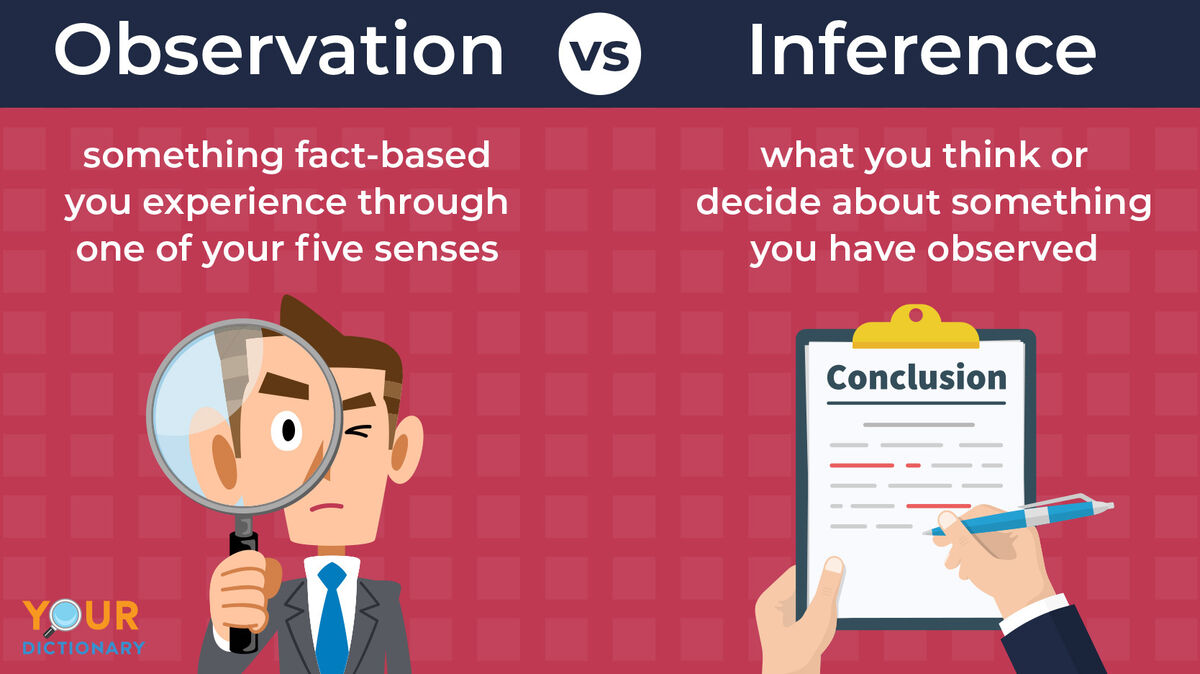
Watch the following short video for the basic distinction and several examples. Notice especially that an inference can be reasonable without being something the observer directly perceived.
“Observations and Inferences,” by Mike Sammartano, introduces the distinction through familiar sights and sounds.
Watch direct observations, from the opening definition through the examples involving the senses. Then skip to drawing inferences: the speaker defines an inference and returns to the earlier examples, including the green lawn and the roaring sound. Focus on what the person notices versus what they conclude might explain it.
In the lawn example, the lawn looks green and it rained recently do different jobs. Rain could explain the appearance, but so could watering. You need not list every possibility each time you speak; you do need to avoid presenting the rain as something you saw.
How interpretations enter ordinary descriptions
Interpretations often hide inside a single word. Consider: “My friend rudely cut me off.” Perhaps you heard your friend begin speaking while you were still speaking. The overlap is observable; “rudely” adds an assessment. “Cut me off” may also imply intent, depending on how it is used. A more careful account might be: “While I was finishing my sentence, my friend started speaking, and I stopped.” You can then add, separately, “I took that as dismissive.”
This separation does not require you to suppress your reaction. Feeling dismissed is important information about your experience. It is different from knowing that your friend intended to dismiss you. Stating both clearly makes a difficult conversation less likely to start with a disputed accusation.
A useful way to hear the difference is to ask what a recording of the moment could help establish. It might capture the words spoken, the order of speakers, and a pause. It could not, by itself, show a person’s private intention. This is a guide, not an infallible test: recordings have limits, and even direct perception can be mistaken. Observation means closer to what was detected, not guaranteed to be correct.
The reading below shows what happens when assumptions slip into notes that are meant to record an event.
Read the short subsection “Eliminating Bias in Your Observation Notes” in The Muse: Misunderstandings and Their Remedies. Its two accounts of a person eating pizza show how easily a description can acquire claims about someone’s thoughts.
Find the heading “Eliminating Bias in Your Observation Notes.” Read the subsection passage, beginning with its explanation of observation versus interpretation and ending with the introduction of the double-entry notebook, just before the figure. Compare what each pizza entry lets an observer see or hear with what it assumes about the student.
The second pizza entry reports that the student says, “This pizza is good.” Hearing those words is an observation. Concluding that the student enjoys everything about the meal, or knows nothing about its nutritional content, goes beyond them. Keeping two columns—what I noticed and what I make of it—lets you preserve the interpretation without disguising it as an observation.
Separate the parts without losing the point
In everyday life, a sentence may contain both kinds of information. You do not have to classify the entire sentence as one or the other. Split it where the leap occurs.
Suppose you say, “The meeting started ten minutes late because nobody respects our time.” You may have directly checked the scheduled and actual start times. “Nobody respects our time” is a broad interpretation of the delay. A clearer version preserves both parts:
Observed: The meeting was scheduled for 10:00 and began at 10:10, according to the clock I checked.
My interpretation: The delay may reflect a lack of regard for attendees’ time.
The revision does not make the concern disappear. It shows which part someone else could confirm quickly and which part would need more support.
Pay particular attention to claims about motives, feelings, and causes. “They wanted to embarrass me,” “she is upset,” and “the new procedure caused the delay” may all be true, but they assert more than a visible action or audible remark. Even “she said she was upset” differs from “she was upset”: you directly heard her report; her inner experience is known to you through what she told you.
Absences need boundaries, too. “I found no answer in the chat when I checked at 3:00” is more precise than “No one answered me.” Someone may have responded elsewhere, or after you checked. The point is not to speak awkwardly at all times. It is to become more precise when the distinction could change a judgment or a conversation.
For a brief habit between study sessions, try a two-column note about one low-stakes event: a message, a meeting, or a household plan. Put only what you directly noticed on the left; put your first explanation on the right. If an item could fit both columns, make its wording more specific. Two minutes is enough to start building the habit.
Takeaway
An observation says what you detected within a particular setting. An interpretation says what you think it means. Both are useful, but confusing them can make a tentative explanation sound indisputable. When something matters, describe the observation precisely, then state the interpretation as an interpretation.
In the next lesson, you’ll use this distinction to turn a vague concern into a precise question you can actually investigate.