Recommended resources
The freely available resources this lesson will direct you to.
- How to Pronounce Every Vowel Sound in British English (RP / Modern)www.youtube.com
- How to Read IPA - Learn How Using IPA Can Improve Your Pronunciationwww.youtube.com
- Help - Phonetics - Cambridge Dictionarydictionary.cambridge.org
- Pronunciation Guide (English/Academic Dictionaries)www.oxfordlearnersdictionaries.com
Welcome back. Last time, you learned to read the core IPA consonant symbols, including /ʃ/ in ship and /j/ in yes. Now you can give the sounds between those consonants equally precise labels. This lesson focuses on recognising vowel symbols in a British learner dictionary, not yet on perfecting every vowel in your own speech. That distinction matters: once you can read the guide, later listening and speaking practice becomes much more targeted.
What a dictionary vowel symbol tells you · About 7 minutes
A pronunciation written between slashes is a guide to sounds, not a respelling of the word. Oxford Learner’s Dictionaries describes its British model as contemporary, mainstream RP rather than an old-fashioned formal accent. Its transcription is broad: it identifies useful sound distinctions without recording every small variation in how someone might say a word.
Pronunciation Guide (English/Academic Dictionaries)
Read Oxford Learner’s Dictionaries’ explanation of its pronunciation model. It establishes why its British vowel symbols are a suitable reference for contemporary RP.
In “Pronunciation in the dictionary,” read the British model. Then read broad transcription. Focus on the difference between representing a meaningful sound contrast and specifying every detail of its production.
You will see three useful shapes in vowel transcriptions. /ɪ/ is a single vowel symbol, as in sit. /iː/ has a length mark /ː/, as in see. /eɪ/ contains two vowel symbols because it represents a diphthong—a vowel that changes quality within the syllable, as in say. The length mark is part of the dictionary label; it does not mean that you can turn /ɪ/ into /iː/ merely by holding it longer. The two vowels also differ in quality.
How to Read IPA - Learn How Using IPA Can Improve Your Pronunciation
Watch “How to Read IPA” from Oxford Online English for a short introduction to how single symbols, length marks, and two-symbol diphthongs appear in a British transcription.
Watch vowel notation. Concentrate on the examples bit, door, and home. Treat “short” and “long” as useful dictionary labels, not as a complete description of how to make each sound.
Here is the chart you used for consonants in the previous lesson. This time, look only at its upper half. It provides a visual map of single-position vowels (monophthongs) and moving vowels (diphthongs).
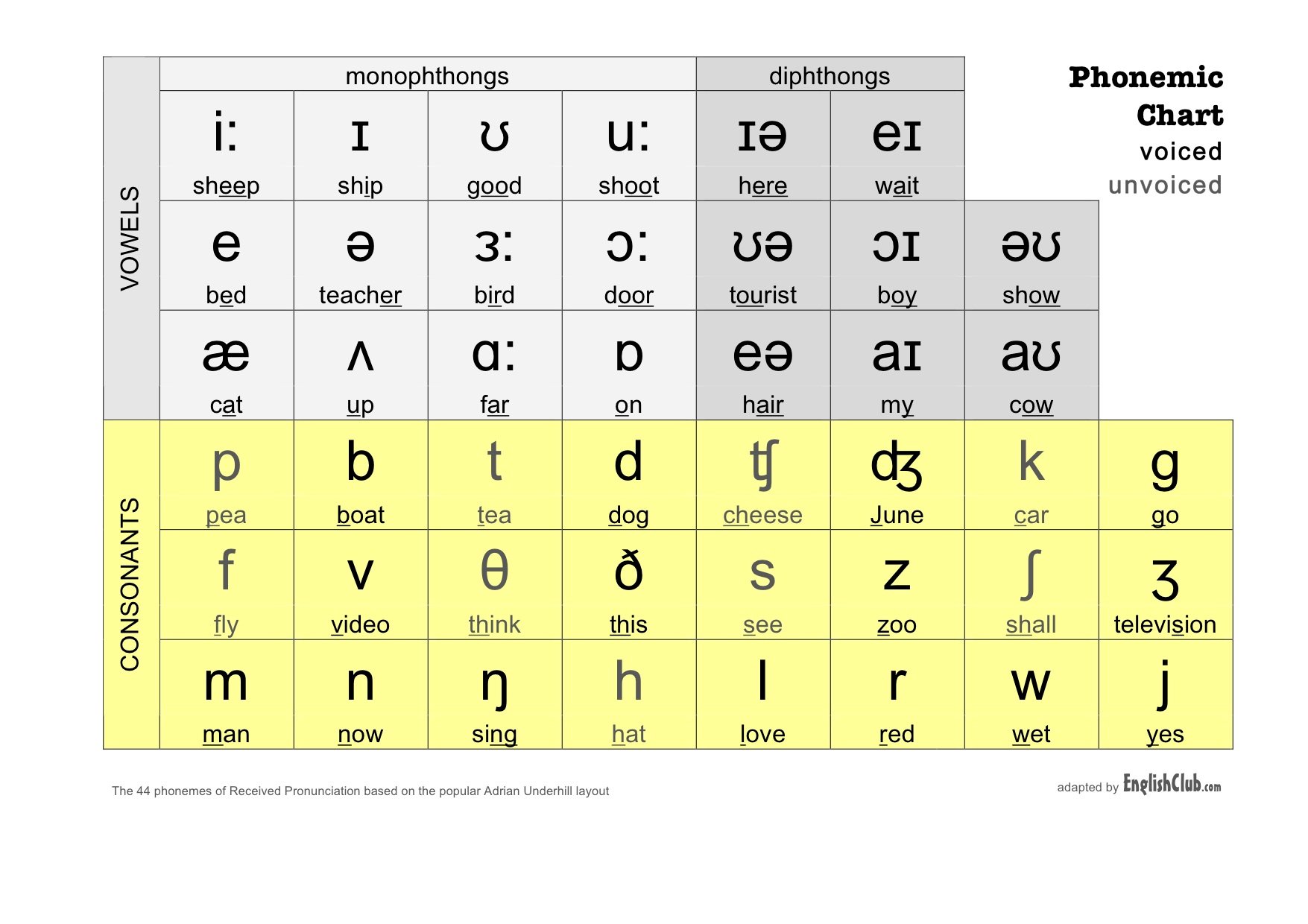
Reading the single-vowel symbols · About 10 minutes
The most reliable way to learn a vowel symbol is to attach it to a heard example word. Do not assign it the name of an English letter: IPA /e/ is the vowel in bed, not the spoken name of the letter E. Also keep your attention on the dictionary’s British entry, since the same written word can have a different US transcription.
Pronunciation Guide (English/Academic Dictionaries)
Use Oxford’s vowel table as your reference inventory. Read the example word and its transcription together, identifying which IPA symbol represents the vowel.
In “Vowels and diphthongs,” begin with the see row and read the single-vowel rows through about. Then locate the diphthong rows, from say through pure; you will use these in the next section. Some British entries have (r) after the vowel. For now, focus on the vowel before those parentheses.
The single-vowel symbols are easier to retain in neighbouring groups than as a string of unfamiliar shapes:
| Symbols | Anchor words | What to read in the dictionary |
|---|---|---|
| /iː/ and /ɪ/ | see, sit | Two different vowel labels; /ː/ is not their only difference. |
| /e/ and /æ/ | bed, cat | /æ/ is the symbol in cat, despite the letter a. |
| /ʌ/ and /ɑː/ | cup, father | The spelling a does not define either sound. |
| /ɒ/ and /ɔː/ | got, saw | Keep these British vowel labels separate. |
| /ʊ/ and /uː/ | put, too | /ʊ/ is not simply an abbreviated /uː/. |
| /ɜː/ and /ə/ | fur, the first vowel of about | /ə/, called schwa, commonly occurs in an unstressed syllable. |
This table is a recognition map, not six instructions to exaggerate contrasts in speech. For example, seeing /ɒ/ in a British entry tells you to use the vowel category illustrated by got; you do not need to settle its exact tongue position today. The forthcoming vowel lessons will give you time to hear and produce each contrast.
Schwa deserves an early mention because it appears frequently in dictionary entries. In about, /ə/ represents the first, unstressed vowel, although the word begins with the written letter a. In fur, /ɜː/ is a different vowel in a stressed syllable. Reading those as separate symbols will prevent spelling from taking over when you encounter longer words.
Reading diphthongs as one vowel movement · About 7 minutes
When two vowel symbols appear together in a transcription such as /eɪ/, read them as one diphthong, not as instructions to pronounce two separate syllables. The symbols suggest where the vowel movement starts and ends. You are learning to recognise the dictionary’s category; the detailed movements come later in the course.
Oxford’s table gives you eight British diphthong labels. Five will appear often: /eɪ/ in say, /əʊ/ in go, /aɪ/ in my, /ɔɪ/ in boy, and /aʊ/ in now. Notice especially the first symbol of /əʊ/: a British learner dictionary writes the vowel of go with /əʊ/, rather than the /oʊ/ you may see in a US entry.
The remaining three in the table are /ɪə/ in near, /eə/ in hair, and /ʊə/ in pure. These conventional dictionary labels help you identify the intended British word vowel. They are not a promise that every contemporary speaker will make an equally obvious two-part movement in each word.
You may also encounter /aɪə/ in fire or /aʊə/ in hour in a pronunciation guide. Read those as the familiar /aɪ/ or /aʊ/ followed by /ə/, rather than adding two more basic diphthongs to your memory list.
Two small symbols that are easy to misread · About 5 minutes
Oxford’s table includes /i/ in happy and /u/ in actual without the length mark. These represent weak vowels in certain unstressed positions. They are not instructions to substitute the stressed vowels /ɪ/ and /ʊ/ automatically, nor are they simply /iː/ and /uː/ with a missing mark.
Pronunciation Guide (English/Academic Dictionaries)
Read Oxford’s explanation of why its transcriptions sometimes use /i/ and /u/ without /ː/. This resolves an important apparent exception to the patterns you have just learned.
In “Pronunciation in the dictionary,” find the paragraph beginning “Some variant pronunciations are represented by the special use.” Read from the explanation of /i/, then continue through the paragraph’s final actual example. Focus on how /u/ also represents a range of weak-vowel pronunciations; you do not need to learn every variant of actual today.
A good first-pass interpretation is: /i/ means a weak, high front vowel; /u/ means a weak, high back vowel. Their exact realisation can vary. Compare the written symbols in Oxford’s see /siː/ and happy /ˈhæpi/: the second word ends in /i/, not /iː/. The small mark before /hæ/ is a stress mark, not part of the vowel. The next lesson will show you how to read such marks systematically.
Connect the symbols to UK recordings · About 9 minutes
A table helps you decode print; audio keeps the symbols attached to actual sounds. Cambridge Dictionary’s phonetics guide supplies UK audio beside its example words. Use the UK controls for this course: the page also displays US entries, including some different symbols for comparable words.
Help - Phonetics - Cambridge Dictionary
Use Cambridge Dictionary’s vowel table chiefly as an audio reference. Hearing a word while viewing its symbol will make later dictionary reading less dependent on spelling.
In the main vowel-symbol table, start at sheep and ship, then follow the rows down through pure. The lower rows include eye, boy, nose, mouth, and ear; hair and pure follow immediately after. Play the UK audio for sheep/ship, head/hat, foot/blue, and day/nose, then for ear/hair. Look at each IPA symbol as you listen. The rows for fire and hour come after pure and can be left for a later pass.
If you have a recording device ready, make one brief recording of those same words after hearing the UK examples. On replay, check a limited question: can you hear which recorded word you intended while looking at its IPA label? Avoid trying to correct every vowel at once. This is a symbol-to-sound check; the later modules will develop the individual contrasts.
A Cambridge page may also show /ɝː/, /ɚ/, or /oʊ/ in rows labelled US. Those are useful for interpreting the page, but they are not replacements for the British /ɜː/, /ə/, and /əʊ/ labels you are learning here.
You can now read the main vowel notation in a contemporary British learner dictionary: single-vowel symbols, the length mark /ː/, two-symbol diphthongs, and the weak-vowel symbols /i/ and /u/. Keep one anchor word beside any symbol that does not yet bring a sound to mind, and use UK audio to check it rather than guessing from spelling.
Next, you will learn to divide words into syllables and locate primary stress. That will let you interpret not just which vowels a dictionary shows, but where each one belongs in the spoken word.