Recommended resources
The freely available resources this lesson will direct you to.
Welcome. This course is designed to help you assess and prepare for a transition into management consulting, while building practical finance and problem-solving skills along the way. We begin with the central question: what does an MBB consulting team actually do that creates value for a client?
The short answer is not “make slides” or even “perform analysis.” A consulting team creates value when it helps leaders move from an important but ambiguous situation to a better decision, a practical plan, and measurable results. The work typically combines structured problem solving, rigorous analysis, stakeholder alignment, and support for execution.
By the end of this lesson, you should be able to explain that process clearly—from initial diagnosis through implementation and sustained impact.
Value is created through decisions and actions—not deliverables
Clients usually bring consultants in when the organization faces a consequential decision with uncertainty, urgency, or complexity. For example:
- A retailer’s profits have fallen, but leaders disagree about whether the cause is pricing, costs, customer churn, or operations.
- A software company is considering a new market but is unsure whether the opportunity is large enough to justify investment.
- A bank has committed to reduce costs but needs an executable program across technology, operations, and the workforce.
- A private-equity investor must decide quickly whether to acquire a company.
A presentation, model, or report may be useful, but it is only an intermediate product. The intended value lies in what it enables:
- Clarity about what is actually happening and why.
- Confidence that leaders understand their options and trade-offs.
- Commitment to a decision, with aligned stakeholders.
- Action that changes financial or operational outcomes.
- Capability so the client can sustain the result after the team leaves.
This distinction matters in both consulting and recruiting. A strong consultant does not describe their contribution as “built an Excel model” or “created a deck.” They describe the decision or action that their work enabled: for example, “identified the two largest profit leaks, enabling leadership to prioritize a cost program expected to reduce annual operating expense.”
The Emory University session below captures this idea especially well: high-impact work gives decision-makers clarity and confidence, but no value is realized until choices are made and actions occur.
How to Approach Problems Like a Management Consultant
Watch “How to Approach Problems Like a Management Consultant” from Emory University's Goizueta Business School. It gives a concise explanation of how consulting work connects an issue to an implementable action.
Start with impact and action. Focus on the distinction between technically high-quality work and work that enables decisions and execution. Then watch the seven steps for a high-level map from problem definition through implementation.
A useful way to state the consulting value proposition is:
A consulting team helps a client make and execute a better decision than it could have made alone, within the time available.
“Better” can mean more fact-based, faster, more cross-functional, less biased, more financially rigorous, or more likely to be implemented.
The typical engagement: from an ambiguous problem to a measurable result
Although projects differ widely, most MBB engagements follow a recurring pattern. A two-week commercial due diligence for an investor moves much faster than a year-long transformation, but both require the same basic disciplines: clarify the decision, develop evidence, create a recommendation, and convert it into action.
The three-phase engagement approach below illustrates the broad flow.
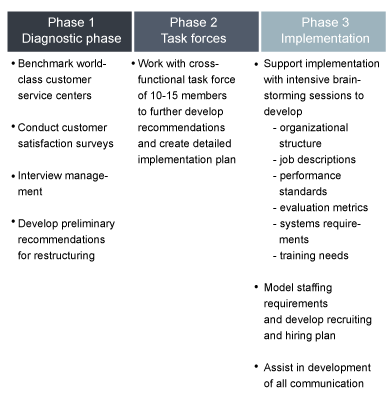
1. Align on the decision and diagnose the situation
The team begins by converting a broad concern into a precise question. “We need to grow” is not yet a workable consulting problem. A stronger version might be:
“How can the North American business increase annual revenue by 15% over three years while maintaining its current gross margin?”
That framing identifies an objective, scope, time horizon, and constraint. It also prompts a measurable definition of success.
At the start of an engagement, the team generally works with senior client sponsors to establish:
- The core decision. What must leadership decide or achieve?
- The baseline. What happens if the organization changes nothing?
- The scope. Which businesses, products, geographies, customers, or functions are included?
- The success metric. Is success measured in profit, revenue, cash flow, customer retention, service level, market share, or another outcome?
- The constraints. What is off-limits because of capital, regulation, timing, contractual obligations, or organizational realities?
- The stakeholders. Who has relevant knowledge, formal decision rights, or the ability to block implementation?
The team then builds a fact base. Depending on the problem, this may include financial data, customer interviews, employee interviews, market research, benchmarks, operational data, and competitor analysis. The aim is not to collect every possible fact. It is to reduce uncertainty around the questions that matter most.
For example, suppose a subscription-software company’s profit margin is deteriorating. A team might initially test several plausible explanations:
- Customer acquisition costs may be rising.
- Sales discounts may be increasing.
- Existing customers may be cancelling at a higher rate.
- Cloud-infrastructure costs may be growing faster than revenue.
- The customer mix may be shifting toward lower-margin segments.
Each explanation is a hypothesis to test, not a conclusion to defend. This prevents the team from accepting the first persuasive story it hears.
The practical output of this phase is usually a shared understanding of the problem and a prioritized agenda for analysis. That alone can create value: client leaders often discover that they were using different definitions, pursuing conflicting objectives, or focusing on symptoms rather than causes.
2. Structure the problem, analyze evidence, and develop choices
Next, the consulting team breaks the core problem into manageable components. Rather than assigning scattered analyses, it creates a logical structure that connects every workstream back to the client’s decision.
For a profitability problem, the structure may examine revenue and cost drivers. For a market-entry decision, it may examine market attractiveness, competitive position, entry requirements, and economics. For an operating-model redesign, it may assess processes, organization, technology, governance, and capability.
This structured approach has two advantages:
- It makes the work complete enough that major explanations are not missed.
- It makes the work efficient enough that the team does not spend time on interesting but decision-irrelevant questions.
The analysis can involve financial modeling, market sizing, customer segmentation, cost benchmarking, process mapping, interviews, or operational data analysis. The method changes with the problem; the core discipline does not. The team continuously asks: What does this finding mean for the decision?
Consider the subscription-software example. Suppose the team finds that:
- Revenue is still growing.
- Customer acquisition cost rose 35% over two years.
- Retention is stable among enterprise customers but weak among small businesses.
- The sales organization spends disproportionate time on low-value accounts.
- Infrastructure cost is manageable and is not the central cause of the margin decline.
A weak conclusion would simply report these facts. A consulting-quality conclusion connects them:
Profitability is being eroded primarily by an uneconomic small-business acquisition model, not by technology costs; the company should redesign channel economics and focus direct sales capacity on higher-retention enterprise segments.
That is the movement from data to insight to action.
The team then evaluates options rather than assuming there is only one answer. Each option should be assessed against criteria the client cares about, such as expected financial impact, investment required, timing, customer implications, operational feasibility, and risk.
For example, possible actions could include:
| Option | Potential upside | Main risk or trade-off |
|---|---|---|
| Raise prices for small-business customers | Faster margin improvement | Higher churn |
| Reduce paid-acquisition spend | Lower customer acquisition cost | Slower new-customer growth |
| Shift small businesses to a lower-touch channel | Better sales productivity | Requires product and service redesign |
| Focus direct sales on enterprise accounts | Higher lifetime value and retention | Leaves a segment less actively served |
Consultants add value by making these trade-offs explicit and comparable. They also pressure-test their own recommendation: What evidence could overturn it? What operational dependency has been overlooked? What would the finance team challenge? Which stakeholder may resist, and why?
Consulting is collaborative, not an outsourced answer machine
MBB teams bring independent analysis and problem-solving capacity, but clients own the business and must live with the consequences. The strongest engagements are therefore co-created with client teams.
A typical project includes several layers of collaboration:
| Group | Main contribution |
|---|---|
| Senior client sponsor | Sets ambition, makes major decisions, removes barriers |
| Client functional leaders | Provide expertise, resources, and ownership of execution |
| Frontline employees and subject-matter experts | Explain how work actually happens and identify practical constraints |
| Consulting team | Structures the problem, conducts analysis, synthesizes findings, facilitates decisions, and helps mobilize action |
| Finance partners | Validate baselines, assumptions, and whether claimed value is real |
This collaboration prevents a frequent failure mode: a recommendation that looks attractive in a presentation but cannot work in the organization.
The consultant’s role is not merely to agree with the loudest executive. It is to surface the relevant facts and tensions in a constructive way. If a proposed cost reduction would lower service quality, if a digital initiative has no clear business case, or if two workstreams depend on the same scarce engineering talent, the team must make those issues visible early.
The following project examples give a useful sense of this in practice. Notice how project structure, team interaction, and stakeholder engagement vary by context.
Inside Real Consulting Projects: BCG & Strategy& Examples
Watch “Inside Real Consulting Projects: BCG & Strategy& Examples” by Prepmatter. It contrasts a short, decision-focused commercial due diligence with a longer digital-transformation project, showing that the engagement model adapts to the client’s decision and time horizon.
Watch the project overview to identify the two project types. Then view commercial due diligence, noting the rapid ramp-up, research, analysis, and client interaction. Continue with digital transformation and compare its exploration, design, quick-win, and stakeholder-management requirements with the due-diligence example.
A key insight from the comparison: a due diligence often creates value by improving the quality and speed of an investment decision, while a transformation creates value through both the decision and the organization’s ability to execute it over time.
Turning recommendations into results
A recommendation has not created full value merely because a leadership team approves it. Many change efforts stall after approval because the organization has not answered practical questions:
- Who owns each action?
- What happens first?
- Which decisions require executive approval?
- Which systems, processes, or policies must change?
- What capabilities or training are required?
- How will the organization know whether results are genuinely appearing?
The distinction is captured in the value-creation model below.
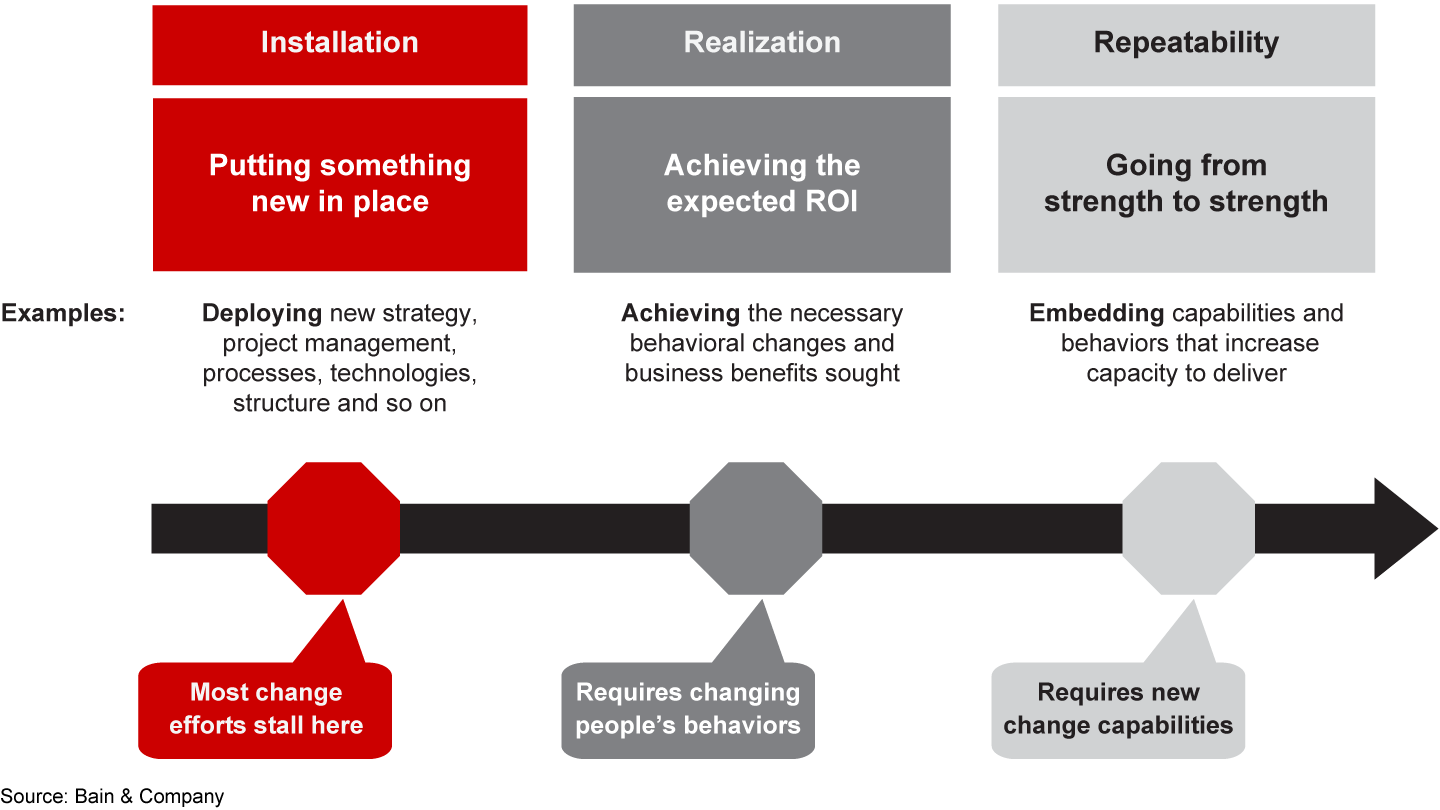
Installation
Installation means putting the new solution in place: launching a pricing policy, deploying a technology platform, establishing a new operating model, or approving a transformation roadmap.
This stage is visible and often receives the most attention. Yet it is not the same as achieving the business case. A company may launch a new sales process without sales representatives actually using it, or introduce a dashboard without leaders using it in decisions.
Realization
Realization is achieving the intended economic or operational outcome. This requires changing behavior and monitoring whether the expected value is actually appearing.
Suppose the client expects a procurement initiative to reduce annual spending by million. Realization requires more than renegotiated supplier contracts. The organization must verify:
- The savings are measured against an agreed baseline.
- The lower prices are actually used in purchase orders.
- Buying volumes do not shift in a way that offsets the savings.
- Costs have not merely moved to another department.
- One-time implementation costs are understood.
- Finance agrees that the benefit is valid.
This is why a consulting team often establishes a value-tracking mechanism: named owners, milestones, financial KPIs, operational KPIs, and a regular review cadence.
Repeatability
Repeatability means the organization has developed the capability to sustain and extend the result. It may include new skills, routines, systems, incentives, decision rights, and leadership behaviors.
For instance, if a consulting team improves product-pricing decisions, repeatability might require:
- A pricing governance process.
- Clear decision rights for product, sales, and finance leaders.
- Tools that show discount levels and margin effects.
- Training for sales managers.
- Incentives aligned to profitable growth rather than revenue alone.
- A recurring routine to review pricing performance.
Without these elements, the organization may gradually return to old habits after the engagement ends.
The BCG resource below focuses on this execution dimension. While it discusses large transformations in particular, its central lesson generalizes: complex value creation needs clear ownership, aligned metrics, cross-functional coordination, and disciplined follow-through.
How to Create a Transformation That Lasts | BCG
Read BCG’s “How to Create a Transformation That Lasts” to see how a transformation office can coordinate cross-functional initiatives, establish financial discipline, and keep promised value from being lost during execution.
In “Key Takeaways” and the opening discussion before “Getting the Transformation Office Off the Ground,” read the transformation-office rationale. Focus on why coordination, transparency, accountability, and behavior change matter alongside a strategy. Then go to “Driving Financial Discipline in a Transformation.” Read the baseline discussion, followed by the tracking approach. Pay particular attention to the difference between an announced initiative and a validated financial impact.
How an MBB team organizes its contribution
Within the consulting team, responsibilities are typically divided by level, although titles vary by firm and office.
- Senior leaders shape the client relationship, challenge the team’s thinking, facilitate major decisions, and help resolve issues that require executive intervention.
- Project leaders or managers convert the engagement objective into a workplan, coordinate the team, maintain quality, guide client communication, and keep the work connected to the decision.
- Consultants and analysts conduct interviews, analyze data, build models, develop insights, create communication materials, and increasingly help run client working sessions.
The important point is that consulting is not a set of isolated individual tasks. A project team operates as a small decision-making system. It needs a shared problem definition, explicit hypotheses, rapid feedback, clear ownership, and regular synthesis.
A strong team rhythm often includes:
- A regular internal meeting to test hypotheses, review evidence, and decide the next analyses.
- Working sessions with client teams to refine facts and design practical solutions.
- Check-ins with senior sponsors to resolve trade-offs and preserve alignment.
- A recurring review of milestones, risks, owners, and value metrics during implementation.
These routines reduce the chance that the team delivers a technically sound answer that the client does not support or cannot execute.
A concise explanation you can use
If someone asks what an MBB team does for a client, you could say:
An MBB team helps a client solve an important business problem by clarifying the decision, building a fact base, structuring and testing the key questions, and translating the findings into a practical recommendation. The team creates the most value when it also aligns stakeholders, establishes owners and metrics, and helps the organization realize and sustain the expected financial or operational impact.
That explanation is stronger than “consultants give advice” because it identifies the full chain from ambiguity to measurable results.
Key takeaways
A typical consulting engagement creates value through a connected set of activities:
- Frame the right problem around a decision, objective, scope, and success metric.
- Build a fact base and test hypotheses instead of relying on assumptions.
- Turn analysis into insight by connecting evidence to the client’s decision.
- Develop feasible choices and make trade-offs explicit.
- Align stakeholders so the recommendation has credibility and ownership.
- Mobilize implementation through initiatives, owners, milestones, and governance.
- Track realized value, not merely completed activities.
- Build repeatable capabilities so results survive after the engagement.
In the next lesson, you will distinguish the main MBB role types in the United States: generalist, digital, specialist, and implementation roles. That will help you connect this engagement model to the kinds of work different consultants actually do.