Recommended resources
The freely available resources this lesson will direct you to.
Hello! Welcome to the final lesson in our foundational science module.
In the previous lessons, you learned about sleep pressure (Process S) and how your circadian rhythm (Process C) is set by light. We established that getting morning sunlight is the non-negotiable first step to anchoring your internal 24-hour clock.
Today, we will explore another powerful biological rhythm that is deeply intertwined with your sleep-wake cycle. This lesson addresses the learning outcome: Describe how your core body temperature cycle influences sleep initiation and quality.
While light is the primary input that sets your master clock, your body temperature cycle is a primary output that dictates when you feel alert and when you feel sleepy. Understanding this mechanism unlocks a new set of tools to control your sleep. By the end of this 20-minute lesson, you'll know precisely why your body needs to cool down to sleep and how that process works.
Your 24-Hour Temperature Rhythm
Your body temperature is not a static 37°C (98.6°F). It follows a predictable 24-hour cycle, orchestrated by your master clock (the SCN). This rhythm is fundamental to your feelings of wakefulness and sleepiness.
To get a clear overview of this cycle, let's start with Dr. Andrew Huberman.
How to Defeat Jet Lag, Shift Work & Sleeplessness
In this clip, Dr. Huberman explains the basic endogenous 24-hour rhythm of your body temperature and its direct correlation with being awake or sleepy.
Watch from 04:07 to 05:39. Focus on the core concept: your temperature has a 24-hour cycle, and we tend to be sleepy as it falls and wakeful as it rises.
As Dr. Huberman stated, this is a biological fact. The simple rule is:
- As your core body temperature rises, you feel more alert and awake.
- As your core body temperature falls, you begin to feel sleepy.
This graph provides a clear visual of this daily cycle.

The most important takeaway for initiating sleep is this: to fall asleep and stay asleep, your core body temperature must drop by about 1-2°F (around 1°C). This is not optional; it is a physiological prerequisite for sleep. The decline typically begins about two hours before your natural bedtime.
The Mechanism: How Your Body Cools Itself
How does your body, which is constantly generating heat, manage to lower its core temperature to trigger sleep? It does so through a process of heat transfer.
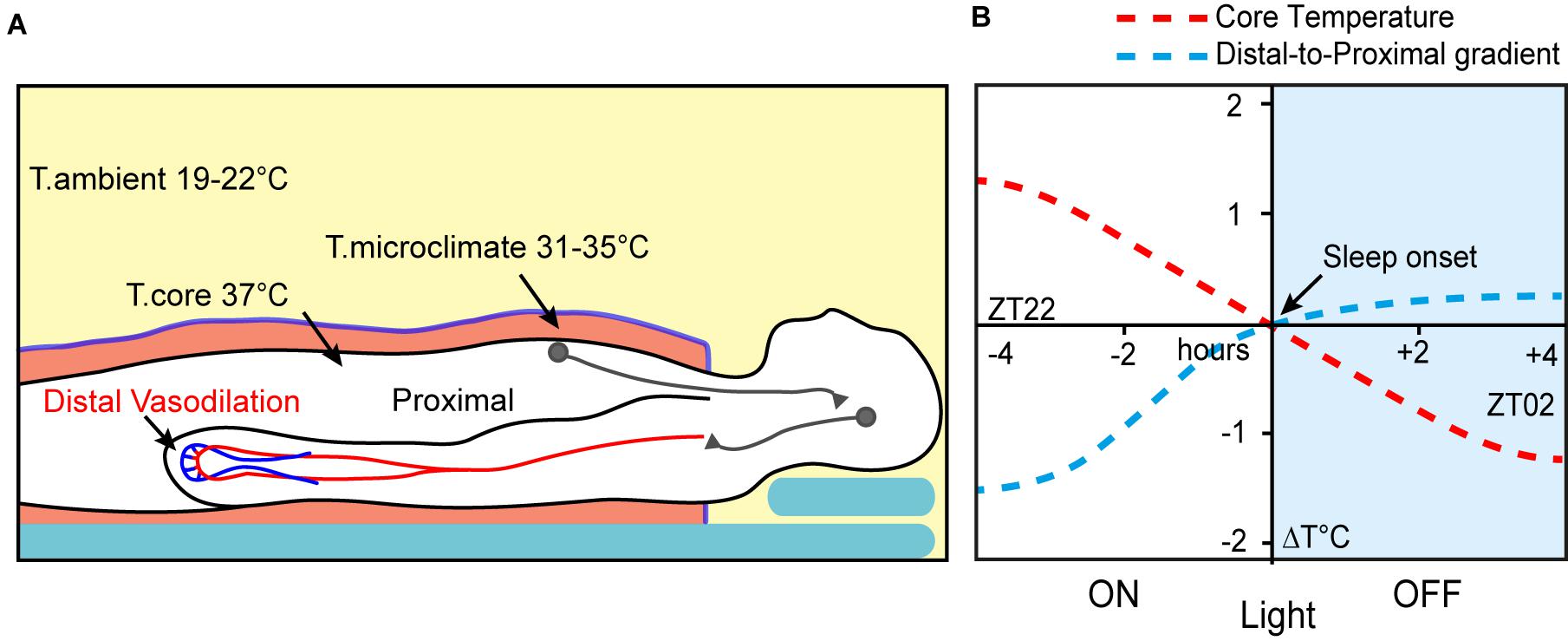
Your body has a core (your torso and organs) and a periphery (your skin, hands, feet, and face). To cool the core, your body cleverly uses your skin as a radiator. It opens up the blood vessels in your hands, feet, and face—a process called vasodilation—and sends warm blood from the core to these surfaces. The heat then dissipates into the cooler, surrounding air.
How To Rig Your Body Temperature For Deep Sleep
Dr. Tracey Marks provides an excellent, straightforward explanation of this heat dissipation process and the difference between core and ambient temperature.
Watch from 04:24 to 05:44. Pay attention to how the body uses the skin of your hands and feet (distal skin) to release heat from your core.
This mechanism explains a very common experience: getting warm hands and feet just as you start to feel sleepy. This isn't a coincidence; it's the physical sign that your body is actively dumping core heat to prepare for sleep.
The following scientific illustration shows this process in action.
Test your understanding!
You're in a cool bedroom, but you decide to wear a pair of thin socks to bed. Why might this simple action help you fall asleep faster?
Show answer
Wearing socks warms the skin of your feet. This encourages the blood vessels in your feet to open up (vasodilation), which makes it easier for your body to release core body heat through them. This accelerates the drop in core body temperature, which in turn sends a powerful signal to your brain to initiate sleep.
Your Temperature Anchor: The Temperature Minimum
Just as morning light provides an anchor for your circadian clock, your temperature cycle has a similar anchor point. This is your Temperature Minimum (T-min), the moment in the 24-hour cycle when your core body temperature is at its absolute lowest.
A simple, practical way to estimate your T-min is by using your average wake-up time.
How to Defeat Jet Lag, Shift Work & Sleeplessness
Dr. Huberman explains the concept of the temperature minimum and how to easily estimate it without a thermometer. This is a powerful concept for understanding your own rhythm.
Read the transcript for the section from 28:52 to 33:24. Focus on the rule for calculating your T-min (it's about 2 hours before your average wake-up time) and why it's considered a crucial reference point for your biology.
Knowing your T-min is like having a key reference point on your body's internal map. For example, if you consistently wake up around 7 AM, your T-min is likely around 5 AM. This is the point when your body is in its deepest state of rest before the process of waking begins.
While we won't go into detail on advanced applications now, understanding this concept is critical. The timing of light exposure, exercise, and even meals relative to your T-min determines whether you shift your clock earlier or later. This becomes an invaluable tool for managing schedule disruptions like travel or social events, which we'll discuss in a later module.
Conclusion and Key Takeaways
This lesson completes our foundational module on the science of sleep. You now understand the three core biological drivers: sleep pressure (adenosine), the circadian clock (set by light), and the temperature cycle.
- Temperature Follows a Rhythm: Your core body temperature rises and falls over a 24-hour cycle, dictating your periods of alertness and sleepiness.
- Cooling Down is Key: A drop in core body temperature of 1-2°F is a non-negotiable biological requirement to fall asleep.
- The Body is a Radiator: Your body cools its core by sending warm blood to the skin of your hands and feet (vasodilation), which release heat into the environment.
- T-min is Your Anchor: Your temperature minimum occurs about 2 hours before your average wake-up time and is a key biological marker for your circadian rhythm.
In our next lesson, we will move from science to action. We will begin Module 2, "Core Protocols," by tackling the single most important habit for stabilizing all the biological rhythms we've just discussed: establishing a fixed wake-up time. This habit acts as the primary behavioral anchor upon which all other sleep improvements are built.