Recommended resources
The freely available resources this lesson will direct you to.
Hello and welcome to your course on resetting your sleep habits.
Your goal is to build a practical, step-by-step system to improve your sleep, eliminate daytime sleepiness, and have more energy. Just like in business, the best results come from understanding the core mechanics of a system and then applying repeatable protocols. This course is designed to give you exactly that, starting with the foundational science of sleep.
In this first lesson, we will dissect the fundamental model that governs your sleep and wakefulness: the Two-Process Model. By the end of this 20-minute lesson, you will be able to explain the two key forces—sleep pressure and your circadian rhythm—and how their interaction dictates when you feel tired and when you feel alert. This is the essential groundwork for every protocol we'll build in the upcoming modules.
The Two Core Drivers of Sleep
Your entire sleep-wake cycle is controlled by two distinct but interconnected systems:
- Process S (Homeostatic Process): This is your sleep pressure or sleep drive. Think of it as an hourglass. From the moment you wake up, sand starts filling the bottom chamber. The longer you stay awake, the more "sand" accumulates, increasing the pressure to sleep.
- Process C (Circadian Process): This is your internal 24-hour master clock. It operates in the background, creating a cyclical rhythm of alertness and sleepiness, regardless of how long you've been awake.
Let's break down each process.
Process S: The Science of Sleep Pressure
Process S is a straightforward concept: the longer you're awake, the sleepier you get. This isn't just a feeling; it's a measurable biological process.
The key chemical behind this process is adenosine. Your brain cells use energy all day, and adenosine is a natural byproduct of this energy consumption. As you go about your day, adenosine levels steadily build up in your brain.
To understand this mechanism clearly, watch this short segment from sleep scientist Dr. Matt Walker.
This clip from Dr. Matt Walker's 'Sleep Diplomat' series explains how the chemical adenosine acts as a 'chemical barometer' for sleep pressure.
Watch from the beginning until timestamp 02:03. Focus on the explanation of what adenosine is and how its buildup creates the feeling of sleepiness.
As Dr. Walker explains, high levels of adenosine signal to your brain that it's time to sleep by "turning down the volume" on wake-promoting regions. When you finally sleep, your brain performs a critical maintenance task: it clears away the accumulated adenosine. After about 8 hours of quality sleep, this "adenosine purge" is complete, the sleep pressure is gone, and you wake up feeling refreshed.
This is why you can't just "decide" not to be tired after being awake for 16 hours. You are fighting against a real, physical buildup of a chemical in your brain.
Process C: Your Internal 24-Hour Clock
Now for the second system, which works in parallel. Process C, your circadian rhythm, is your body's internal clock that manages a wide range of functions on a roughly 24-hour cycle, including:
- Alertness and sleepiness
- Core body temperature
- Hormone release
Unlike sleep pressure, which just builds and releases, the circadian rhythm is a wave. It generates an alerting signal that rises and falls throughout the day.
To see how this works, please watch the following clip.
This video from The BioClock Studio at UC San Diego provides a clear, animated overview of the circadian rhythm's role in the two-process model.
Watch from 00:45 to 01:43. Pay attention to how the circadian alerting signal (Process C) fluctuates over 24 hours, independent of sleep pressure.
A key insight here is that the circadian alerting signal doesn't just fade away as the day goes on. It actually gets stronger and peaks in the early evening. This is the reason you can often get a "second wind" and feel more alert around 6-8 PM, even if you've been awake all day and your sleep pressure (Process S) is high. Your internal clock is actively working to keep you awake.
Putting It Together: The Daily Tug-of-War
So, you have one system (Process S) making you progressively sleepier, while another system (Process C) is sending out a powerful signal to keep you awake. Your level of alertness at any given moment is the net result of this daily tug-of-war.
This graph provides a perfect visualization of the interaction:
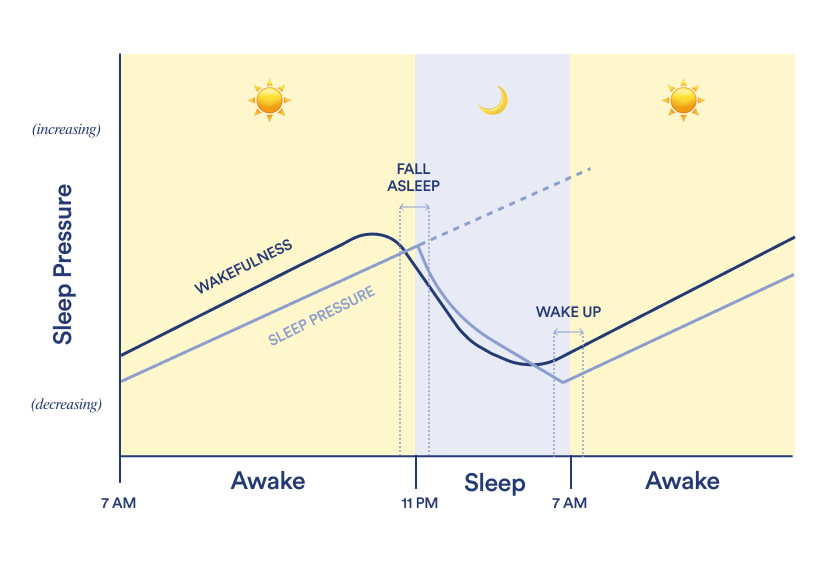
Let's walk through a typical 24-hour cycle using this model:
- Morning (e.g., 7 AM): You wake up. Your adenosine level (Process S) is at its lowest, and your circadian alerting signal (Process C) is starting to rise. The combination makes you feel alert and ready for the day.
- Afternoon (e.g., 2-4 PM): Sleep pressure (S) has been building for several hours. Simultaneously, the circadian alerting signal (C) experiences a slight, temporary dip. This combination creates the classic "afternoon slump" or post-lunch dip in energy.
- Evening (e.g., 7-9 PM): Your sleep pressure (S) is now very high. However, your circadian alerting signal (C) is near its peak. This strong alerting signal counteracts the high sleep pressure, making it difficult to fall asleep. This period is sometimes called the "wake maintenance zone" or "forbidden zone for sleep."
- Late Evening (e.g., 11 PM): Your sleep pressure (S) is maximal. Crucially, your circadian alerting signal (C) has now begun its sharp, nightly decline. The pressure to sleep is finally stronger than the signal for wakefulness. This opens the "sleep gate," making it the ideal time to fall asleep.
This interaction explains why sleep timing is just as critical as sleep duration. Getting 8 hours of sleep from 10 PM to 6 AM is fundamentally different from getting 8 hours from 4 AM to 12 PM, because the latter is misaligned with your body's natural circadian rhythm.
Test your understanding!
You've been awake for 15 hours and feel very tired (high sleep pressure). It's 8 PM, but you don't feel like you can fall asleep just yet. Based on the two-process model, what is the most likely reason for this "tired but wired" feeling?
Show answer
The reason is the opposition between Process S and Process C. Your sleep pressure (Process S) is high due to being awake for 15 hours. However, at 8 PM, your circadian alerting signal (Process C) is also near its peak, actively promoting wakefulness. This strong alerting signal is counteracting your high sleep pressure, creating the feeling of being "tired but wired" and making it difficult to fall asleep.
Conclusion and Key Takeaways
Understanding this model is the first and most critical step in taking control of your sleep. It's the foundational "why" behind all the practical protocols we will build.
Here are the key takeaways from this lesson:
- Your sleep is governed by two systems: Process S (sleep pressure) and Process C (circadian rhythm).
- Process S is driven by the chemical adenosine, which builds up the longer you are awake, creating a powerful drive to sleep.
- Process C is your internal 24-hour clock that sends an alerting signal, which peaks in the evening to counteract sleep pressure.
- The optimal time to sleep—the "sleep gate"—occurs when sleep pressure is high and the circadian alerting signal begins to fall.
In our next lesson, we will dive deeper into Process S by focusing specifically on adenosine. We'll examine its role in daytime sleepiness and, most importantly, how substances like caffeine interact with it. This will set the stage for our first actionable protocol: how to time your caffeine intake to maximize alertness without sabotaging your sleep.