Recommended resources
The freely available resources this lesson will direct you to.
Introduction
Welcome to the final lesson of our course on the foundations of economics. In our previous session, we explored the Policy Trilemma, which revealed the fundamental trade-offs nations face when managing their exchange rates, capital flows, and monetary policy in a globalized world. That discussion highlighted that a country's choices about its integration with the global economy have profound consequences.
Today, we will address one of the oldest and most persistent debates in economics, one that perfectly synthesizes many concepts from our course: the controversy over free trade. Your learning outcome for this lesson is to evaluate common arguments for and against free trade policies. We will move beyond a simple list of pros and cons to understand the nuanced perspective held by most economists, exploring why they often favor free trade even while acknowledging its downsides. This topic is a fitting conclusion, as it requires us to apply principles of efficiency from microeconomics and concerns about growth and employment from macroeconomics.
1. The Core Economic Case for Free Trade
From our early lessons on comparative advantage, you'll recall the basic principle that trade can make everyone better off. The modern case for free trade builds on this foundation, centering on the concept of economic efficiency.
Free trade is argued to improve efficiency in two main ways:
- Production Efficiency: When countries open to trade, they can specialize in producing goods and services where they have a comparative advantage. This might be due to technology, resource endowments (like labor or capital), or the ability to achieve economies of scale. As production shifts to the most efficient producers globally, the total world output of goods and services increases. For a single country, this contributes to a higher Gross Domestic Product (GDP).
- Consumption Efficiency: For consumers, free trade brings benefits through lower prices, as domestic firms must compete with more efficient foreign producers. It also provides a greater variety of goods and services to choose from. This combination of lower prices and more choice allows consumers to achieve a higher level of utility or satisfaction.
To see these arguments explained with clear examples and graphical intuition, let's watch the first part of a video that breaks down the benefits of free trade.
Free Trade - Benefits and Costs
The video 'Free Trade - Benefits and Costs' by EconplusDal provides a dynamic overview of the main arguments. We'll start with the benefits.
Watch the video from 00:30 to 04:52. Pay attention to how the presenter connects free trade to concepts like comparative advantage, lower prices for consumers, and macroeconomic growth.
The video effectively summarizes the key advantages. To deepen your understanding, let's turn to a more formal written explanation.
Evaluating the Controversy between Free Trade and Protectionism
The text 'Evaluating the Controversy between Free Trade and Protectionism' from Saylor.org provides a structured overview of the economic efficiency arguments. This will solidify the concepts from the video.
Please read the section titled 'Economic Efficiency Effects of Free Trade'. This section formally defines the production and consumption efficiency gains we've discussed.
In essence, the theoretical case for free trade is powerful: by allowing goods to be produced where it is cheapest to do so and consumed by those who value them most, it increases the overall size of the economic pie.
2. The Arguments Against Free Trade (and for Protectionism)
Despite the strong efficiency arguments, the push for free trade has always been met with resistance. The arguments against it are often framed as arguments for protectionism—policies designed to shield domestic industries from foreign competition, such as tariffs (taxes on imports) and quotas (limits on the quantity of imports).
The main arguments for protectionism are clear and compelling. Let's watch a video that outlines the three most common justifications.
The video 'Free Trade vs. Protectionism' by Professor Dave Explains clearly lays out the standard arguments in favor of restricting trade.
Watch from 01:59 to 03:43. Focus on the three main arguments presented: protecting domestic workers, nurturing infant industries, and ensuring national security.
These three arguments—jobs, infant industries, and national security—form the bedrock of the case against unfettered free trade. Other significant concerns include:
- Unfair Competition and "Dumping": Critics argue that some countries subsidize their firms or manipulate their currency, giving them an unfair advantage. "Dumping" occurs when a firm sells goods abroad at a price below its cost of production, a practice that can drive domestic competitors out of business.
- Environmental and Labor Standards: Free trade can create a "race to the bottom," where companies relocate to countries with lax environmental regulations and poor worker protections to cut costs.
- Income Inequality: While trade may increase a country's total income, the benefits are not shared equally. As we've seen in models like the Heckscher-Ohlin model, trade creates winners and losers within a country. Import-competing industries may shut down, leading to structural unemployment and depressing wages for low-skilled workers in developed countries.
- Over-specialization: A country that specializes too heavily in one or two industries becomes vulnerable to global demand shocks or price fluctuations in those specific markets.
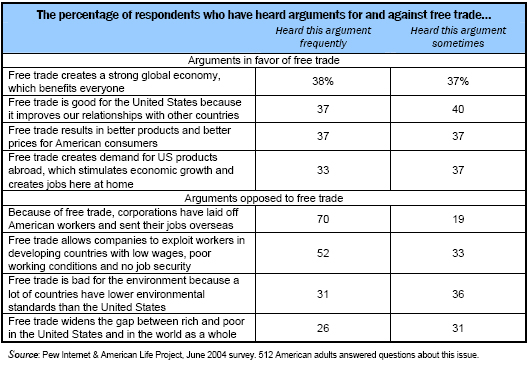
These arguments resonate strongly in public and political debates. The image below, from a Pew Research Center survey, shows which arguments are most commonly heard by the public.
3. Evaluating the Debate: The Economist's Rebuttal
So, we have a clear conflict: a strong theoretical case for free trade's efficiency versus powerful, practical arguments for protection. How do economists resolve this?
The modern economic consensus doesn't deny the validity of the arguments against free trade. Trade does cause job displacement. An infant industry might benefit from temporary protection. However, economists tend to favor free trade on pragmatic grounds, arguing that while it may not be a perfect policy, the proposed protectionist solutions are often worse in practice.
This counter-argument rests on four main pillars.
Evaluating the Controversy between Free Trade and Protectionism
Let's return to the Saylor.org text, which provides an excellent, nuanced explanation for why economists remain skeptical of protectionism, even while acknowledging market imperfections.
Please read the section titled 'The Economic Case against Selected Protection'. Focus on understanding the four main themes: retaliation, the theory of the second best, information deficiencies, and political economy problems.
Let's summarize these crucial counter-arguments:
-
The Threat of Retaliation: Protectionist policies are often "beggar-thy-neighbor" policies—they aim to benefit the home country at the expense of its trading partners. This invites retaliation. If the U.S. puts a tariff on steel, Europe and China might respond with tariffs on U.S. cars or agricultural products. The resulting "trade war" can shrink global trade and harm all countries involved, as happened during the Great Depression.
-
The Theory of the Second Best: This argument states that when there is a market distortion (like unemployment or pollution), a trade policy is usually a "second-best" and inefficient tool to fix it. A first-best policy attacks the problem directly.
- Problem: Workers in the textile industry are losing jobs to imports.
- Second-Best Policy (Inefficient): A tariff on textiles. This "helps" the workers but also raises prices for all consumers and distorts the market.
- First-Best Policy (More Efficient): Domestic policies like unemployment benefits, job retraining programs, and wage subsidies to help displaced workers transition to new jobs. These policies directly address the harm without distorting prices for everyone.
-
Information Deficiencies: For protectionism to work as intended, the government needs a huge amount of information that it almost never has. To properly implement an "infant industry" tariff, officials would need to know: Which industry will be a future success? What is the exact tariff level needed? How long should it be in place? If they get it wrong, they may end up protecting an inefficient industry forever at a great cost to consumers.
-
Political Economy and Lobbying: The benefits of protectionism are usually concentrated among a few firms or a specific group of workers. The costs, however, are spread thinly over millions of consumers. For example, a sugar quota might generate millions in profits for a few sugar producers but cost each consumer only a few extra dollars a year. The producers have a massive incentive to lobby the government for protection, while individual consumers have little incentive to organize and oppose it. This process often leads to policies that serve special interests rather than the national interest.
Because of these practical problems, most economists conclude that free trade is "pragmatically optimal." It is not a perfect policy, but it is a more reliable and less error-prone path to prosperity than a system of selective protectionism that is vulnerable to retaliation, inefficiency, and political capture.
Conclusion
Congratulations on completing the final lesson and, with it, our entire foundational course in economics! Today, we delved into the complex debate over free trade, moving beyond a simple list of pros and cons to evaluate the arguments critically.
Key Takeaways:
- The primary arguments for free trade are rooted in economic efficiency: specialization according to comparative advantage and economies of scale increase production, while competition leads to lower prices and more variety for consumers.
- The main arguments against free trade (and for protectionism) center on protecting domestic jobs, nurturing infant industries, ensuring national security, and addressing concerns about environmental standards and income inequality.
- While economists acknowledge the validity of these concerns, they generally favor free trade on pragmatic grounds. Protectionist policies are often second-best solutions that are prone to retaliation, require unattainable information to implement correctly, and are easily captured by special interest lobbying.
The table below provides a concise summary of the debate, contrasting the key benefits and threats of free trade.
| Impact Level | Benefits of Free Trade | Threats of Free Trade / Arguments for Protection |
|---|---|---|
| Country | Economic Growth, Comparative Advantage Gains | Structural Unemployment, Economic Instability |
| Monopoly Prevention, Increased Investment | National Security Risks, Infant Industry Failure | |
| Firms | Economies of Scale, Access to Larger Markets | Increased Competition, Risk of "Dumping" |
| Consumers | Lower Prices, Greater Variety of Products | Potential for Lower Quality/Safety Standards |
Course Wrap-Up
Over the past twelve modules, you have built a comprehensive framework for economic thinking. We began with the fundamental principles of scarcity, opportunity cost, and marginal analysis. We modeled the interactions of supply and demand, explored the behavior of consumers and firms, and analyzed market structures from perfect competition to monopoly.
We then scaled up to the macroeconomic level, learning how to measure a nation's economic health with indicators like GDP, inflation, and unemployment. We examined the powerful policy tools governments and central banks use to manage the economy and, finally, situated our analysis within the complex world of international trade and finance.
You started this journey with a goal to build a rigorous foundation in economics, and you have accomplished that. You are now equipped with the analytical tools to understand and critically evaluate the economic forces and policy debates that shape our world. I hope you feel empowered to continue exploring the many fascinating sub-fields of economics—from behavioral to development economics—and to apply the powerful logic of economic thinking to any new question you encounter.