Recommended resources
The freely available resources this lesson will direct you to.
Hello!
In our last lesson, we explored the excitations and thermodynamics of a BCS superconductor. We saw how a mean-field treatment of the attractive interaction between fermions led to the formation of Cooper pairs and the opening of a superconducting gap. The central idea was describing a complex many-body state through a simpler, macroscopic order parameter.
Today, we will apply a similar philosophy to a system of interacting bosons. Our goal is to derive the fundamental equation that describes the ground state of a weakly interacting Bose gas, a system better known as a Bose-Einstein Condensate (BEC).
By the end of this lesson, you will be able to:
- Derive the Gross-Pitaevskii equation (GPE) for a weakly interacting Bose gas.
This equation, a type of nonlinear Schrödinger equation, governs the behavior of the "macroscopic wavefunction" that characterizes the entire condensate. It stands as one of the cornerstones of the physics of quantum gases, and you will see how concepts like mean-field theory, which we used for fermions, reappear in a new context for bosons.
1. From Many Bosons to a Mean Field
Let's consider a system of interacting bosons at zero temperature, confined by an external potential . In the language of second quantization, the Hamiltonian is:
Here, and are the bosonic field operators that create and annihilate a particle at position .
The interaction term, containing four field operators, makes this Hamiltonian intractable to solve exactly. We need an approximation. For the ultracold, dilute gases where BECs are formed, the interactions are dominated by low-energy, two-body collisions. These collisions are well-described by a single parameter, the s-wave scattering length . This allows us to replace the true interaction potential with a simple, effective contact potential:
The sign of (and ) determines whether the interactions are repulsive () or attractive ().
Even with this simplified potential, the Hamiltonian is still too complex. The key insight, central to the physics of BEC, is the mean-field approximation. In a condensate, a macroscopic number of bosons, , occupy the same single-particle quantum state. This suggests that the quantum field operator , which describes the annihilation of a particle from this state, can be approximated by a classical, complex-valued function—the "macroscopic wavefunction" or "order parameter" .
This is analogous to the Bogoliubov approximation, where the operator for the condensate mode is replaced by a c-number, . The function is conventionally normalized to the total number of particles, . Thus, represents the particle density .
2. Deriving the Gross-Pitaevskii Equation
With the mean-field approximation in hand, we can derive the equation for using a variational principle. We will treat as a trial wavefunction and find the form that minimizes the system's total energy.
The following resource provides a clear, step-by-step derivation of the time-independent GPE using this variational method.
Lecture 1 Bose-Einstein condensation and superfluidity
These lecture notes provide a concise derivation of the Gross-Pitaevskii equation. The approach is ideal for your background, as it starts from the many-body Hamiltonian and uses a variational method to find the optimal mean-field state.
Please read section 2.2, "Gross-Pitaevskii equation" (pages 8-9). Focus on how the total energy functional E[φ] is constructed from the many-body Hamiltonian under the assumption of a product state. Follow the logic of using a Lagrange multiplier to handle the normalization constraint and how applying the calculus of variations (minimizing the functional) leads directly to the GPE.
As you saw in the derivation, we seek to minimize the energy functional subject to the constraint that the total number of particles is fixed. By replacing the field operators with the c-number function , the energy functional becomes:
Using the method of Lagrange multipliers to enforce the normalization constraint , we minimize the quantity , where is the Lagrange multiplier. Performing the functional derivative with respect to and setting it to zero yields the time-independent Gross-Pitaevskii equation:
The Lagrange multiplier is identified as the chemical potential of the gas—the energy required to add one more particle to the condensate.
3. Interpreting the Equation and Its Consequences
The GPE looks like a single-particle Schrödinger equation, but with a crucial difference: the nonlinear term . This term represents the mean-field interaction energy. Each particle in the condensate moves in an effective potential that is the sum of the external trap and a potential generated by the average density of all the other particles. Since the density depends on the wavefunction , which in turn depends on the potential, the equation is nonlinear and must be solved self-consistently.
The following video provides an excellent physical explanation of the GPE and its most important consequences.
Prof. Ketterle, a Nobel laureate for his work on BEC, gives a superb conceptual overview of the GPE. He explains its derivation from a physicist's point of view and discusses its physical meaning and applications.
Please watch from 13:27 to 25:54. Pay close attention to: The replacement of the field operator with a macroscopic wavefunction (the Bogoliubov approximation in position space). The physical interpretation of each term in the GPE, especially the nonlinear mean-field repulsion. The concepts of the healing length and the Thomas-Fermi approximation, which arise from the competition between kinetic and interaction energy.
Let's summarize the key physical concepts from the video:
-
Thomas-Fermi Approximation: In a large, strongly interacting condensate ( and are large), the interaction energy term dominates the kinetic energy term . If we neglect the kinetic energy, the GPE simplifies to an algebraic equation:
This means the density profile of the condensate is simply the inverted profile of the trapping potential, filled up to the chemical potential . This approximation is remarkably accurate for the bulk of the condensate.
-
Healing Length: The kinetic energy term cannot be neglected near the edges of the condensate, where the density must drop to zero. The kinetic energy penalizes sharp changes in the wavefunction. The competition between interaction energy (which wants to keep the density flat) and kinetic energy (which smooths out the wavefunction) defines a characteristic length scale over which the wavefunction "heals" from zero to its bulk value. This is the healing length, , given by , where is the bulk density.
Test your understanding!
Consider two Bose-Einstein condensates with repulsive interactions (). One is in a box potential and the other is in a harmonic trap potential. Using the GPE and the concepts of interaction energy vs. kinetic energy, qualitatively describe the shape of the ground state density profile in both cases. How would the profiles differ from a non-interacting () condensate?
Show answer
- Non-interacting case (): The GPE becomes the standard Schrödinger equation. In the box, the ground state density is a shape. In the harmonic trap, it's a Gaussian.
- Interacting case (): The repulsive interaction term penalizes high-density regions.
- In the box: The interaction tries to make the density as uniform as possible to minimize the energy. The density profile will be nearly flat across the box, dropping to zero only near the walls over a distance of the order of the healing length.
- In the harmonic trap: The gas still spreads out to lower its interaction energy. In the Thomas-Fermi limit, the density profile becomes a broad, inverted parabola, much wider than the non-interacting Gaussian profile.
The Time-Dependent GPE and Beyond
The GPE also has a time-dependent form, obtained by the usual prescription :
This equation describes the rich dynamics of a BEC, including the formation of quantized vortices and collective oscillations, which have been extensively studied in experiments.
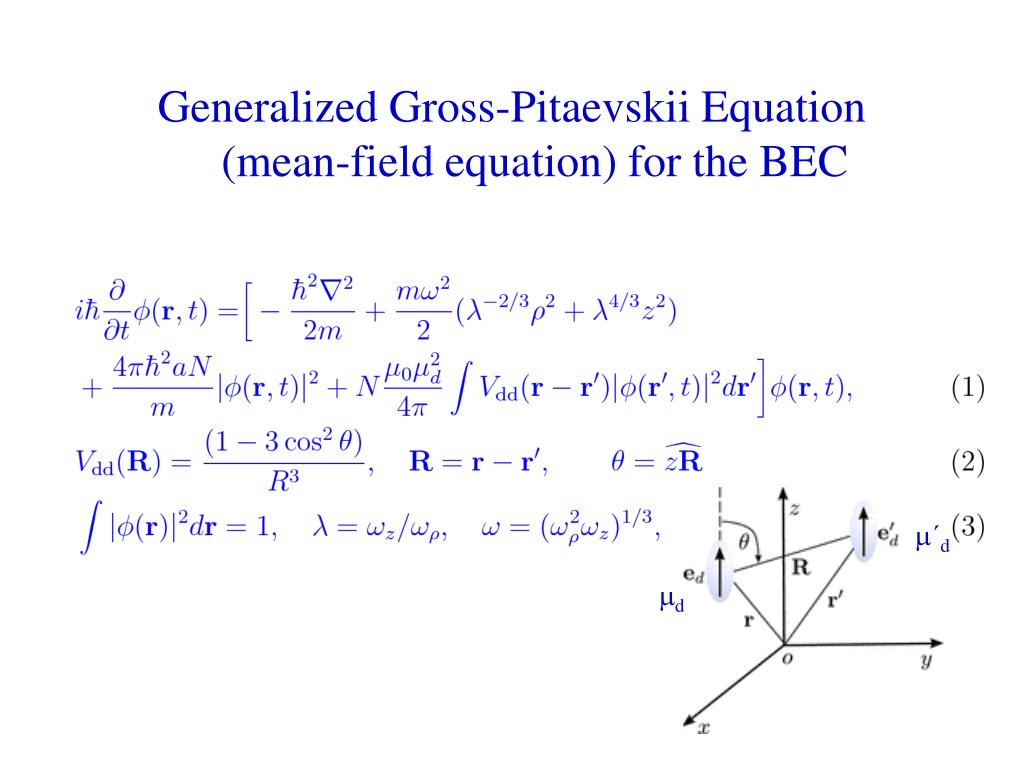
The simple contact interaction is also not the only possibility. In your condensed matter studies, you'll encounter systems with more complex interactions. For example, atoms with large magnetic dipole moments lead to long-range, anisotropic interactions. The GPE can be generalized to include these effects, opening up even richer physics.
Conclusion
In this lesson, we have derived the Gross-Pitaevskii equation, the central theoretical tool for describing Bose-Einstein condensates. Starting from a full many-body Hamiltonian, we employed the crucial mean-field approximation, justified by the macroscopic occupation of a single quantum state, to arrive at a tractable nonlinear Schrödinger equation for the condensate's macroscopic wavefunction.
Key Takeaways:
- The Gross-Pitaevskii equation is a mean-field theory for a weakly interacting Bose gas.
- It is a nonlinear Schrödinger equation, where the nonlinearity arises from the mean-field potential that each particle experiences due to all other particles.
- The competition between kinetic energy and interaction energy gives rise to a fundamental length scale, the healing length.
- In the limit of strong interactions, the Thomas-Fermi approximation neglects kinetic energy, providing a simple algebraic relation for the condensate's density profile.
Preview of the Next Lesson:
The GPE gives us an excellent description of the condensate itself—the ground state of the many-body system. However, it doesn't directly tell us about the low-energy excitations that can exist on top of this condensate. In the next lesson, we will apply the Bogoliubov transformation to the Hamiltonian for a weakly interacting Bose gas. This will allow us to diagonalize the Hamiltonian and find the spectrum of elementary excitations (quasiparticles), revealing the origin of superfluidity in these systems. This will draw a strong parallel to our analysis of quasiparticles in BCS theory.