Recommended resources
The freely available resources this lesson will direct you to.
Hello! Welcome back.
In our last lesson, we focused on creating the essential documents—the lookbook, treatment, and shot list—that translate your artistic vision into a concrete plan. You now have the blueprints for your film.
Today, we move from the drawing board to the film set. This lesson is about bringing those blueprints to life by learning how to collaborate with your technical crew to execute a planned shot. We'll explore the on-set dynamics, communication channels, and the creative dialogue required to transform a line on a shot list into a powerful image on screen. This is the moment your vision becomes a shared reality.
For your work, which is deeply rooted in visual design and performance, this collaborative skill is what enables you to guide the technical craft of filmmaking to serve your unique aesthetic and emotional goals.
The Core Partnership: Director and Cinematographer
While a film crew can be large, the creative heart of a film's visual language beats in the partnership between the director and the cinematographer (also known as the Director of Photography, or DP). This person is your primary ally in translating mood, theme, and story into light, shadow, and composition.
The nature of this collaboration can vary greatly. Some directors dictate every technical choice, while others entrust the entire visual execution to their DP. The following video explores this dynamic relationship.
How Directors Collaborate With Cinematographers
The video 'How Directors Collaborate With Cinematographers' from In Depth Cine provides an excellent overview of this crucial partnership, explaining the different ways directors and DPs can work together.
As you watch, please focus on these key ideas: 01:30 - 02:40: The breakdown of traditional roles and the areas where the director and DP collaborate. 02:40 - 03:13: The spectrum of director involvement, from hands-on to delegative. 04:55 - 07:53: The case study of the Coen Brothers. Notice how working with different DPs (Roger Deakins vs. Bruno Delbonnel) created distinct visual styles, even when the directors controlled the framing and shot selection. This illustrates the DP's significant artistic contribution. 09:36 - 11:03: The importance of building trust, familiarity, and a shared vision through ongoing conversation.
Given your strong background in visual communication and design, you will likely have a clear vision for the composition, color, and texture of your film. Your role is to communicate that vision effectively, while trusting your DP to use their technical expertise with cameras, lenses, and lighting to help you achieve it.
The On-Set Communication Chain
On set, you don't need to give instructions to every single person. To work efficiently, you communicate through a clear chain of command. For executing a shot, your primary conversation is with your DP, who then directs their camera and lighting teams.
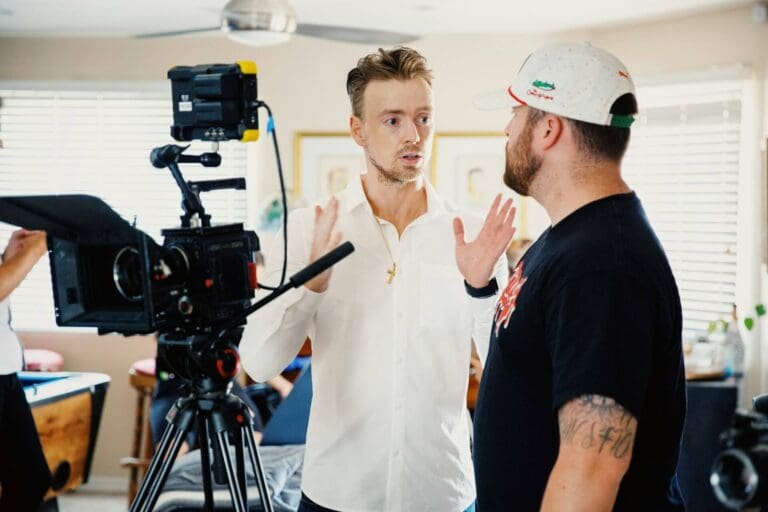
Let's get to know the key players in this process and see how they interact on a professional set.
COMMERICAL FILM SET CREW POSITIONS | Behind the Scenes
The video 'COMMERICAL FILM SET CREW POSITIONS' by Griffin Conway offers a practical, on-the-ground look at the roles within the technical crew and how they work together.
Watch these sections to understand the key roles and their relationships: Director (01:05 - 01:54): The ultimate creative decision-maker. Cinematographer/DP (01:54 - 03:57): Crafts the lighting and mood, works with the Gaffer. First AC (03:57 - 05:20): Manages the camera and pulls focus. Gaffer (05:20 - 05:59): The head of the lighting department; the DP's right hand for lighting. Key Grip (05:59 - 06:46): Rigs the lights and camera supports safely and effectively.
This is how the communication typically flows when setting up a shot:
- You (Director) brief the DP on the shot's purpose, referencing your shot list and lookbook. You describe the desired feeling, framing, and movement.
- The DP translates your creative intent into technical choices. They decide on the lens, camera position, and lighting design.
- The DP communicates the lighting plan to the Gaffer, who, with their team, sets up the lights.
- The Gaffer may need a light placed in a complex position. They instruct the Key Grip and their team to build the necessary rigging to support the light safely.
- The First Assistant Camera (1st AC) builds the camera, ensures it's functioning correctly, and prepares to pull focus during the take.
From Plan to Reality: The On-Set Discussion
Your shot list and lookbook are the starting point for a conversation on set. They are not rigid instructions to be followed without question. The real creative work happens when you, your DP, and your team collaborate to bring the plan to life, adapting it to the realities of the location and performance.

Let's read about the practicalities of these on-set collaborations.
Collaborate with Cinematographers: 9 Production Steps (2025)
The article 'Collaborate with Cinematographers: 9 Production Steps' offers excellent, practical advice for what happens during the production phase.
Please read the section titled 'Production and What Comes After.' Focus on the first three subsections: 'Camera Department on Set,' 'Happy Accidents,' and 'Mother of Invention.' This describes the process of briefing the crew, staying open to unforeseen creative opportunities, and problem-solving when things don't go as planned.
Practical Application: Staging the Conversation
Let's apply this to your film concept. In the last lesson, you created a shot list for a scene where a performer in a restrictive costume struggles to rise. Let's focus on this shot:
- Shot: CU (Close Up) on the fabric of the costume stretching to its limit.
- Movement: Handheld, slight tremor.
- Notes: Focus on the tension in the threads.
Now, imagine you are on set, ready to film. Your shot list gives the technical details, but it doesn't convey the full emotional weight. In your notebook, write out how you would brief your DP to ensure they understand your deeper intent.
-
Communicating the Feeling to Your DP: How would you describe the feeling and purpose of this shot? What visual references from your lookbook (e.g., photos of stressed materials, textures) might you refer to?
- Example starter: "For this shot, I need the audience to feel the fabric's strain as if it's their own skin. The camera shouldn't just observe; it should feel the struggle. That's why the handheld tremor is so important. We need to be so close that the costume's threads look like prison bars about to snap..."
-
Requesting Light from Your DP/Gaffer: Based on the feeling you described, what kind of lighting would you request from your DP (who would then instruct the gaffer)?
- Example starter: "To get that feeling of strain, we can't have flat, pretty light. I need to see the texture. I'm imagining a harsh, raking light from the side that catches the edges of the threads and creates deep shadows in the weave. It should feel raw and physical..."
Take about 10-15 minutes to write down your thoughts for this briefing. This exercise practices the crucial skill of translating your abstract, artistic goals into actionable, evocative language for your technical team.
Conclusion
Today we've moved your vision off the page and onto the set. You've learned that executing a shot is a dynamic, collaborative process centered on clear communication and mutual respect for expertise.
Key Takeaways:
- Collaboration is a Dialogue: The director-cinematographer partnership is a creative dialogue. Your role is to provide the "why"—the emotional and thematic intent—while trusting your DP to provide the technical "how."
- Communicate with Intent: Use your lookbook and shot list as conversation starters, not just as instruction manuals. Explaining the feeling behind a shot is often more valuable than just stating the technical parameters.
- Know Your Team: Understanding the roles of the DP, 1st AC, Gaffer, and Key Grip allows you to communicate efficiently through the proper chain of command.
- Trust Your Crew: You are hiring artists and technicians for their expertise. A great director empowers their crew by giving them a clear creative vision and the space to contribute their skills to it.
What's Next?
In this lesson, we focused on executing a planned shot. But as the reading mentioned, filmmaking is full of "happy accidents" and moments where things go wrong. In our next lesson, we will focus on adapting to unexpected on-set challenges while preserving the scene's core artistic intent. We will explore how to think on your feet and turn problems into creative opportunities.