Recommended resources
The freely available resources this lesson will direct you to.
Hello! Welcome back.
In our last lesson, we choreographed the "what" and "where" of a scene by focusing on blocking and staging. We established the physical foundation—the movements of the actors and the camera that create the scene's visual architecture.
Today, we build directly on that foundation by focusing on the "how" and "why." Our learning outcome is to direct performers through a key scene to achieve a specific emotional tone. This is where you move from being an architect to being a conductor, guiding your performers to fill the structure you've built with nuanced, authentic emotion. Given your interest in the deeply psychological and emotional cinema of directors like Ingmar Bergman, this lesson is at the very heart of the artistic practice you wish to develop.
The Art of Conversation: Guiding, Not Dictating
A common misconception is that a director's job is to tell actors exactly how to feel or how to say their lines. In reality, great directors create a space for discovery. They provide a clear destination—the emotional core of the scene—but allow the actor to find their own path to get there. Micromanaging a performance often leads to confusion and stilted results.
Let's start with some expert advice on what not to do.
How Directors Confuse Actors - Judith Weston
In this video, 'How Directors Confuse Actors,' renowned acting coach Judith Weston explains the most common pitfalls directors fall into and offers a more effective approach. This is fundamental knowledge for building a productive relationship with your performers.
Please watch these key sections: 00:00 - 01:33: Pay attention to the core problem Weston identifies: over-talking. Notice her advice to "listen more than you talk." 01:33 - 02:43: This is crucial. Focus on the distinction between directing for a result (e.g., "get mad") versus defining the emotional event (e.g., "this is an argument"). This shift in language empowers the actor. 05:58 - 08:49: Absorb the concept of the 'language of permission.' Phrases like "I had this idea... do you want to try that?" transform a command into a collaboration. It reframes your relationship with the actor as one between fellow artists.
Weston's advice boils down to this: Treat your actors as collaborators. Your role is to ensure they understand the circumstances and objective of the scene, not to dictate the surface-level emotion.
From Vision to Actionable Direction
So, if you can't say "be more sad," what can you say? The answer lies in translating your desired emotional tone into playable actions, objectives, and images. This is especially vital in the experimental and performance-art-driven work you're drawn to, where a script might be minimal or non-existent.
The following text provides a fascinating first-hand account from an actor working in experimental film. It offers a clear window into how a performer translates a director's abstract notes into a concrete performance.
| Acting In Experimental Film - James Devereaux
In the article 'Acting In Experimental Film,' actor James Devereaux describes his collaborative process with director Rouzbeh Rashidi. This text is incredibly relevant as it details how to create emotionally rich scenes through improvisation, starting from very simple directorial prompts.
As you read, focus on the practical techniques the actor uses to build a performance from the director's notes: Read the section beginning "Our very first feature film...". Notice how the director's note, "you are trying to remember something," is converted by the actor into a playable action: "to solve a mystery." This is the key process you need to facilitate. Continue to the section on the film "HE". Observe how the actor creates the fiction of a relationship from scratch based on a director's prompt. He uses an imagined detail—the swipe marks on a kitchen floor—to generate a genuine emotional starting point. Finally, read the section describing "Tools" (starting "Boredom Of The Disgust..."). 'Tools' are the different tactics an actor can use to achieve their objective (to reason, to persuade, to cajole, to beg). As a director, you can suggest different tools to bring new colors to a scene.
This article reveals the engine of actor-driven performance. The director provides the spark—a simple prompt, a core idea, a boundary—and the actor generates the emotional fire by translating that spark into an active pursuit. Your job is to provide the right kind of spark.
Case Study: Sculpting Emotion with Bergman
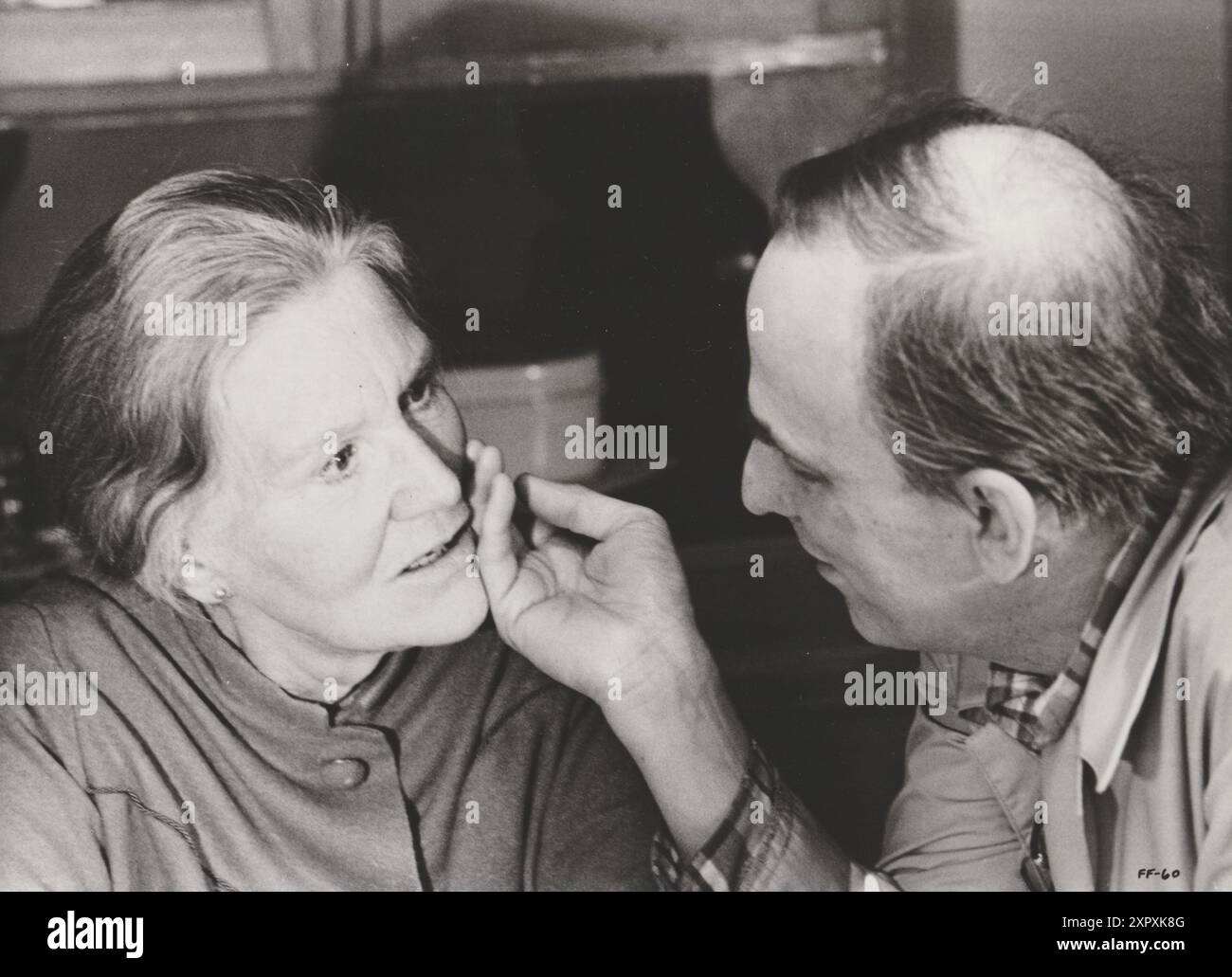
Ingmar Bergman, one of your key influences, was a master of directing for emotional tone. He understood that the actor's face is a landscape and that the director's job is to create the conditions under which the most profound emotional truths can emerge. His process was a blend of deep psychological intimacy and exacting visual precision.

Bergman's approach wasn't just about what he said to the actors; it was about how he chose to see them with his camera.
The Director Who Mastered The Art of Filming Faces
The video 'The Director Who Mastered The Art of Filming Faces' by Thomas Flight is a superb analysis of Bergman's visual techniques. It shows how his directorial choices were inseparable from the performances he elicited.
Watch these two sections, which get to the core of Bergman's method: 03:47 - 04:19: Notice Bergman's trust in the power of the face. By holding a close-up, he allows the audience to witness the subtle, internal conflict on an actor's face, creating incredible tension. 06:24 - 10:06: This is a critical section. Pay close attention to how Bergman's direction went beyond dialogue. He blocked scenes on the scale of a head turn, precisely choreographing movements to mirror a character's internal emotional shift. This is a powerful fusion of the blocking we discussed last lesson and the emotional direction we're focusing on today.
Bergman's work demonstrates that directing for emotional tone is a holistic process. It involves everything from building a trusting, almost telepathic connection with your performers to the precise choreography of a glance.
This intense relationship between director and actor is a recurring theme in auteur cinema. Let's briefly touch on a more academic perspective that explores this dynamic.
3 Actor, Avatar | Self-Projection | Manifold@UMinnPress
The text 'Actor, Avatar' offers a deep dive into the complex relationships between directors and their actors. We'll focus on the section about Bergman and his most famous collaborator, Liv Ullmann.
Please read the section titled 'A Painful Connection.' Focus on Liv Ullmann's description of working with Bergman. She speaks of the camera's closeness as a form of recognition, showing 'what is behind the skin.' This beautifully articulates the goal of directing for emotional truth: to make the inner world visible.
The bond Bergman and Ullmann shared allowed for a "mutual surrender," where the line between director's vision and actor's expression blurred. This is the kind of profound collaboration that can lead to the artistically rich, emotionally resonant work you aspire to create.
Practical Application: Giving Notes
Let's return to your film concept: a performer struggling for self-expression inside a restrictive costume designed by you. In our last lesson, you blocked the opening: the performer starts on the floor and struggles to rise.
Now, imagine you've just filmed the first take. The performance is fine—the physical struggle is clear—but it lacks the specific emotional tone you envisioned. You want a feeling of quiet desperation mixed with a flicker of defiance.
In your notebook, write down three different notes you could give the performer for the next take. Remember Judith Weston's advice: avoid giving a result. Instead, give them a playable action, an image, or a new objective.
Here are some examples to get you thinking:
- Instead of "look more desperate," you could say... "Imagine a single thread is pulling you up from the crown of your head. Your only goal is to follow that thread, even if the rest of your body resists." (This gives a clear, physical focus).
- Instead of "be more defiant," you could say... "In this take, I want you to try and make the costume submit to you. Find one small part of it—a seam, a strap—and focus all your energy on trying to dominate it." (This creates a specific objective and an antagonist).
- For a more internal approach... "As you struggle, try to silently repeat a single, powerful word to yourself. Don't show me the word, just let me see the effect it has on you." (This provides an inner monologue).
Take about 10 minutes to formulate your own notes. Think about how each one might produce a different nuance in the performance.
Conclusion
Directing actors for emotional tone is arguably the most sensitive and crucial part of your job. It's a delicate dance of clear communication, psychological insight, and profound trust.
Key Takeaways:
- Be a Collaborator, Not a Dictator: Use the "language of permission" and define the scene's emotional event, leaving the "how" to the actor.
- Give Actionable Notes: Translate your vision into playable objectives, physical tasks, and vivid imagery rather than demanding emotional results.
- The Camera is Your Partner: Your framing and composition choices are an extension of your direction, highlighting the emotional moments you want the audience to see. As Bergman showed, a precisely blocked head turn can be as powerful as any line of dialogue.
- Trust is the Foundation: The kind of vulnerable, boundary-pushing work you admire—from Horn to Bergman—is only possible when built on a bedrock of mutual respect and trust between director and performer.
What's Next?
We have now explored the intimate creative loop between you and your performer, from blocking the physical space to guiding the emotional journey. But a film set is a busy place. In our next lesson, we'll zoom out to look at the bigger picture: Communicate creative vision and specific shot requirements effectively to crew members. We will learn how to ensure that your cinematographer, sound recordist, and other key collaborators are all perfectly aligned to capture the powerful performance you and your actor have worked so hard to create.