Recommended resources
The freely available resources this lesson will direct you to.
- ELLINGHAM DIAGRAM | THERMODYNAMIC PRINCIPLES OF METTALURGYwww.youtube.com
- Ellingham Diagram in Metallurgy || Super-Tricks and Core Concept || IIT Jee Mains | Advanced | NEETwww.youtube.com
- Research Progress of Titanium Sponge Production: A Review - MDPIwww.mdpi.com
- An Overview of Thermochemical Reduction Processes for Titanium ...www.mdpi.com
Hello! Welcome to the third lesson in our deep dive into the Kroll process.
In the last two lessons, we've covered the first major stage of titanium production: transforming titanium dioxide (TiO₂) ore into highly purified titanium tetrachloride (TiCl₄). We first discussed the process qualitatively and then performed a quantitative mass balance to understand the feedstock requirements.
Now, we arrive at the heart of the matter: converting that purified TiCl₄ into titanium metal. This lesson focuses on the fundamental "why" of the Kroll process. We'll explore the chemical and thermodynamic principles that make this transformation possible. Specifically, you will learn to use Ellingham diagrams—a powerful graphical tool in metallurgy—to understand and justify why magnesium is the chosen reducing agent for this critical step.
1. The Challenge of Reduction and the Role of Thermodynamics
The core of the Kroll process is a reduction reaction. In chemical terms, reduction is the gain of electrons. For TiCl₄, the titanium atom has an oxidation state of +4. To become pure titanium metal (Ti), its oxidation state must be reduced to 0. This is achieved by using a reducing agent—another substance that readily gives up its electrons. In the Kroll process, that agent is magnesium (Mg).
The fundamental question is: why does this reaction happen spontaneously? Why does magnesium give its electrons to titanium? The answer lies in thermodynamics, specifically the concept of Gibbs Free Energy ().
As you may recall from your science courses, the Gibbs-Helmholtz equation governs the spontaneity of a chemical reaction:
Where:
- is the change in Gibbs Free Energy. A reaction is spontaneous if .
- is the change in enthalpy (heat of reaction).
- is the absolute temperature.
- is the change in entropy (a measure of disorder).
Think of as the chemical equivalent of a cost function in an optimization problem. A system will spontaneously move towards a state of lower Gibbs Free Energy. For a reaction to proceed, the total must be negative.
2. Ellingham Diagrams: A Visual Guide to Reduction
Metallurgists need to quickly assess which reduction reactions are feasible at different temperatures without calculating from scratch every time. This led to the development of the Ellingham diagram.
An Ellingham diagram is simply a plot of the standard Gibbs free energy of formation () versus temperature for the formation of various compounds, typically oxides or chlorides.
To get a solid grasp of these diagrams, please watch the following video. It provides a clear, step-by-step explanation of their construction and interpretation.
ELLINGHAM DIAGRAM | THERMODYNAMIC PRINCIPLES OF METTALURGY
This video from TETRAHEDRON CHEMISTRY CLASSES explains the fundamentals of Ellingham diagrams, from the underlying thermodynamics to their practical application in choosing a reducing agent.
Please watch the following segments: Introduction (00:03 - 05:24): Focus on what the diagram plots (\Delta G^\circ vs. T) and its purpose in pyrometallurgy. Thermodynamic Principles (05:24 - 19:10): This is the core theory. Pay attention to how the signs of \Delta H and \Delta S determine the spontaneity (\Delta G < 0) and how temperature affects this. Slope of the Lines (18:56 - 26:35): Understand why most lines have a positive slope (consumption of gaseous O₂, leading to a negative \Delta S). Selecting a Reducing Agent (31:31 - 37:10): This is the key application. Focus on the fundamental rule for reduction: a metal lower on the diagram can reduce the oxide of a metal higher on the diagram.
3. The Central Problem: Why Not Just Reduce TiO₂?
After watching the video, you might have a question: Titanium ore is TiO₂. Why did we go through the complex and costly carbochlorination and purification steps you learned about previously? Why not just reduce TiO₂ directly with a cheap and abundant reducing agent like carbon (coke)?
The Ellingham diagram for oxides gives us the answer.
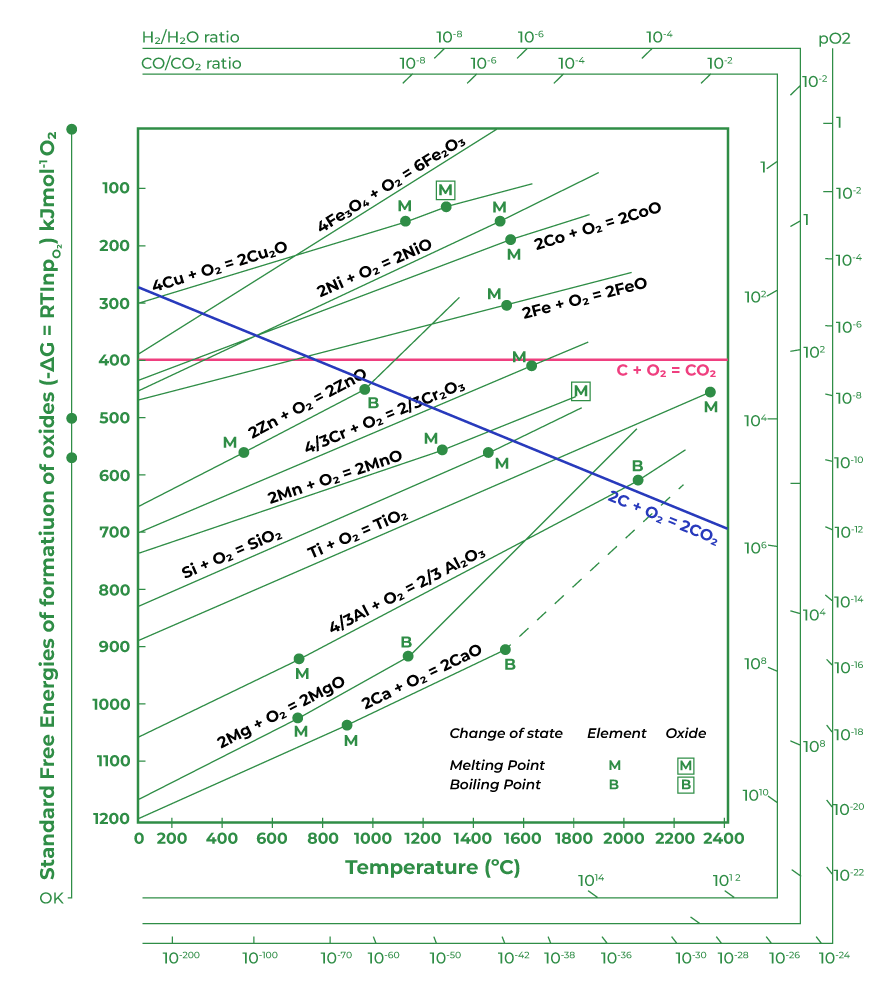
Let's use the diagram to assess the reaction: TiO₂ + 2C → Ti + 2CO.
- Locate the Lines: Find the line for the formation of TiO₂ (
2Ti + O₂ → 2TiO₂). Also, find the line for the oxidation of carbon to carbon monoxide (2C + O₂ → 2CO). - Apply the Rule: At any typical industrial temperature (e.g., 1000-1500°C), the line for TiO₂ is far below the line for CO.
- Interpret the Result: According to the rule from the video, this means titanium is a much more powerful reducing agent for carbon monoxide than carbon is for titanium dioxide. The reaction
TiO₂ + 2C → Ti + 2COis not thermodynamically spontaneous; its is positive. In fact, the reverse reaction is the one that's favored.
This thermodynamic barrier is the entire reason for the existence of the Kroll process's two-stage approach. TiO₂ is exceptionally stable. To produce titanium, we first need to convert it into a less stable compound. That compound is TiCl₄.
4. The Kroll Solution: Reducing TiCl₄ with Magnesium
Now we can see why the carbochlorination step is so crucial. By converting TiO₂ to TiCl₄, we move to a different thermodynamic landscape—the world of chlorides.
The following resource provides a brilliant side-by-side comparison.
Research Progress of Titanium Sponge Production: A Review
This review paper, 'Research Progress of Titanium Sponge Production', concisely explains the thermodynamic rationale for using TiCl₄ as a precursor.
Please read the text within the section titled 'Thermal Reduction' that accompanies Figure 1 (starting from the second paragraph, 'In the thermal reduction process...'). Pay close attention to Figure 1 itself, which compares the Ellingham diagrams for common oxides and chlorides. Note the relative positions of the TiO₂ and TiCl₄ lines and the conclusions the authors draw about their reducibility.
As the paper and its diagrams show, TiCl₄ is significantly less stable (has a much less negative ) than TiO₂. This makes it a viable candidate for reduction.
Now, let's use the chloride Ellingham diagram from that paper (Figure 1b) to justify the choice of magnesium as the reducing agent.
The reaction we want to happen is:
We can think of this as two separate reactions:
- Decomposition of TiCl₄: (Reversal of formation, so )
- Formation of MgCl₂: (Formation, so )
The total Gibbs free energy change is .
Looking at the chloride Ellingham diagram at the Kroll process temperature (~850°C or 1123 K):
- The line for the formation of MgCl₂ is far below the line for the formation of TiCl₄.
- This means is much more negative than .
- Therefore, will be a large, negative number. The reaction is highly spontaneous and exothermic.
The vertical distance between the two lines on the Ellingham diagram at a given temperature is a direct visual representation of the driving force () for the reduction.
5. Why Magnesium? Why Not Other Reductants?
The Ellingham diagram shows that other metals, like Sodium (Na), Calcium (Ca), and Aluminum (Al), also have chloride formation lines below TiCl₄ and could theoretically work. The choice of magnesium is an engineering and economic optimization.
- Sodium (Na): This is used in the older Hunter process. It works perfectly well thermodynamically. However, magnesium is generally cheaper and safer to handle at an industrial scale, and the technology for recycling the MgCl₂ byproduct is highly developed.
- Calcium (Ca): Ca is an even more powerful reducing agent (its chloride line is lower than magnesium's). However, it is more expensive, and its reaction can be too exothermic, making temperature control difficult.
- Aluminum (Al): While thermodynamically feasible, aluminum has a fatal flaw mentioned in the paper you just read: it readily forms Ti-Al intermetallic compounds. These are brittle impurities that would contaminate the final titanium product, destroying its valuable mechanical properties.
This highlights a critical lesson: thermodynamics tells you what can happen, but kinetics, economics, and secondary chemical effects determine what is practical and profitable. Magnesium hits the sweet spot of being thermodynamically powerful enough, cost-effective, and producing a clean product.
Conclusion
In this lesson, we've unraveled the thermodynamic secret behind the Kroll process. You are now equipped to explain not just what happens, but why it happens.
Key Takeaways:
- A reaction is spontaneous if its change in Gibbs Free Energy () is negative.
- Ellingham diagrams are graphical plots of vs. Temperature that allow for rapid assessment of reduction feasibility.
- The direct reduction of TiO₂ by carbon is thermodynamically unfavorable, which necessitates the carbochlorination step to produce the less stable TiCl₄.
- On the chloride Ellingham diagram, the line for MgCl₂ is significantly below the line for TiCl₄, indicating that magnesium has a strong thermodynamic driving force to reduce TiCl₄ to titanium metal.
- The choice of magnesium over other potential reductants like sodium, calcium, or aluminum is an engineering trade-off based on cost, safety, reaction control, and the avoidance of product contamination.
Now that we understand the fundamental chemical principles, our next lesson will examine how this reaction is carried out in practice. We'll explore the design, operation, and control of the Kroll batch reactor where the magic of turning liquid TiCl₄ into solid titanium sponge takes place.