Recommended resources
The freely available resources this lesson will direct you to.
Hello. In the previous lesson, you assessed an initiative by its customer, financial, strategic, and organisational outcomes. That same breadth matters when assessing your readiness to lead initiatives at a larger scale. Being good at creating an idea is valuable; an innovation-led executive must also help the organisation decide which ideas deserve resources, turn promising ones into repeatable results, and make trade-offs across the business.
This final lesson in the enterprise-leadership module will help you build an evidence-based capability map: what a target role requires, what you have demonstrated so far, and what evidence you need next. Allow about 40–45 minutes, including the short videos, focused reading, and time to start your map. You do not need to settle on a particular CXO title today.
Define the destination before measuring the gap
“CXO” is too broad to serve as a useful assessment standard. A chief innovation officer who develops an enterprise innovation system, a product executive who owns product outcomes, and a business-unit head who owns a commercial result have overlapping but different accountabilities. For now, use a working destination: an innovation-led executive role in a technology or product company, with enough commercial and organisational breadth to take on wider enterprise responsibility later.
The question is not whether you could succeed in such a role someday. It is what you would need to reliably do and be accountable for in that role. This short video provides a useful picture of how innovation leadership extends beyond originating ideas.
Watch What Makes a Great Leader? from Harvard Business Review to distinguish leading innovation from personally producing innovative work.
Watch innovation leadership for the architect and bridger roles: building conditions for teams to experiment and connecting them with capabilities beyond the organisation. Then watch influence without authority. Notice why securing commitment differs from directing people who report to you.
For your working destination, translate that picture into a small set of accountabilities. An innovation-led executive might need to shape an innovation portfolio, win commitment for selected investments, connect customer opportunities to business economics, establish ways of testing ideas, and arrange ownership when a successful experiment becomes an operating business. The exact mix depends on the role. Use these as candidate requirements, not a universal CXO checklist.
The Skills Framework for the Information Age (SFIA) gives more precise language for one part of that destination. Its innovation-management descriptions distinguish managing a pipeline, developing organisational innovation capability, and embedding innovation across business units. They describe different scopes of responsibility, not automatic stages tied to job titles.
Innovation management — English
Read the SFIA Foundation’s Innovation management descriptions to see how the scope of innovation leadership changes.
Under “Innovation management,” read Levels 5, 6, and 7, from pipeline to enterprise culture. Compare the verbs and scope at each level. Do not assign yourself a level merely because a future job title sounds senior.
Separate demonstrated capability from aspiration
An evidence-based gap is a comparison between a specific target accountability and work you have actually done. Knowledge, exposure, and potential matter for development, but they are not the same as having exercised an accountability. Attending a budget review, for example, may teach you how decisions are made; it does not establish that you can defend an investment recommendation or own its result.
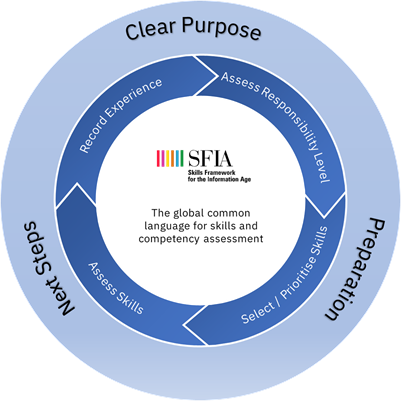
SFIA’s self-assessment guidance starts with the purpose of the assessment, then asks you to consider your level of responsibility and relevant skills before recording supporting experience. Its wheel is a reminder that evidence and next steps are part of the assessment, not an afterthought.
Self-assessment guidelines — English - SFIA
Read the opening steps of the SFIA Foundation’s Self-assessment guidelines to establish a fair basis for your map.
In the opening overview, follow “Clear purpose,” “Preparation,” “Assess SFIA level of responsibility,” and “Record work experience to support assessment,” from purpose to evidence. Then, under “Assess SFIA level of responsibility,” read the explanation from seven levels, and the caution beginning current experience. Focus particularly on autonomy, influence, and complexity: what decisions were yours, whom did you influence, and how difficult was the situation?
A useful evidence note can be short: “I was accountable for [decision or delivery], across [scope], and the observed result was [outcome]; [artifact or person] can corroborate it.” A proposal you wrote, an approved decision, a pilot result, or a change adopted by another team may help. State your own contribution rather than claiming everything the team achieved.
Look for repeatability as well as one success. If you led one unusually well-supported pilot, record it—but do not treat that alone as proof that you can run an innovation portfolio under ordinary constraints. Conversely, a blank evidence cell may mean not yet assessed, not incapable. If you have not had the opportunity to own a P&L, the map should show an experience gap, not pronounce a limit on your ability.
Build a map you can update
Keep the first version small enough to use: five or six capability areas, selected for the target role, not every skill you might eventually want. Include innovation depth and the breadth needed to turn innovation into enterprise value. For each area, capture the following:
| Field | What to record |
|---|---|
| Target accountability | A concrete decision or outcome you would be expected to own or substantially influence. |
| Current evidence | Your contribution, scope, observed result, and a source that could verify it. Mark missing evidence honestly. |
| Gap type | Knowledge (need to understand it), application (need practice doing it), or scope (have done it, but not at the required scale or accountability). More than one may apply. |
| Next proof | A realistic assignment and the result or artifact that would demonstrate progress. |
The following fictional map shows the level of specificity to aim for. It is not an assessment of your experience.
| Capability and target accountability | Current evidence in the example | Gap and next proof |
|---|---|---|
| Innovation portfolio: allocate attention across concepts and stop weak ones | Led two customer-discovery pilots and recommended ending one after its assumptions failed; no portfolio funding responsibility | Scope: help set review criteria for several initiatives and document the resulting continue-or-stop decisions |
| Commercial judgement: defend the economics of an investment | Attended budget reviews but has not built or owned a business case | Knowledge and application: prepare a business case with explicit revenue, cost, and downside assumptions; obtain a finance review |
| Product and technology judgement: assess customer value alongside delivery constraints | Defined a user problem and worked with a technical team on a pilot; no evidence yet of making a roadmap trade-off | Scope: co-lead a prioritisation decision that records customer, commercial, and technical reasons |
| Enterprise influence: secure commitments across functions | Won support to run a pilot; the operating team has not agreed to own a wider rollout | Scope: negotiate ownership, support capacity, and success conditions before a scale decision |
| Organisational capability: make innovation repeatable beyond one team | Improved a pilot team’s way of gathering feedback; no evidence that other teams adopted it | Scope: establish a review practice another team can use and observe whether it changes decisions |
Notice that the example does not turn every gap into “take a course.” Reading can address a knowledge gap; accountability at greater scope requires an opportunity to act, and evidence that the action worked. The “next proof” column therefore specifies both an assignment and something observable.
Use the next part of the guidelines to check the honesty of your evidence and turn the gaps into development objectives.
Self-assessment guidelines — English - SFIA
Continue the SFIA guidelines with a narrow focus on matching experience to a skill and deciding what to develop next.
Under “Assess SFIA skills,” find the guidance beginning “Read the SFIA skill names” and read from workplace application. Under “Record work experience to support assessment,” read the evidence criteria from personal contribution. Finally, under “Next steps,” find “Planning my next career steps” and read from gaps to objectives. Focus on actions already taken, rather than intentions or familiarity with a topic.
To start your own map, choose a working destination and create five rows. For each, record your strongest recent, specific example—or write “evidence not yet gathered.” You can refine the target accountabilities as you learn what particular roles require. The map is a working document, not a verdict.
Check the map with other perspectives, then prioritise
Self-assessment has a blind spot: you may not see how your decisions affect people outside your immediate work. Feedback from a manager, peers, collaborators, or people responsible for operating what you create can reveal a mismatch between your intended contribution and its effect. A full formal review is not necessary to begin; specific observations tied to work are more useful here than general ratings of “leadership potential.”
What is 360-Degree Feedback? | HRM | From A Business Professor
Watch What is 360-Degree Feedback? from Business School 101 for a brief introduction to gathering multiple perspectives—and to its limits.
Watch multiple perspectives for who provides feedback and how it can inform development. Then watch feedback pitfalls for subjectivity, misinterpretation, and the risk of confusing popularity with performance. For your map, seek examples of decisions and outcomes rather than treating any rating as proof.
A useful request for feedback identifies a particular piece of work: “When we decided whether to extend that pilot, what did I do that clarified the trade-off, and what was missing from my analysis?” Compare such observations with your artifacts and results. If the sources disagree, mark the row uncertain and investigate; do not simply average opinions.
Finally, choose two priorities, not ten. A sensible first pair for an innovation-led executive path often combines one strength to extend—such as moving from a successful concept to a repeatable innovation decision—and one breadth gap that could block enterprise responsibility, such as financial judgement. But your own evidence, opportunities, and target role should determine the choice. Prioritise gaps that matter to the destination, constrain your next step, and can be tested through a realistic assignment.
Conclusion
An evidence-based capability map connects target accountabilities, demonstrated work, the type of gap, and the next proof of progress. It distinguishes creating ideas from building an organisation that can select, fund, deliver, and learn from them. It also keeps honest distinctions between knowing about a subject, contributing to a decision, and owning its outcome.
Keep this first map provisional and update it as your responsibilities and evidence change. In the next module, you will begin building one important area of executive breadth: reading financial statements so you can judge the financial consequences of business decisions more confidently.