Recommended resources
The freely available resources this lesson will direct you to.
- Research Aims, Objectives & Research Questions (The Golden Thread) - Definitions + Examples 📚www.youtube.com
- Research Proposal 101: 8 Common Mistakes That Will Get Your Proposal Rejected + Exampleswww.youtube.com
- 💡 Grant Writing Tip: Think SMART when writing objectives | Proposal Development Servicesproposaldev.ucdavis.edu
- Protocol Writing in Clinical Researchpmc.ncbi.nlm.nih.gov
Welcome to the critique stage of the course. In this module, you will examine research aims and objectives, improve weak formulations, and eventually bring a research problem, aim, and objectives together in a coherent report. This lesson concentrates on the first of those tasks: recognizing what is wrong before trying to rewrite it.
A research aim expresses the study’s overall purpose; objectives specify what the study will do to achieve that purpose. An aim can be broader than an objective without being vague. The distinction matters in clinical laboratory sciences, where a statement can sound clinically important yet leave unanswered what specimens, tests, results, or patients the proposed study would actually examine.
By the end of the lesson, you should be able to explain why an aim or objective is weak when it is vague, too wide for the proposed study, or impossible to assess from the planned evidence. Allow about 35–40 minutes, including the short readings and video.
What makes a critique useful?
Consider this proposed aim:
“To improve patient care through better laboratory testing.”
It identifies a worthwhile aspiration, but not a study that can be planned. Which aspect of care? Which testing process? In which setting? What could the laboratory investigate, as distinct from what clinicians or a health system might subsequently change?
A useful critique does more than call the sentence “too broad.” It identifies the missing decision and its consequence: because neither the testing process nor the intended outcome is defined, the researcher cannot select appropriate data or judge whether the study has fulfilled its aim.
Objectives require a closer level of inspection. If an aim concerns agreement between two hemoglobin analyzers, an objective such as “to see whether the new analyzer is good” gives no criterion for good. A reader cannot tell what result would answer it. By contrast, the aim itself need not contain every comparison statistic or sampling detail. Its job is to establish a defensible overall direction; the objectives and methods make that direction operational.
The following video draws out that difference and shows how a mismatch can arise even when the individual statements sound plausible.
Research Aims, Objectives & Research Questions (The Golden Thread) - Definitions + Examples 📚
Watch “Research Aims, Objectives & Research Questions (The Golden Thread)” from Grad Coach to sharpen the distinction between an overall aim and the more specific work proposed in objectives. Its later example also illustrates how to spot a change of focus between connected statements.
Watch aims and objectives for the distinction and the SMART framework. Then skip to alignment critique; notice how a change in population or in what is being investigated weakens the proposed study, even if its wording sounds polished.
One principle from that comparison will guide the lesson: judge a statement both on its own terms and in relation to the study it belongs to. “Determine the 30-day mortality rate” names a measurable outcome, but it may still be an unsuitable objective for a small project whose aim is to compare laboratory turnaround times.
Vagueness: when the reader must guess what will be studied
The University of California, Davis provides a useful weak-and-strong pair of objectives. The subject is ecology rather than laboratory science; read it for the diagnostic method, not for its subject matter.
💡 Grant Writing Tip: Think SMART when writing objectives | Proposal Development Services
Read the UC Davis Proposal Development Services article, “Think SMART when writing objectives,” to see how an apparently reasonable intention can fail to specify what a researcher would investigate.
In “What does a weak objective sound like?”, begin at the sentence introducing the ecological example and read the weak example through the explanation of what is missing. Continue to “What does a SMART objective sound like?” and read the comparison. Focus on the information added: a defined setting, what will be measured, a comparison, and a period of observation.
The lesson is not that every objective must be a long sentence. It is that its key terms must carry enough meaning to guide a study. In a laboratory proposal, words such as better, effective, accurate, and improved deserve scrutiny because each can conceal several different outcomes.
Suppose an objective reads:
“To assess whether the new microbiology method gives better results.”
What counts as a “result”? The number of organisms correctly identified, time to identification, agreement with a reference method, contamination, or cost? These are different investigations. The critique is therefore not merely stylistic: “better results” leaves the outcome unspecified, so the objective does not tell the researcher what evidence to collect.
Likewise, “to study anemia in hospital patients” omits the relevant patient group and the aspect of anemia under investigation. Is the proposed study estimating how often anemia occurs, comparing hemoglobin measurements between analyzers, or examining a suspected laboratory error? Naming a condition does not define a research task.
Be careful, though, not to label every concise statement vague. “To assess agreement between two hemoglobin analyzers using paired patient samples at Hospital B” has a discernible population of specimens, comparison, outcome concept, and setting. The protocol must still specify how agreement will be assessed, but a critique should recognize what the objective already establishes.
Vagueness can affect an aim differently. An aim such as “to evaluate the performance of a new hematology analyzer at Hospital B” indicates a field of inquiry, but performance may still be too open-ended. If the study concerns agreement of hemoglobin measurements with an existing analyzer, saying so would give the aim a clear focus without turning it into a methods paragraph.
Excessive scope: when the promise exceeds the study
A statement can use precise terminology and still promise more than one study can deliver:
“To determine the diagnostic accuracy, costs, patient outcomes, and national implementation requirements of all available sepsis tests.”
The problem is not only its length. It combines multiple tests and forms of evidence: diagnostic comparisons, economic information, patient follow-up, and implementation across settings. Completing one part would not establish the others. The scope must be judged against the research problem, available data, setting, personnel, and study period—not against how ambitious the subject sounds.
“Protocol Writing in Clinical Research” discusses why aims should be feasible and why accumulating too many specific aims can produce poorly defined results.
Protocol Writing in Clinical Research
Read the guidance on study objectives in “Protocol Writing in Clinical Research” for a clinical-research perspective on concise, feasible aims. Its protocol-quality and common-mistakes sections help distinguish a promising sentence from a workable plan.
In “5) Study Objectives (Aims),” start where the authors discuss how aims arise from the study question; read the aims guidance. Then read “Specific Aims,” beginning with “Details of each objective that will finally lead to the achievement of the goal should be stated,” through the examples of action verbs at the end of that paragraph. Later, under “How to Judge A Good Protocol?”, read the design criterion. Finally, in “Common Mistakes (Common Pitfalls to Avoid),” read the cautions. Look especially for the difference between stating an objective and having the means to achieve it.
The article uses aims and objectives somewhat interchangeably in places. For this course, keep the working distinction: one overarching aim describes the study’s purpose, while specific objectives identify the tasks needed to fulfill it. Its practical warning still holds: each additional objective makes a claim on the study’s time, data, and methods.
Scope is also a matter of reach. Imagine a single hospital evaluating the time from a positive blood culture signal to organism identification before and after introducing a rapid identification assay. An aim to assess that time at the hospital fits the proposed evidence. An aim to “eliminate sepsis deaths throughout the region” does not. The latter asserts a far wider clinical outcome and population. Even a faster laboratory result would not, on its own, establish a reduction in mortality.
When critiquing scope, ask: What would the study have to do for this statement to be true? If the answer requires several new patient groups, laboratories, outcome measures, or study designs, the statement is probably carrying too much. Do not mistake narrower scope for lesser significance: a well-executed local investigation may address a consequential laboratory problem more convincingly than a sweeping but unsupported promise.
Measurability: can the proposed evidence answer the objective?
The SMART image summarizes five checks often applied to objectives. Here, attainable asks whether the work can be done with the available study resources; relevant asks whether it serves the research problem and aim. Time-based means that the work has a meaningful time boundary, not that every sentence must repeat a calendar date.
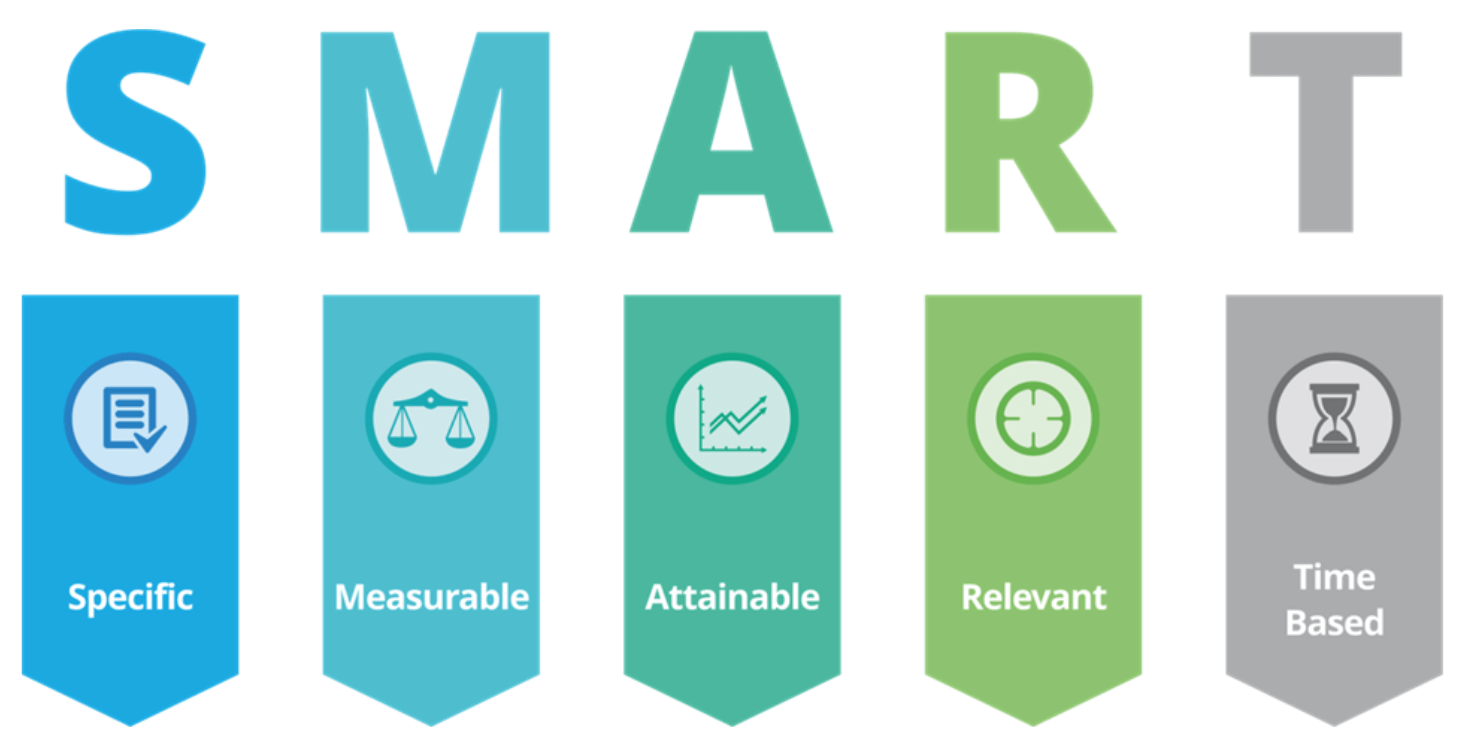
Measurability is easy to misunderstand. An objective does not become measurable simply because it begins with “measure,” and not every valuable finding has to be a number. What matters is whether the planned evidence could support a defensible answer.
Take these two statements:
“To measure hemoglobin in adult samples.”
“To compare hemoglobin results from two analyzers using paired adult EDTA blood samples tested at Hospital B.”
The first describes a laboratory activity. It does not say which uncertainty the measurements address. The second names a comparison that could yield evidence relevant to an analyzer study. The methods would still need to specify how results will be compared and what data are available. An objective is assessable when a reader can envisage the evidence that would address it, not when every methodological choice has been settled in the sentence.
This applies to qualitative work too. “To understand laboratory staff feelings about quality” leaves feelings and quality unclear. But an objective to describe staff-reported barriers to using an external quality assessment scheme in a specified laboratory could be assessed using appropriately collected and analyzed accounts. Measurability here means a clear basis for examining what participants report; it does not require converting every response into a numerical score.
Some objectives are measurable in wording but unanswerable by the proposed design. Suppose a laboratory has only records of assay use and identification turnaround times. “To determine whether the assay reduced 30-day mortality” identifies a measurable outcome, yet those records alone cannot answer it. Nor should a simple before-and-after comparison automatically be described as proving a causal effect: other changes may have occurred over the same period. A sound critique identifies the mismatch between claim and evidence rather than dismissing mortality as an unimportant outcome.
Bringing the three criticisms together
Here is a hypothetical proposal involving a rapid blood culture identification assay at Hospital C. Its stated laboratory problem is uncertainty about whether the new workflow shortens the time taken to identify organisms from positive adult inpatient blood cultures.
Aim: “To transform infection care by using rapid diagnostics for all patients.”
Objective 1: “To see whether the assay gives better results.”
Objective 2: “To determine whether the assay reduces 30-day mortality among all patients with infection in the region.”
A strong critique treats the statements separately before judging how they fit together.
The aim is excessively wide for the identified problem. “Transform infection care” promises a clinical change without defining what will be examined, while “all patients” reaches beyond adult inpatients with positive blood cultures at Hospital C. A study of identification turnaround time could contribute evidence to decisions about care, but it could not fulfill that promise on its own.
Objective 1 is vague and not assessable as written. “Better results” could mean faster identification, correct identification, or something else. Because it names no outcome, a reader cannot know what data would satisfy it. It also misses the particular uncertainty stated in the problem: identification time.
Objective 2 is different. Thirty-day mortality is an identifiable measure, so calling the objective simply “unmeasurable” would be inaccurate. Its weaknesses are misalignment and excessive scope. It substitutes a region-wide patient outcome for a hospital laboratory timing question. To investigate mortality credibly would require suitable patient-outcome data and a study design capable of addressing influences beyond the assay. Those requirements are not supplied by a turnaround-time study.
For contrast, an objective concerned with comparing the time from blood culture positivity to organism identification before and after assay introduction at Hospital C points toward evidence the proposed laboratory study could collect. It does not, by itself, prove a benefit for patients; that distinction is part of its strength. The next lesson will address how to turn a diagnosis like this into precise, assessable wording.
When writing your own critique, a short explanation often works better than a label. Aim to state the flaw, the missing or mismatched element, and why it matters. For example: “The objective says the assay will produce ‘better results’ but does not identify an outcome. Without specifying whether it concerns time or identification performance, the proposed data collection cannot be planned against it.” That is more informative than writing “Not SMART.”
Conclusion
An effective critique does not demand that an aim contain an entire protocol or that every objective contain a number. It asks whether the aim defines a credible overall purpose and whether each objective specifies a task that the study can assess. Vagueness leaves key terms open to interpretation; excessive scope promises work or conclusions beyond the study; lack of measurability—or a mismatch with available evidence—prevents a defensible answer. A statement may have more than one of these faults, so name each one accurately.
In the next lesson, you will use these diagnoses to rewrite weak objectives as precise and assessable ones.