Recommended resources
The freely available resources this lesson will direct you to.
- SAST vs DAST vs IAST vs RASP vs SCA | App Security | Comparison between SAST, DAST, IAST, RASP, SCAwww.youtube.com
- You will never forget SAST, DAST and SCA after this.www.youtube.com
- [PDF] AI-Driven Hybrid SAST–DAST–SCA–IAST Framework for Risk ...www.preprints.org
- SAST vs DAST vs IAST: Complete Comparison (2026) - AppSec Santaappsecsanta.com
Hello! Welcome back to the course.
In our previous lessons, we've gone deep into the architecture of individual security tools. We've designed the engines for Static Application Security Testing (SAST), Dynamic Application Security Testing (DAST), and Software Composition Analysis (SCA). Most recently, we architected a findings management system to ingest, deduplicate, and prioritize the outputs from these tools.
Now it's time to zoom out and think like a chief architect. Having designed the components, how do we assemble them into a coherent, effective security program? Which tools should you use, and when? Answering these questions requires a clear understanding of the architectural trade-offs involved.
This lesson is designed to provide that strategic perspective. Our learning outcome is to: Evaluate the architectural trade-offs across SAST, DAST, and SCA regarding coverage, accuracy, and CI/CD integration speed.
We will compare these three foundational pillars of application security, not on their implementation details, but on their strategic value and place within a modern software development lifecycle (SDLC).
1. A Framework for Comparison
Before diving into the trade-offs, let's establish a clear, high-level understanding of what SAST, DAST, and SCA each bring to the table. They are often described using the concepts of white-box, black-box, and "bill of materials" analysis.
To get a quick but comprehensive refresher, I'd like you to watch a short segment from a video you've seen before, which succinctly summarizes these concepts.
You will never forget SAST, DAST and SCA after this.
Let's start with a quick review. This video provides a clear, concise summary of the three methodologies.
Watch the section from 17:32 to 20:12. The speaker effectively recaps the core function of SAST (static analysis of source code), SCA (dependency checking), and DAST (runtime testing).
Now, let's visualize these differences. The following chart provides an excellent at-a-glance summary of the strengths of each approach.
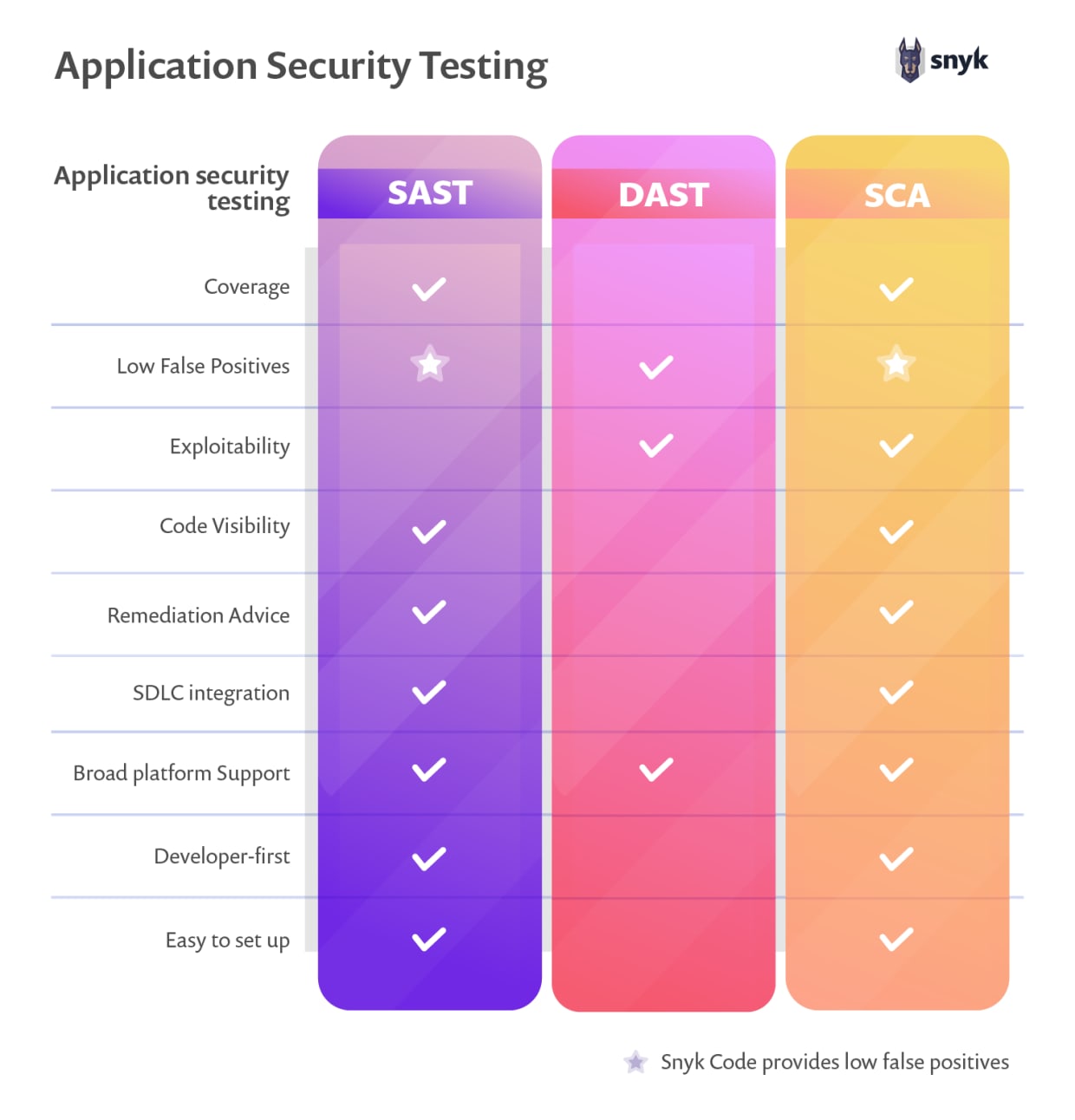
With this foundation, we can now analyze the trade-offs along the three critical dimensions for any architect: coverage, accuracy, and speed.
2. The Core Architectural Trade-offs
Choosing and integrating security tools is a classic system design problem involving complex trade-offs. Let's break them down.
For a detailed analysis, the following article is one of the best resources available. We will refer to it throughout this section.
SAST vs DAST vs IAST: Complete Comparison (2026) - AppSec Santa
This article, 'SAST vs DAST vs IAST: Complete Comparison', provides an excellent and detailed breakdown of the trade-offs we're about to discuss. We'll use it as our primary reference for this section.
For now, please read the 'Side-by-side comparison' table in the middle of the page. It's a dense, informative summary that we will unpack.
A. Coverage: What Can Each Tool "See"?
Coverage refers to the breadth and depth of a tool's analysis. An architect must ask: what parts of my system's attack surface is this tool designed to protect?
-
SAST (Static Analysis): White-Box Coverage
- Strengths: SAST has a "100% code coverage" guarantee in one sense: it can analyze every single line of your first-party source code, including code paths that are rarely executed. This makes it strong at finding certain classes of vulnerabilities like buffer overflows, insecure cryptographic practices, and injection flaws by tracing data flow from source to sink.
- Weaknesses: It is completely blind to the runtime environment. It cannot detect server misconfigurations, authentication logic flaws that only manifest during execution, or issues in third-party services your application calls.
-
DAST (Dynamic Analysis): Black-Box Coverage
- Strengths: DAST excels at finding runtime vulnerabilities. It interacts with your application exactly as an attacker would, making it highly effective at discovering issues like missing security headers, insecure session management, and server configuration problems.
- Weaknesses: Its coverage is only as good as its crawl. If a part of your application is not linked from anywhere, is behind a complex authentication flow, or is part of a Single-Page Application (SPA) that the crawler can't navigate, DAST will be blind to it. It has no visibility into the underlying code.
-
SCA (Composition Analysis): Dependency Coverage
- Strengths: SCA is hyper-focused on one thing: identifying known vulnerabilities (CVEs) in your third-party dependencies. Given that open-source components can make up 70-90% of a modern application's codebase, this is a critical area of coverage.
- Weaknesses: SCA knows nothing about your first-party code or your runtime environment. It can't tell you if you've introduced a custom SQL injection, only if you're using a version of a library with a known one.
To see a practical list of which vulnerability types each tool is best suited for, please read the following section from the article.
SAST vs DAST vs IAST: Complete Comparison (2026) - AppSec Santa
Let's look at how these coverage differences translate to detecting specific vulnerability types.
Read the section 'What does each approach detect?'. The table in this section clearly maps common vulnerability types to the tool that is most effective at finding them.
B. Accuracy: Can We Trust the Results?
Accuracy is about the signal-to-noise ratio. A tool that generates thousands of findings is useless if most are false positives, as it leads to developer fatigue and distrust.
-
SAST: Has the highest potential for false positives. Because it lacks runtime context, it might flag a vulnerable code pattern that is unreachable (dead code) or is implicitly sanitized by the web framework in a way the tool doesn't understand. This is why the output of SAST tools often requires significant tuning and triage.
-
DAST: Generally has a lower false positive rate. If a DAST tool successfully injects a payload and gets a database error, that vulnerability is almost certainly real and exploitable. However, DAST can suffer from false negatives—it can miss real vulnerabilities simply because its crawler didn't find the vulnerable endpoint.
-
SCA: Accuracy is high for what it reports. It's a binary check: is this component version associated with a known CVE? Yes or no. The "noise" here is more nuanced. It might flag a vulnerability in a library, but the vulnerable function within that library may never be called by your application, making it technically unreachable. This is a key challenge that more advanced SCA tools are trying to solve.
The problem of false positives is a major architectural consideration. Let's get more detail on this from both a video and our reference article.
SAST vs DAST vs IAST vs RASP vs SCA | App Security | Comparison between SAST, DAST, IAST, RASP, SCA
This short video segment discusses the likelihood of false positives for each testing type, which is a crucial factor in their architectural evaluation.
Please watch from 03:17 to 03:56. It provides a quick comparison of false positive rates across the different AST methodologies.
SAST vs DAST vs IAST: Complete Comparison (2026) - AppSec Santa
Now, let's read a more in-depth explanation of why these false positive rates differ.
Read the section titled 'How do you handle false positives and noise?'. This section explains the reasons behind the different accuracy levels and ties back to our previous lesson on findings management.
C. Speed & SDLC Integration: How Fast is the Feedback?
In a DevSecOps world, the speed of feedback is paramount. A tool that takes a day to run cannot be part of a CI/CD pipeline that completes in 15 minutes. This is where the three methodologies differ most dramatically.
-
SAST & SCA: Built for Speed and "Shifting Left"
- Both SAST and SCA analyze static artifacts (source code, manifest files). They are very fast, often taking just a few minutes to run.
- This makes them ideal for integration early in the SDLC, or "shifting left." You can run them in a developer's IDE, as a pre-commit hook, or as a blocking gate in every Pull Request. The feedback is immediate, and the cost to fix is lowest.
-
DAST: The Deliberate, Slower Pace
- DAST requires a fully running application in a deployed environment. Furthermore, a comprehensive DAST scan involves crawling the entire application and then launching thousands of attack payloads. This is inherently slow, often taking several hours.
- Because of its speed, DAST is not suitable for running on every commit. It is typically integrated later in the SDLC, running against a staging or QA environment on a nightly basis or as a pre-release check.
Our reference article provides an excellent summary of where each tool fits.
SAST vs DAST vs IAST: Complete Comparison (2026) - AppSec Santa
Understanding where to place each tool in your development pipeline is a key architectural decision.
Please read the section 'Where each fits in the SDLC'. It clearly outlines the typical integration points for SAST, DAST, and IAST (a hybrid approach we'll discuss more in the future).
3. The Unified Strategy: Architecting Defense in Depth
As is now clear, SAST, DAST, and SCA are not competing technologies; they are complementary pieces of a larger puzzle. A robust application security architecture uses all three, layering them to cover each other's weaknesses.
- SCA and SAST run on every pull request, providing rapid feedback on vulnerable dependencies and coding flaws before they are even merged.
- DAST runs nightly against the integrated application in a staging environment, finding runtime and configuration issues that static analysis missed.
- The output of all three feeds into the findings management system we designed in the last lesson. There, the findings are deduplicated, correlated, and prioritized.
This layered approach is a classic example of the "defense in depth" security principle applied to the SDLC.
The future of this field lies in fusing the signals from these disparate tools even more tightly. Your interest in mathematics and first principles makes this an area you might find particularly engaging. Advanced systems use machine learning to combine the outputs into a single, unified risk score.
[PDF] AI-Driven Hybrid SAST–DAST–SCA–IAST Framework for Risk ...
To give you a sense of the cutting edge in this space, take a look at the abstract and introduction of this research paper. It describes an AI-driven framework that unifies these tools to produce a much more accurate prioritization of vulnerabilities.
Read the 'Abstract' and the 'Introduction'. You don't need to understand all the math, but focus on the problem statement: individual tools produce 'inconsistent, redundant, or conflicting results'. The proposed solution is to fuse these signals to get a 'coherent understanding of risk'. This is the ultimate goal of architecting a multi-tool AST program.
This research points to the next evolution of the findings management system we designed: not just ingesting and normalizing data, but intelligently synthesizing it to produce a risk score that is more accurate than any single tool could provide alone.
Conclusion
In this lesson, we stepped back from implementation details to evaluate the strategic architectural trade-offs between the three pillars of application security testing.
Key Takeaways:
- No Silver Bullet: SAST, DAST, and SCA each have unique strengths and weaknesses in terms of coverage, accuracy, and speed. No single tool can secure an application on its own.
- Coverage Trade-offs: SAST sees all your code (white-box), DAST sees your running application (black-box), and SCA sees your dependencies (bill of materials). They are blind to what the others see.
- Accuracy vs. Speed: There is an inverse relationship. SAST and SCA are very fast but can be noisy (higher false positives or contextless findings). DAST is slower but its findings are typically high-confidence (lower false positives) at the cost of potential false negatives.
- Layered Defense: The optimal architecture is a "defense in depth" strategy that integrates each tool at the appropriate stage of the SDLC—SAST/SCA early and fast, DAST later and more deliberately.
- Unified Risk: The architectural endgame is to fuse the signals from all tools into a centralized system that provides a single, prioritized, and context-aware view of risk.
Preview of the Next Module:
We have now concluded our deep dive into Application Security Testing. In our next module, we will shift our focus from securing the application code to securing the cloud infrastructure it runs on. We'll begin by architecting a Cloud Security Posture Management (CSPM) tool. Our first lesson will be: "Architect a multi-cloud abstraction layer to normalize resource representations across AWS, Azure, and GCP." This will be a fascinating challenge that parallels the ingestion and normalization pipeline we designed for security findings, but applied to a much more complex and varied set of cloud resources.